Climate models: cold blob south of Greenland may fade as AMOC weakens further
A Nature Communications study of 100 simulations found that AMOC weakening first deepens the North Atlantic cold anomaly, then lets it fade, driven by air and clouds.
A team led by Duo Chan of the University of Southampton has examined how the temperature of the subpolar North Atlantic relates to the strength of the Atlantic Meridional Overturning Circulation (AMOC) under different climate conditions, scinexx reports. The researchers analysed 100 simulations of one Earth system model and results from other climate models. The work was published in Nature Communications, and Pennsylvania State University issued a release on it. scinexx.de
scinexxscinexx.deOpen source ↗
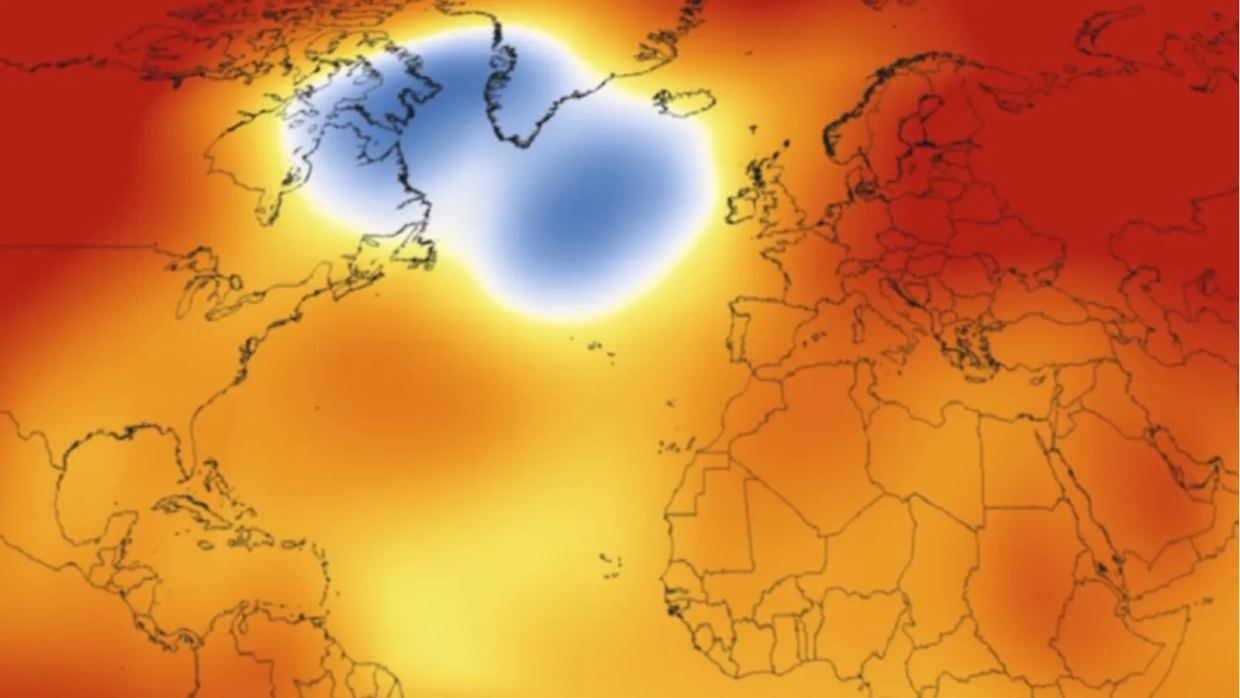
The region south of Greenland has warmed relatively little over the long term, or even cooled. It has long been considered a possible sign of changes in the AMOC. Sea surface temperature, however, is not a direct flow gauge: heat exchange with the atmosphere and cloud cover also affect how much the surface cools. scinexx.de
scinexxscinexx.deOpen source ↗
Three phases of the cold anomaly
The calculations showed three phases. With a strong AMOC, its weakening is accompanied by only a small additional cooling. At intermediate strength, the regional temperature difference responds to further weakening more than three times as sensitively. When the AMOC is already very weak, this extra cooling effect declines again. scinexx.de
scinexxscinexx.deOpen source ↗
In the intermediate phase, cooler and drier air layers let less thermal radiation reach the sea surface, and low clouds reflect more sunlight, which reinforces the anomaly. In the model, these atmospheric effects weaken again as the AMOC weakens further, and their centres shift northeast. The centre of the cold anomaly can move toward Iceland and the Norwegian Sea. The sea south of Greenland then warms increasingly in step with the global average and can even take up heat from the atmosphere. scinexx.de
scinexxscinexx.deOpen source ↗
Model limits and uncertainty
In 15 models under a high-emission scenario, the maximum of this temperature sensitivity fell between 2021 and 2067, depending on the model. These differences explained about 80 percent of the spread in modelled regional temperature deviations toward the end of the century. scinexx.de
scinexxscinexx.deOpen source ↗
The years are model indicators, not observed abrupt changes in the real current. For example, 2021 is the central year of a 40-year evaluation window. Direct AMOC measurement series have existed only for a relatively short time, so a long-term shift can be checked against observations only to a limited extent. scinexx.de
scinexxscinexx.deOpen source ↗
The possible disappearance of the cold blob therefore does not imply a recovery of the AMOC, and a pronounced cold zone alone is not evidence of an impending collapse. The model thresholds are not demonstrated tipping points of the real Atlantic. Laifang Li of Penn State said that more field data and research could reduce uncertainty in models that predict North Atlantic temperatures and climate patterns. scinexx.de
scinexxscinexx.deOpen source ↗