Parker Solar Probe data show turbulent magnetic fields reverse rotation direction between scales
An international team using Parker Solar Probe data found that the preferred rotation of turbulent magnetic fields flips where fluid-like plasma behavior gives way to particle dynamics.
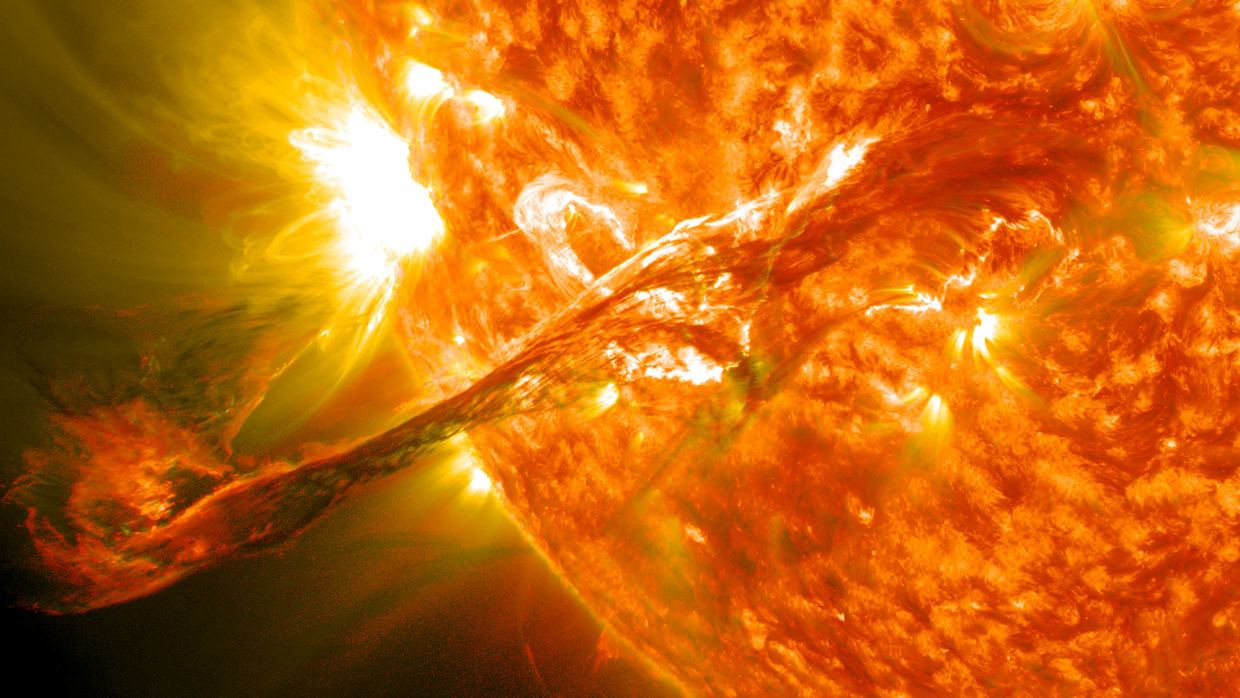
An international research team has used magnetic field and particle data from NASA's Parker Solar Probe to show that turbulent magnetic fields in space plasma reverse their preferred direction of rotation across a scale transition, SciTechDaily reports. The results were published in The Astrophysical Journal Letters. The collaboration spanned ten countries and included the Institute of Theoretical Physics at TU Braunschweig and the University of Tokyo scitechdaily.com
SciTechDailyscitechdaily.comOpen source ↗.
Turbulence in collisionless plasma
Space plasma is an ionized gas containing charged particles, whose motion is strongly influenced by electric and magnetic fields. It is so dilute that its particles rarely collide, which makes it effectively collisionless. Physicists are still working to understand how turbulence develops under these conditions and how its energy is distributed scitechdaily.com
SciTechDailyscitechdaily.comOpen source ↗.
At large scales, plasma behaves like a fluid, and turbulence develops through swirling vortices and electromagnetic waves, with random fluctuations. At smaller scales, the dynamics of individual particles become important. These are different ways the same material behaves, depending on the size of the disturbances being examined scitechdaily.com
SciTechDailyscitechdaily.comOpen source ↗.
Reversal of the rotation direction
According to the authors, this is the first direct demonstration that turbulent magnetic fields reverse their preferred direction of rotation across this transition. Viewed looking radially away from the Sun, the fields preferentially rotate counterclockwise at larger scales and clockwise at smaller scales scitechdaily.com
SciTechDailyscitechdaily.comOpen source ↗.
The reversal occurs at the wavelength, or spatial scale, where fluid-like behavior gives way to particle-like dynamics. Farther from the Sun, the reversal becomes more pronounced and shifts toward longer wavelengths, which correspond to larger spatial scales scitechdaily.com
SciTechDailyscitechdaily.comOpen source ↗.
"We see a clear structure in the spectrum, even though the turbulence represents unstructured motions," said Dr. Masatomi Iizawa of TU Braunschweig, the first author of the paper "Nonlocal Evolution of Magnetic Helicity across the Magnetohydrodynamic–Kinetic Interface" scitechdaily.com
SciTechDailyscitechdaily.comOpen source ↗.
Plasma turbulence plays an important role in the solar wind, solar eruptions and interplanetary space, as well as in Earth's magnetosphere and in accretion disks. In interplanetary space, it can influence the shock waves and magnetic clouds produced by solar eruptions, which makes it an important factor in predicting geomagnetic storms scitechdaily.com
SciTechDailyscitechdaily.comOpen source ↗.