CNR-Nanotec: three-polymer artificial synapse reproduces learning and forgetting in lab devices
Italian CNR-Nanotec researchers and partners made organic artificial synapses from a PEDOT:PSS:Nafion polymer system; the lab devices respond to dopamine and have eight tunable states.
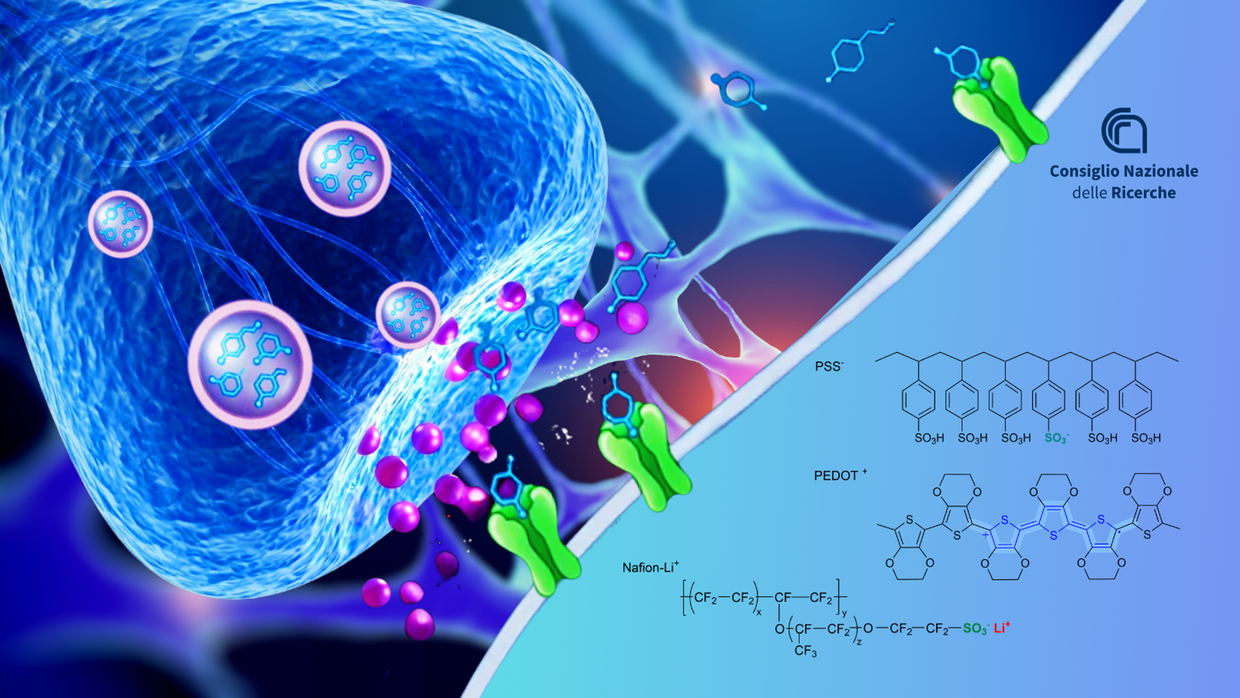
The Institute of Nanotechnology of the National Research Council of Italy (CNR-Nanotec) in Rome has coordinated an international study on organic artificial synapses made from polymers that exchange signals directly with biological molecules, Le Scienze reports. The work was published in Communications Materials (Nature Portfolio). The devices were developed at Northwestern University in the USA. lescienze.it
Le Scienzelescienze.itOpen source ↗
The approach rests on a new class of polymers that transport electrical charges (electrons) and biological signals (ions) at the same time. According to Pierluigi Cossari, a CNR-Nanotec researcher and the scientific coordinator of the study, the team tuned the conduction properties of these polymers chemically, by controlling the morphology and structure of the materials, without external superstructures or circuits. lescienze.it
Le Scienzelescienze.itOpen source ↗
Learning, forgetting and eight states
The resulting organic artificial synapses, functional junctions between neurons, interact directly with dopamine, the neurotransmitter involved in learning. Cossari says the main result is that the devices reproduce not only learning but also forgetting, a fundamental function of neurons. lescienze.it
Le Scienzelescienze.itOpen source ↗
The authors report that in tests their technology outperformed systems based on PEDOT:PSS, poly(3,4-ethylenedioxythiophene)-poly(styrene sulfonate), one of the most studied and widely used conductive polymers in organic electronics. In the three-polymer system PEDOT:PSS:Nafion, changing the chemistry of the material gives eight different states. These allow more precise control of the rate and time of forgetting (synaptic decay) of the artificial synapse. Cossari notes that in bioelectronics, as in biological systems, forgetting helps optimize resources, and regulating it chemically opens new application possibilities. lescienze.it
Le Scienzelescienze.itOpen source ↗
Neuromorphic chips and partner institutes
The experimental data were used for complete neuromorphic chips based on structures called crossbar arrays, which, according to the authors, shows the potential of the technology for next-generation computing systems. Cossari points out that traditional computers are very fast at processing but consume large amounts of energy, while the human brain performs equally complex operations, such as visual recognition, with much lower consumption. The simulations in the study move in this direction: the neuromorphic approach imitates the architecture of the brain and its energy efficiency. lescienze.it
Le Scienzelescienze.itOpen source ↗
Several CNR institutes took part in the work. The Institute of Crystallography handled structural characterization, the Institute for Microelectronics and Microsystems studied electrical transport properties, and the Institute for the Study of Nanostructured Materials analyzed surfaces. The Department of Chemistry of the University of Calabria studied ionic conductivity and transport mechanisms.