ExoMars orbiter detects hydrogen chloride seeping from Alba Mons fissures on Mars
ESA's Trace Gas Orbiter recorded hydrogen chloride rising through fresh fissures in Alba Mons, which the authors link to a dormant magma chamber beneath the surface.

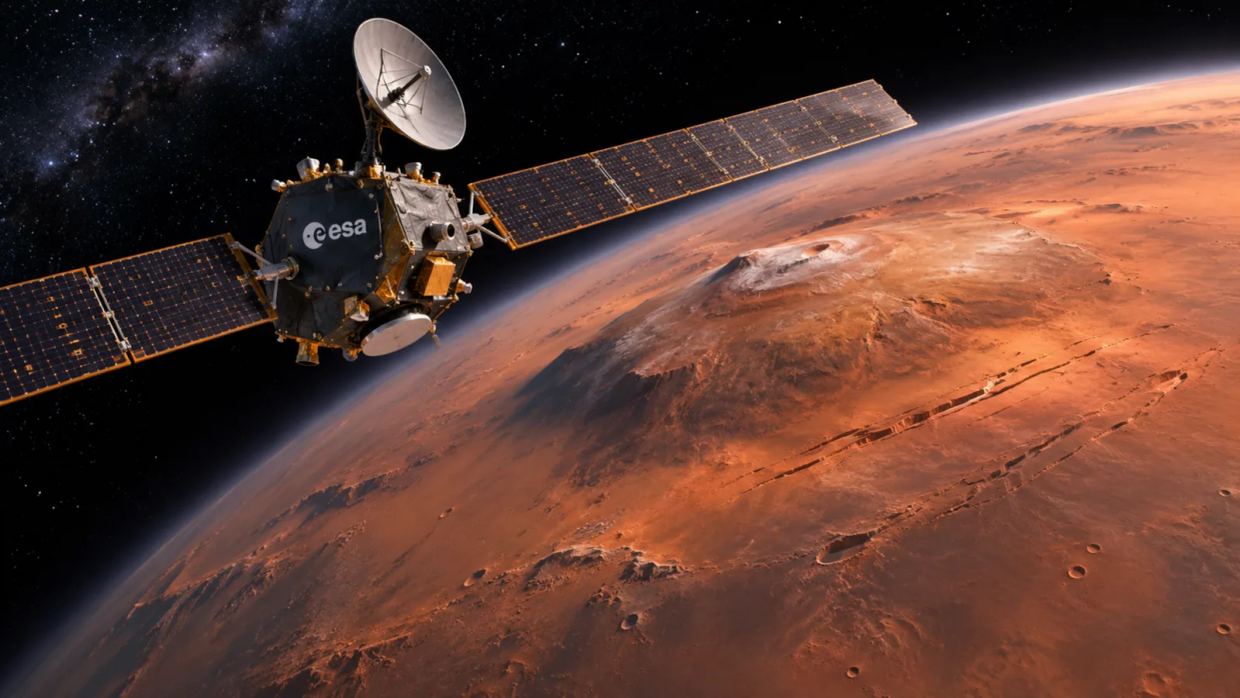
The European Space Agency's ExoMars Trace Gas Orbiter (TGO) detected gas containing hydrogen chloride reaching the Martian surface through volcanic fissures in the Alba Mons region, Space.com reports. The results were published in Science Advances on Nov. 4. space.com
Space.comspace.comOpen source ↗ Alba Mons lies in the Tharsis region, which also hosts Olympus Mons.
Olympus Mons rises about 16 miles (26 kilometers) above the surrounding plains and is the largest mountain in the solar system. It is 374 miles (600 km) across. Alba Mons is the largest volcano by surface area. space.com
Space.comspace.comOpen source ↗
Hydrogen chloride out of season
The team, whose co-leader is Daniel Mège of the Space Research Centre of the Polish Academy of Sciences, first noticed spikes of hydrogen chloride in Martian summer in the northern hemisphere, when and where the gas is not expected. Normally it peaks in the northern hemisphere in winter and disappears in summer, a variation tied to the water and dust cycle. The exception was found over volcanic fissures on the flanks of Alba Mons in early summer. space.com
Space.comspace.comOpen source ↗
TGO then detected fresh, narrow fissures in the region, in some cases hundreds of feet long. On Earth, the same gas commonly escapes from magmatic vents, where it comes from hot magma below the surface. space.com
Space.comspace.comOpen source ↗
Proposed mechanism and astrobiology
The researchers think the gases rise from the interior during the Martian winter and are blocked by ice. When the ice sublimates in summer, the gas is released, producing the spikes seen by TGO. They propose that the gas is connected to a dormant magma chamber under the surface. space.com
Space.comspace.comOpen source ↗
Earlier orbital imagery had suggested that some volcanoes were active within the last few million years, and seismometers have recorded marsquakes. Eruptions and lava flows, however, have not been observed. space.com
Space.comspace.comOpen source ↗
"Our findings suggest that Mars has retained enough internal heat to support volcanic activity until recently, and possibly still does," Mège said. space.com
Space.comspace.comOpen source ↗
Mège added that if hydrothermal systems are active in the seeping fissures of Alba Mons, they could contain ingredients and energy needed for microorganisms and shield them from the environment above the surface. He said searching there for Martian life would make sense. space.com
Space.comspace.comOpen source ↗