Loess Plateau biomarkers show repeated cold–dry extremes in East Asia over the past 250 kyr
Membrane lipids of soil bacteria in a loess section at Mangshan gave separate records of temperature and monsoon rainfall at 900-year average resolution.
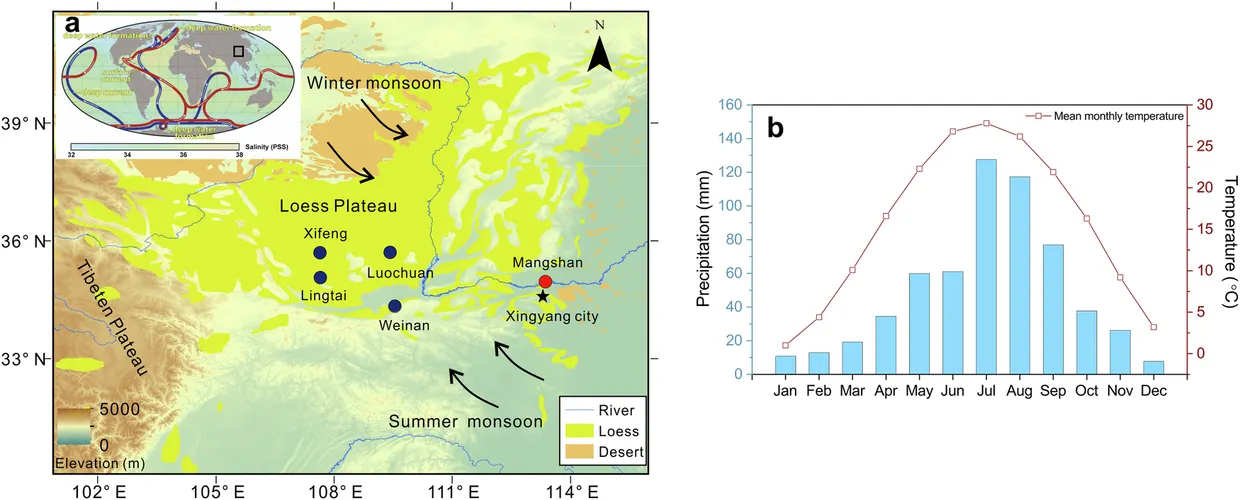
A team at Utrecht University led by Dr. Hao Lu has published quantitative reconstructions of land temperature and monsoon precipitation from the Chinese Loess Plateau covering the past 250 kyr, according to nature.com nature.com
nature.comnature.comOpen source ↗. The records have an average resolution of 900 years and are based on molecular fossil proxies. They show repeated extreme cold–dry events during glacial inceptions and pronounced droughts during glacial terminations.
Most terrestrial archives integrate several climatic signals, so cold and dry episodes are hard to tell apart. Marine and ice-core records are widely used to infer abrupt transitions, but direct terrestrial evidence that constrains land temperature and hydroclimate at once has been scarce.
Molecular proxies in the Mangshan loess
The authors analysed lipids preserved in a loess–paleosol sequence at Mangshan on the southeastern plateau. The section has an exceptionally high sedimentation rate and a well-resolved chronology. The lipids are branched glycerol dialkyl glycerol tetraethers (brGDGTs), membrane lipids produced by soil bacteria.
Their degree of methylation is used to reconstruct growing-season temperature. Their degree of cyclization records mean annual precipitation through carbonate weathering, which releases calcium ions that favour cyclic forms under wetter conditions nature.com
nature.comnature.comOpen source ↗. Complementary GDGT-based aridity indicators show how much moisture was actually available to the soil, so a dry phase can be seen even when annual rainfall changes less. Because both signals come from one archive, temperature and hydrology can be compared directly.
Cold–dry extremes and model results
The authors report that the cold–dry extremes are not clearly expressed in widely used terrestrial proxies such as speleothem oxygen-isotope records. In their view, this indicates that some aspects of continental climate variability have remained under-recognized. In places the moisture indicators showed larger swings than the reconstructed annual precipitation, so evaporation and the seasonal distribution of rain may also have contributed to the dryness.
Transient climate simulations reproduce the timing of the extreme cooling events. According to the authors, this provides model-based support for threshold-like climate responses to declining boreal summer insolation. They suggest that such behaviour may be an important mode of continental response to orbital forcing. The work offers a long-term perspective on how regional climate extremes may emerge when background conditions approach critical thresholds.