Surveys Confirm Active Breeding of Rare Oil Beetle Meloe brevicollis in Wales
Field surveys at Castlemartin Range detected larvae of the threatened oil beetle, providing evidence of local reproduction.
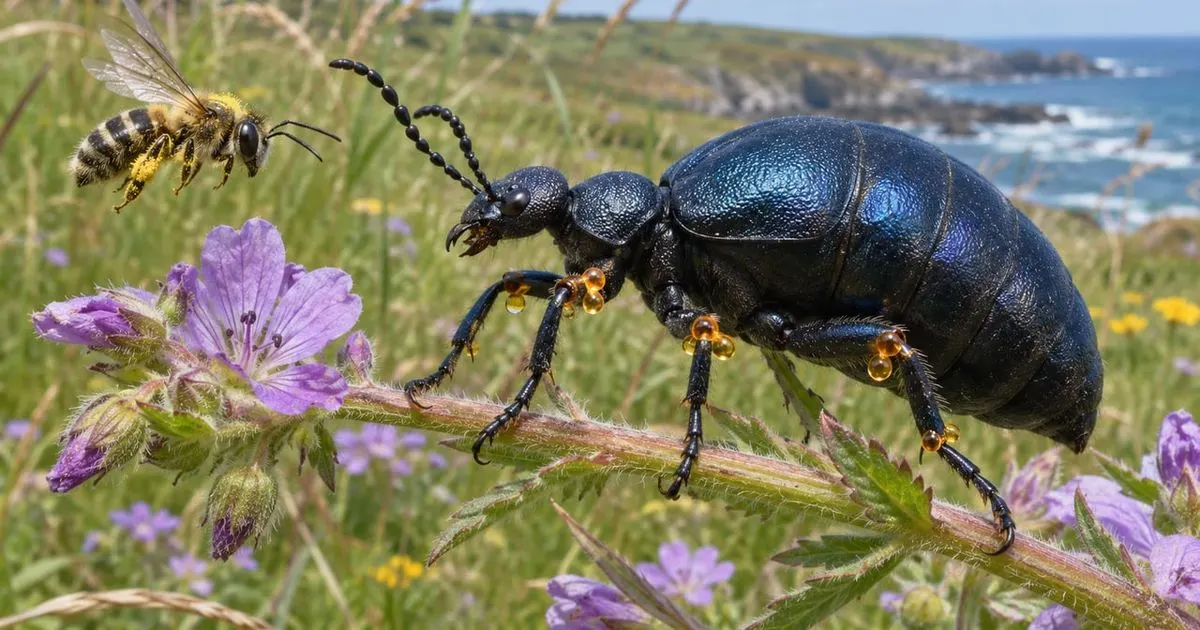
Field surveys conducted in 2026 at Castlemartin Range in Pembrokeshire, Wales, identified larvae of the rare oil beetle Meloe brevicollis, according to catracalivre.com.br catracalivre.com.br
catracalivre.com.brcatracalivre.com.brOpen source ↗. The findings provide evidence of active local reproduction after previous searches in 2022 and 2025 yielded only dead adult specimens. Castlemartin remains the only known habitat for this nationally rare insect in Wales, where it was not recorded between 1944 and its initial recent rediscovery announced in 2020.
Chemical Defense and Complex Life Cycle
Meloe brevicollis, commonly known as the short-necked oil beetle, is recognized for its reflex bleeding behavior. When disturbed or attacked, the insect releases an oily yellow or orange defensive fluid derived from hemolymph through joints near its leg articulations. The compound can cause skin irritation, serving as a deterrent against potential predators in the wild.
The species maintains an intricate parasitic life cycle spanning approximately one year. Newly hatched larvae, known as triungulins, ascend onto flowers and use hook-shaped legs to attach themselves to solitary bees. Transported directly into bee nests, the larvae consume stored pollen to complete their development. According to reported survey estimates, approximately one in 10 mil larvae successfully reaches the adult stage.
Habitat Vulnerability and Regional Distribution
The survival of Meloe brevicollis depends entirely on the co-occurrence of wildflower resources, dense vegetation, exposed soil for egg-laying, and viable host bee populations catracalivre.com.br
catracalivre.com.brcatracalivre.com.brOpen source ↗. The beetle underwent a steep decline across the United Kingdom during the 20th century due to rural land-use changes and the degradation of flower-rich coastal grassland habitats. After being regarded as nationally extinct, it was rediscovered in Devon in 2006, with additional localized populations documented in Salisbury Plain and the Hebrides.
Entomologists noted that the distribution and timing of the larvae located in 2026 suggest origins from a larger brood within a restricted area of Castlemartin Range. Ongoing site management must sustain floral resources, patches of bare ground, and solitary bee nesting areas to support future population stability.