JWST Observations of Interstellar Comet 3I/ATLAS Reveal Water Ice Properties
The James Webb Space Telescope has provided new insights into the water ice content of interstellar comet 3I/ATLAS, revealing unique spectral characteristics.
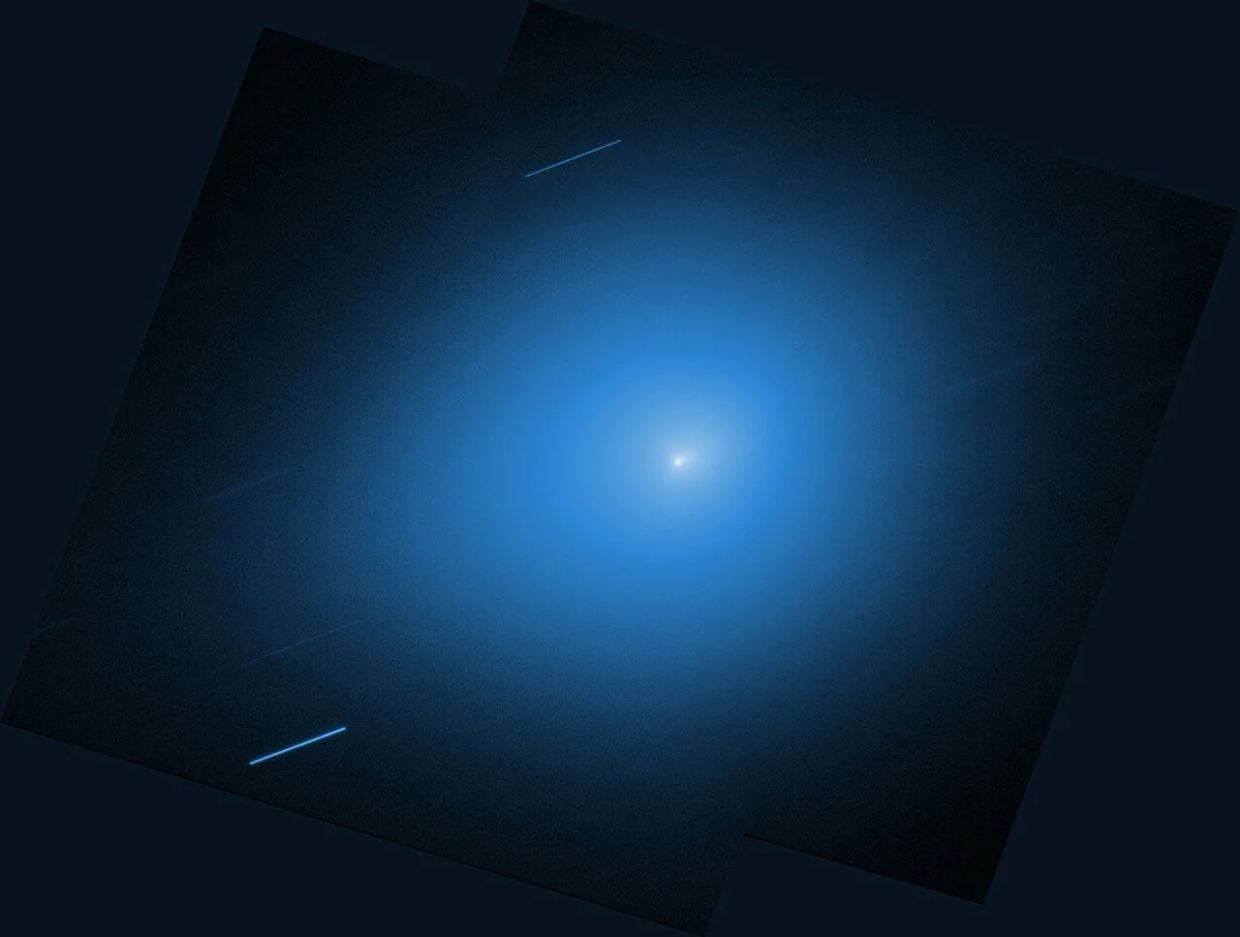
The James Webb Space Telescope (JWST) conducted observations of the interstellar comet 3I/ATLAS on August 6, December 22, 2025, and April 1, 2026, capturing data over eight months around its perihelion at heliocentric distances of 3.3, 2.4, and 5.7 astronomical units (au), respectively. The findings were published in The Astrophysical Journal Letters. The spectral data revealed a broad 3 μm absorption band alongside emissions from H₂O, CO₂, and CO gases. Unlike typical water-ice-rich comets in the solar system, the absorption features at 1.5 and 2.0 μm were weak or absent, indicating a different composition of water ice in 3I/ATLAS doi.org
The Astrophysical Journal Lettersdoi.orgOpen source ↗.
Spectral Analysis
The spectral modeling suggests that the observations are best explained by aggregates of water ice containing refractory materials, sized from submicron to micron. The spectrum from Epoch 3 indicates a second population of larger, micron-sized, ice-rich aggregates, with a subtle Fresnel-like structure near 3.1 μm, consistent with crystalline water ice. This evolution in spectral properties may arise from changes in grain size and the mixing of refractory materials, or a transition from an amorphous to a crystalline state doi.org
The Astrophysical Journal Lettersdoi.orgOpen source ↗.
Implications for Planetary Science
The spectral characteristics of 3I/ATLAS bridge the properties of water-ice-bearing comae in our solar system and various spectral classes of mid-sized trans-Neptunian objects. These similarities suggest that the icy building blocks of planetesimals formed in different protoplanetary disks may share a continuum in the physical state of water ice, ranging from pure ice grains to aggregates with varying refractory content. The findings enhance our understanding of the composition of interstellar objects and their relation to solar system bodies doi.org
The Astrophysical Journal Lettersdoi.orgOpen source ↗.