Globular cluster VVV CL001 near the Galactic center dated at 13.4 billion years from 155 stars
Astronomers for the first time measured the distance and age of VVV CL001 using turnoff and horizontal-branch stars. The age is close to that of the Universe.
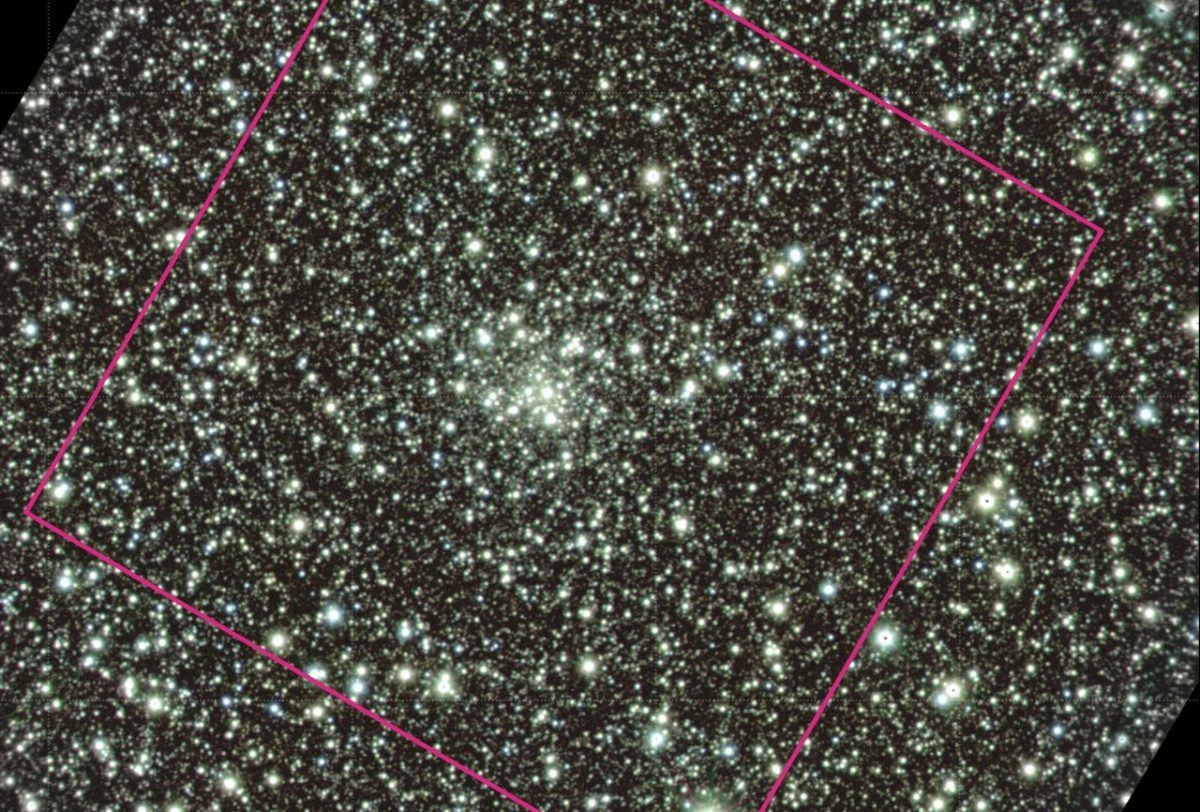
A team led by Julio Olivares Carvajal of the Capodimonte Astronomical Observatory has found, for the first time, stars in the globular cluster VVV CL001 that allow both its distance and its age to be measured, Universe Magazine reports. The cluster lies near the center of the Milky Way, behind dense clouds of interstellar dust. Its age is about 13.4 billion years, with a statistical uncertainty of 400 million years in either direction. The Universe is estimated at 13.8 billion years old and the Sun at about 4.6 billion. universemagazine.com
Universe Magazineuniversemagazine.comOpen source ↗
The authors acknowledge that about a billion years should be added to the uncertainty because of the error in the distance. With the distance from a study published in Astronomy & Astrophysics in early 2026, about 23 thousand light-years, the age comes out at 13.7 billion years. universemagazine.com
Universe Magazineuniversemagazine.comOpen source ↗
Measuring a cluster hidden by dust
VVV CL001 was discovered in 2010 in the infrared survey VISTA Variables in the Vía Láctea and was confirmed only in 2019. Interstellar dust weakens its visible light roughly five thousand times, so the object had been studied almost exclusively in the infrared. The cluster is small and faint, and no RR Lyrae variables, which are normally used to measure distances, were found in it. As a result, the distance was known only to within at least 3 thousand light-years. universemagazine.com
Universe Magazineuniversemagazine.comOpen source ↗
The team used infrared images from the Magellan Baade telescope in Chile and from Hubble. Cluster members were separated from other stars by their common motion across the sky, comparing frames taken almost 13 years apart. This gave 155 stars, including, for the first time, both stars at the turnoff point and horizontal-branch stars. universemagazine.com
Universe Magazineuniversemagazine.comOpen source ↗
The turnoff point is where a star leaves the main sequence after the hydrogen in its core is exhausted. The older the cluster, the less massive and fainter the stars that have reached it, so its position on the diagram gives the age. In the cores of horizontal-branch stars helium is converted to carbon, and they shine with nearly equal brightness, so their apparent brightness gives the distance. The result is about 24 thousand light-years with an uncertainty of roughly 1.5 thousand, a precision not achieved before. universemagazine.com
Universe Magazineuniversemagazine.comOpen source ↗
Orbit and origin
With the refined distance, the cluster's orbit does not take it farther than 7 thousand light-years from the Galactic center. The cluster approaches us at 325 km/s. Its stars contain about 160 times less iron than the Sun, and clusters with fewer elements heavier than helium generally formed earlier. According to the authors, this indicates that VVV CL001 most likely formed in the central region of the Galaxy rather than arriving with an absorbed dwarf galaxy. universemagazine.com
Universe Magazineuniversemagazine.comOpen source ↗
The paper has been accepted by the peer-reviewed journal Astronomy & Astrophysics, and a preprint is available on arXiv. To check the origin, the team plans high-resolution spectroscopy to determine the abundances of chemical elements in the cluster's stars. New optical observations should cover fainter horizontal-branch stars that are not visible in the current images. universemagazine.com
Universe Magazineuniversemagazine.comOpen source ↗