Obsthof Bernhard deploys 2.4 MWp agrivoltaic system over apple orchards in Germany
The commercial installation covers 2.1 hectares with semitransparent panels and includes a 3.4 MWh battery, operating without direct public subsidies.
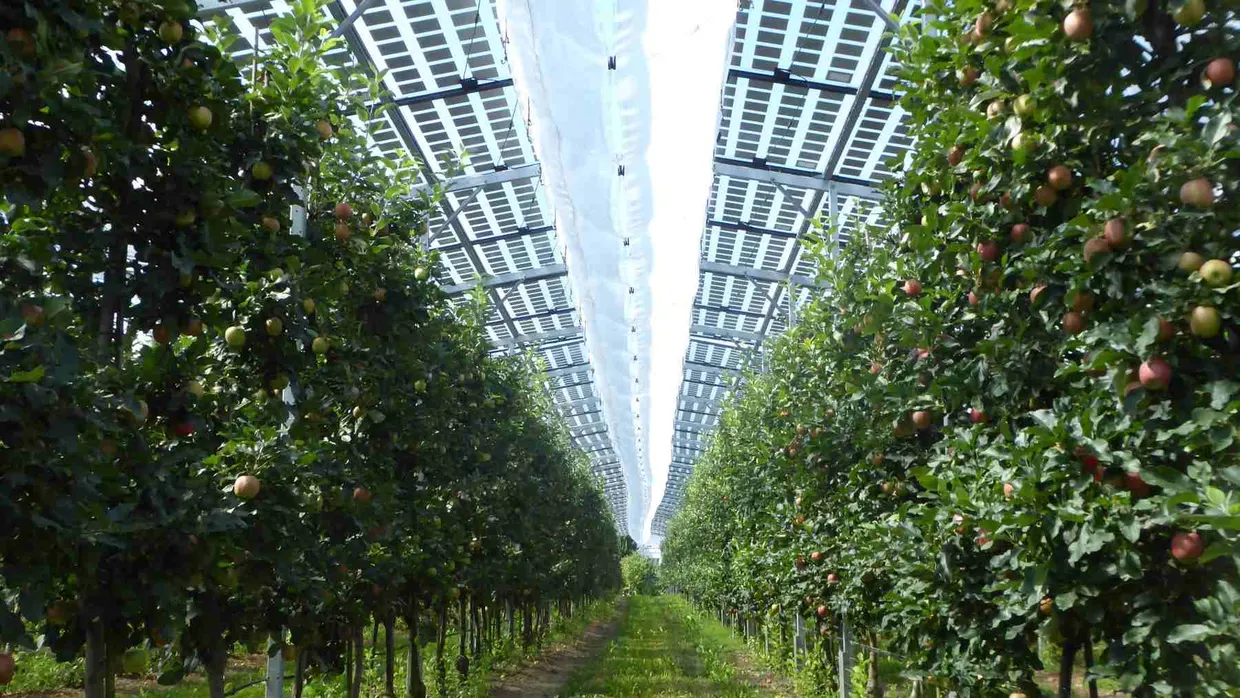
German farm Obsthof Bernhard has launched a 2.4 MWp agrivoltaic installation over apple orchards in Kressbronn, near Lake Constance, according to autonocion.com. The project spans 2.1 hectares and comprises 6,300 semitransparent photovoltaic panels, representing the largest agrivoltaic facility over apple trees in Europe autonocion.com
autonocion.comautonocion.comOpen source ↗.
Technical design and agricultural effects
The photovoltaic modules feature light transmittance ranging between 40% and 50%. Mounted on fixed steel structures at an approximate height of four meters with an east-west orientation, the system allows standard agricultural machinery to pass beneath the canopy. The structure protects the trees against hail, extreme heat, and late frost, functioning as a substitute for conventional protective netting.
According to the grower's observations, the system achieves a 70% to 80% reduction in phytosanitary treatments and saves 30% to 40% of irrigation water during heatwaves. However, documentation from the Baden-Württemberg Agri-PV model region shows that shading can impose an agronomic cost: regional trials with 51% and 40% light transmission modules saw yield decreases of roughly 43% and 51%, respectively. The farm's owner estimates current yield losses under 10% after adjusting crop varieties and management routines.
Energy management and commercial model
Electricity generated on site does not rely primarily on public utility injection. Instead, it travels via a dedicated 500-meter direct cable line to a fruit sorting and packaging facility operated by BayWa Obst autonocion.com
autonocion.comautonocion.comOpen source ↗. A power purchase agreement (PPA) governs direct energy supply to the consumer, supported by a 3.4 MWh stationary storage battery deployed by developer Sonntag Energy to arbitrage fluctuating power prices.
The farm owner directly holds equity ownership of the generation assets rather than leasing land to third-party developers. Project developers stated that the installation operates viably without direct state subsidies, though specific initial capital expenditure, operational costs, and amortization timelines were not publicly disclosed.