ETH Zurich engineers patent Flexiquad drone with deformable ring frame
A prototype quadcopter withstands collisions at 25 km/h, reaches 80 km/h, and transports payloads exceeding its own weight.
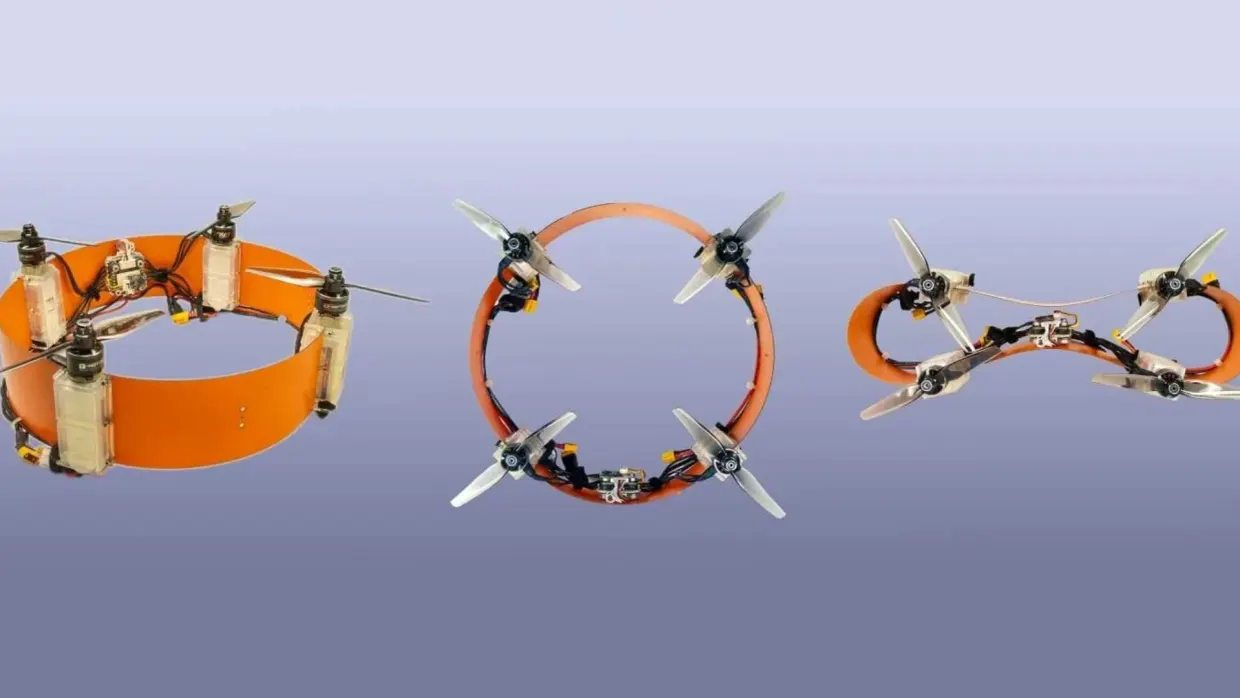
Researchers at ETH Zurich have developed Flexiquad, a quadcopter prototype featuring a deformable ring frame without a central hub, as reported by IT-Markt it-markt.ch
IT-Marktit-markt.chOpen source ↗. The project was led by Luca Girardi from the Mobile Robotics Lab alongside Stefano Mintchev, now a professor at the University of Bonn. The team has filed a patent for the architecture and received a nomination for the Spark Award.
Traditional multirotors rely on rigid central bodies that frequently break or lose control upon unexpected impacts. The Flexiquad design distributes its rotors, batteries, and flight control electronics symmetrically along a flexible ring. In crash tests, the drone struck solid barriers at speeds of roughly 25 km/h, momentarily deforming to absorb kinetic energy before resuming flight without structural failure. The frame materials cost under 15 Swiss francs, and the opened ring structure disassembles into flat segments that fit inside standard luggage.
Directional stiffness and dynamics
The airframe incorporates anisotropic structural stiffness inspired by insect and bird wings. The ring yields flexibly along the lateral plane to mitigate impacts, while maintaining high vertical rigidity so the propulsion system can transfer flight thrust efficiently. Despite the compliant chassis, the drone achieves linear and angular accelerations comparable to rigid multicopters and reaches flight speeds up to 80 km/h.
Payloads and recovery control
Beyond absorbing impacts, the deformable ring allows the drone to passively grasp objects it-markt.ch
IT-Marktit-markt.chOpen source ↗. During trials, Flexiquad clamped onto a soft first-aid kit, transported it, released it, and carried payloads that weighed more than the aircraft itself. In addition, the central cavity can accommodate an intercept net to catch rogue multicopters.
Because structural oscillations after an impact can blur optical camera feeds, the researchers implemented a stabilization routine based on movement sensors. The system uses internal sensor feedback to damp residual vibrations and re-establish autonomous navigation. Future testing will evaluate using chassis deformation and vibration directly as sensory inputs for flight control.