Gemini North images show Pa 30 supernova filaments are chains of knots, with the star near the center
Deep narrowband images of the Pa 30 nebula, left by the supernova of 1181, resolve its filaments into knots and place the surviving star near the nebula's center.
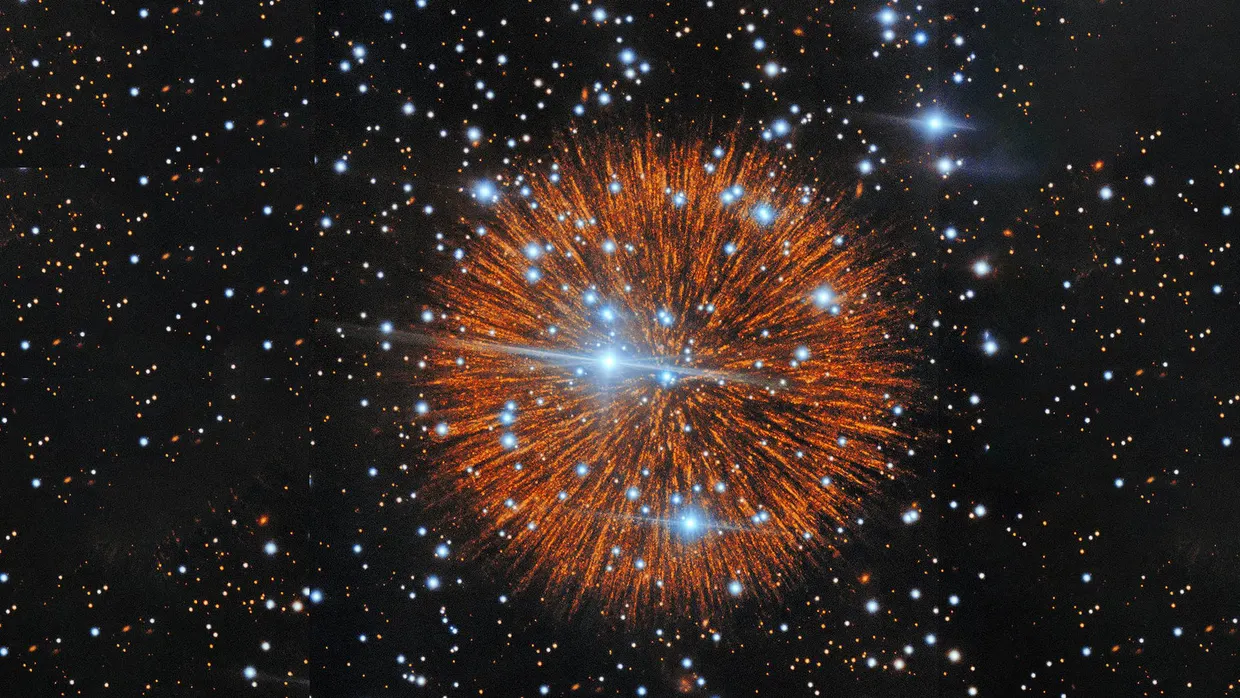
Astronomers led by Tim Cunningham of the University of Warwick and Ilaria Caiazzo of the Institute of Science and Technology Austria took deep narrowband images of the Pa 30 nebula with the Gemini North telescope on Mauna Kea, Hawaii. The telescope gathered nearly seven hours of data in mid-2025, and the results appear in The Astrophysical Journal iop.org
The Astrophysical Journaliop.orgOpen source ↗. Pa 30 is the remnant of a supernova recorded in 1181 by Japanese, Chinese and Arabic astronomers. It lies about 7500 light-years from Earth.
Filaments made of knots
In the [S II] line, the number of detected filaments rose by about an order of magnitude compared with earlier studies. The filaments are not smooth radial streaks. They are cascades of knots or clumps. The authors give a characteristic knot diameter of about 100 billion km.
The [O III] images gave the first confirmation that the diffuse [O III] emission seen before comes from the same filaments as the [S II] emission. Cross-sectional profiles in both lines show a central peak on a nebular background, likely diffuse emission or unresolved filaments. The [S II] widths are slightly broader than the seeing, which the authors read as partial resolution of the filaments.
The star sits near the center
The measured center of the nebula is consistent with the position of the central star. According to the authors, this means the remnant did not receive a large transverse kick: the 3σ upper limit on the stellar kick velocity is about 100 km/s or less iop.org
The Astrophysical Journaliop.orgOpen source ↗. Caiazzo said this suggests the explosion was fairly symmetric.
The star is a white dwarf that survived a Type Iax supernova, in which the white dwarf is not completely destroyed. Pa 30 is the only remnant of this kind known in the Milky Way. It was identified in 2013 in archived infrared images and later tied to the 1181 record.
Limits and open questions
The knots are only barely sharp enough to measure, and filaments overlapping along the line of sight make their spacing hard to determine. The star's motion toward or away from Earth has not been measured directly, and spectra so far cover only about a tenth of the cloud. What exploded is still open: researchers have proposed a merger of two white dwarfs, or a white dwarf drawing material from a companion star.
The clumpy substructure gives models of the origin and evolution of the Pa 30 ejecta a new observational constraint iop.org
The Astrophysical Journaliop.orgOpen source ↗. The team has observing programs on the James Webb and Hubble space telescopes.