Swordfish dive below 1,000 m: 29 extreme dives confirmed in satellite tag data from 34 fish, WHOI study
Satellite tags on 34 North Atlantic swordfish recorded 29 confirmed dives below 1,000 m. Their pattern fits environmental profiling during long migrations, though the mechanism is unresolved.
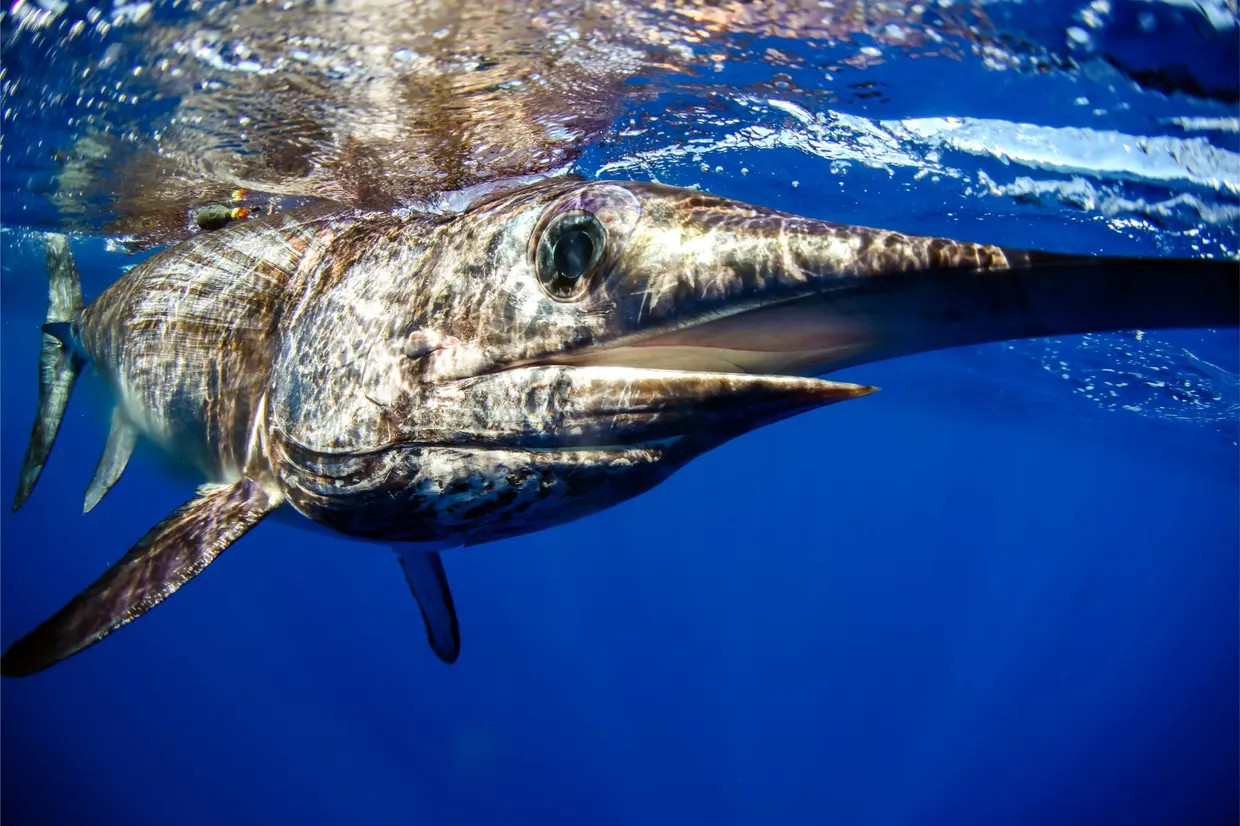
Swordfish (Xiphias gladius) usually follow the diel vertical migration of mesopelagic animals: about 600 m in daylight and near the surface at night. A team from Woods Hole Oceanographic Institution (WHOI) has analysed rare dives that go deeper than 1,000 m. The results were published in the journal Marine Biology springer.com
Marine Biologyspringer.comOpen source ↗.
The authors used data from pop-up satellite archival transmitting tags on 34 North Atlantic swordfish, deployed for one to six months. Over 3,666 deployment days, statistically "extreme" maximum daily depths were found on 39 days, and 29 extreme dives were confirmed from depth-time series. The data were collected in partnership with NOAA's Southeast Fisheries Science Center and the Massachusetts Division of Marine Fisheries. According to WHOI, the fish travelled thousands of miles between waters off Canada and the Caribbean.
What the dives look like
The dives were brief and mostly took place in daytime. They occurred across the whole geographic range of the dataset, from temperate to tropical waters and from shelf-break regions to the Mid-Atlantic Ridge.
The researchers compared several explanations: foraging, predator avoidance and navigation. They used dive geometry and mixed-effects models of environmental conditions springer.com
Marine Biologyspringer.comOpen source ↗.
Link to ocean fronts and currents
Extreme dives were most likely when sea surface height was elevated and sea surface temperature varied. Such conditions are associated with dynamic features such as frontal systems and major currents. Associations with bathymetric and magnetic field features were weaker.
The authors conclude that the findings are most consistent with environmental profiling: the fish intermittently sample the vertical structure or physical cues of the water during large-scale movements. This may contribute to navigation, but the underlying mechanisms remain unresolved.
Lead author Ciara Willis, who conducted the work as a doctoral student in the MIT-WHOI Joint Program, suggested that a fish entering an eddy or front may check how deep the feature extends. This is a hypothesis, not a measured result. Researchers still do not know how widespread extreme diving is among swordfish, how it varies between populations or life stages, or how much it matters for navigation overall.
The work required combining tagging data from different studies. Co-author Simon Thorrold noted that a single tagging operation or a single laboratory would not have provided enough data for this analysis.