Corn smut fungus Ustilago maydis uses host proteases to activate its GPCR Gpe1 and speed division
Plant enzymes cleave the fungal protein Pit2 and release a nine-amino-acid peptide that activates receptor Gpe1. The effect was shown in yeast reporter assays and on corn seedlings.
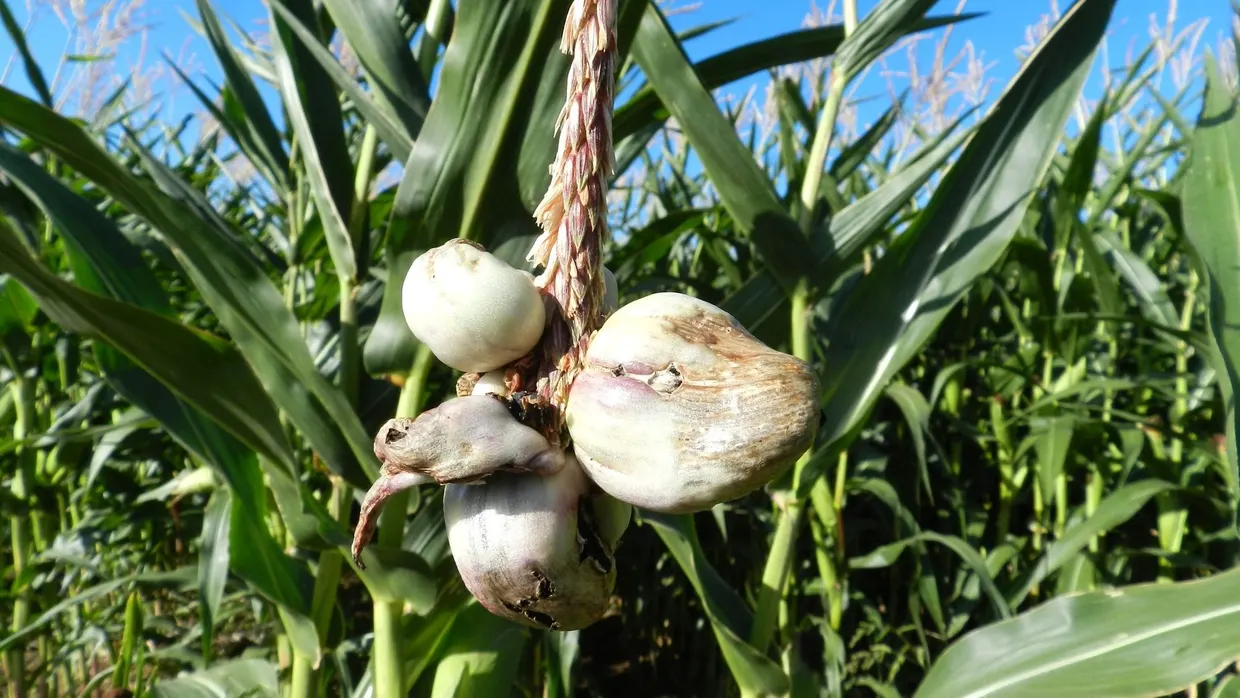
A group led by Florian Altegoer at the Institute of Microbiology, Heinrich Heine University Düsseldorf, described how the corn pathogen Ustilago maydis detects that it has entered plant tissue. The work was published in Nature Communications. During infection the fungus secretes the protein Pit2. Cysteine proteases of the host apoplast cleave it and release a peptide ligand hidden in the protein core. This peptide activates the fungal G-protein coupled receptor Gpe1 and promotes proliferation after the initial penetration nature.com
Nature Communicationsnature.comOpen source ↗.
How the signal is released
Both genes were already known to be essential for virulence: without either one, the fungus forms almost no galls. Gpe1 was one of 34 proteins with a seven-helix receptor fold found in the fungal genome. The authors expressed it in baker's yeast with a fluorescent reporter. Intact Pit2 gave a weak signal, while Pit2 fragments fully activated the reporter at a tenth of the dose. The active fragment was narrowed down to nine amino acids.
The crystal structure of Pit2 shows two copies locked together, with this stretch buried in the seam between them. This explains why the intact protein activates the receptor only weakly. The structure of the Gpe1-peptide complex was modeled computationally and used to choose residues for mutation.
Effects on the fungus and conservation
In microscopy, the receptor moved from the cell surface into the cell after the fragment was applied. One division cycle took about 226 minutes without the fragment and about 167 minutes with it. Cells with extra Gpe1 produced about five times more messenger RNA of the Clp1 regulator gene, and the fragment raised it further. Two single-residue changes in the predicted binding pocket, which also impaired the receptor in yeast, sharply reduced galls on seedlings scored 12 days after infection nature.com
Nature Communicationsnature.comOpen source ↗.
Gpe1 has relatives across smut fungi, while Pit2 occurs only in close relatives of the corn fungus. The signal of a related corn fungus activated the corn smut receptor, but the barley smut signal did not. The nine-amino-acid stretch has changed little across these species, which the authors interpret as co-evolution of receptor and ligand. A region of Gpe1 resembles a switch in a large class of mammalian receptors.
The authors note limits. The two weakest receptor variants may be less stable rather than worse at binding. Plant enzymes cut Pit2 into more than one fragment, one of which blocks plant defenses, and the contribution of each fragment during real infection has not been tested.
Sources · 2
Found a mistake?Read also