Voynich manuscript: text analysis suggests it began as loose bifolia, not bound quires
A Digital Medievalist study applies latent semantic analysis to Yale's MS 408. The two halves of one sheet are more alike than the pages that now face each other.
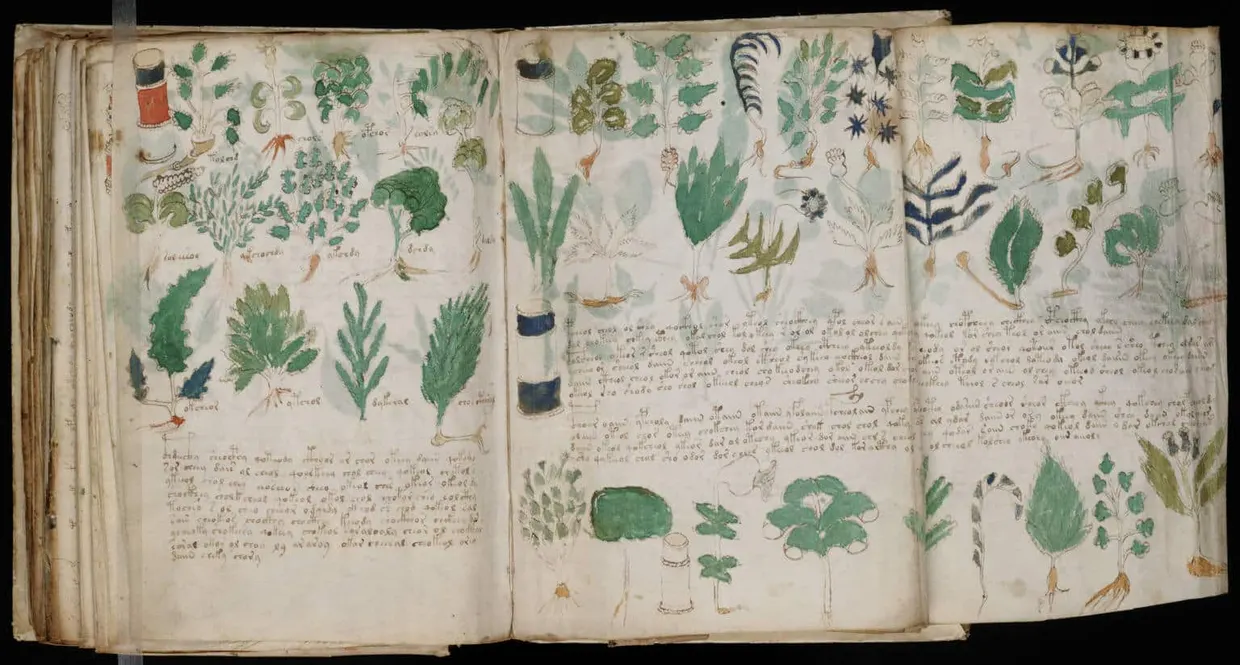
Colin Layfield (University of Malta) and Lisa Fagin Davis (Medieval Academy of America) report in Digital Medievalist, vol. 19 (2026), that the Voynich manuscript was probably not conceived as a set of quires. Their conclusion is that it was originally a collection of individual bifolia meant to be read in sequence, so-called singulions doi.org
Digital Medievalistdoi.orgOpen source ↗. The codex is held as MS 408 in the Beinecke Library at Yale. It is written in a script that no one has read, and its parchment was radiocarbon dated in 2009 to the early 15th century.
The study continues earlier work by the same authors. That work showed that the text has some coherence and flow, as in other known documents, but left some findings unexplained.
Method and controls
The authors used latent semantic analysis, which measures how much two passages share vocabulary without requiring the text to be understood. According to the description of the work, the text was split into blocks of about 40 words and compared page by page. The control texts were the Aberdeen Bestiary and the Speculum Humanae Salvationis.
In a properly bound book, facing pages resemble each other more than pages joined by the fold. The Voynich manuscript shows the opposite. The two halves of the same sheet score 0.433, and the pages that now face each other score 0.298.
Handwriting points the same way. Davis had earlier distinguished five hands, and nearly every bifolium turns out to be written by one person: 50 of the 52 surviving bifolia. The authors suggest the sheets were worked one at a time and were sewn into quires later.
Testing a different order
The authors also tried to hypothesize the original sequence of the bifolia doi.org
Digital Medievalistdoi.orgOpen source ↗. They shuffled the sheets and measured how similar facing pages became. In the bath section the similarity rose by 12.1% across 120 orderings tested. In the section with stars in the margins it rose by 20% across 720 orderings.
The authors themselves write that the correct order will remain a hypothesis as long as the text cannot be read. The material is also incomplete. The 52 surviving bifolia are distributed across 18 quires, and 14 leaves are missing.
At Yale the manuscript remains sewn in its 18 quires. The proposed reordering is a statistical result and has not been applied to the physical codex.