FLIP method from Northwestern University improves JWST exoplanet imaging sensitivity 2–15 times
Authors of the FLIP method report 2–15 times better sensitivity on JWST NIRCam coronagraph data and the first detection of 51 Eridani b at 4.3 μm.
Researchers have described a physics-based method of starlight subtraction for direct imaging of exoplanets, as reported on nature.com. The method, called FLIP, was applied to observations from the coronagraph of the Near-InfraRed Camera (NIRCam) on the James Webb Space Telescope (JWST). According to the authors, sensitivity is 2–15 times higher than with standard techniques, including the first detection of 51 Eridani b at 4.3 μm nature.com
nature.comnature.comOpen source ↗. According to chip.pl, the work comes from a team at Northwestern University, and the archival JWST data covered the stars HIP 65426, 51 Eridani and TYC 5899.
Why starlight limits direct imaging
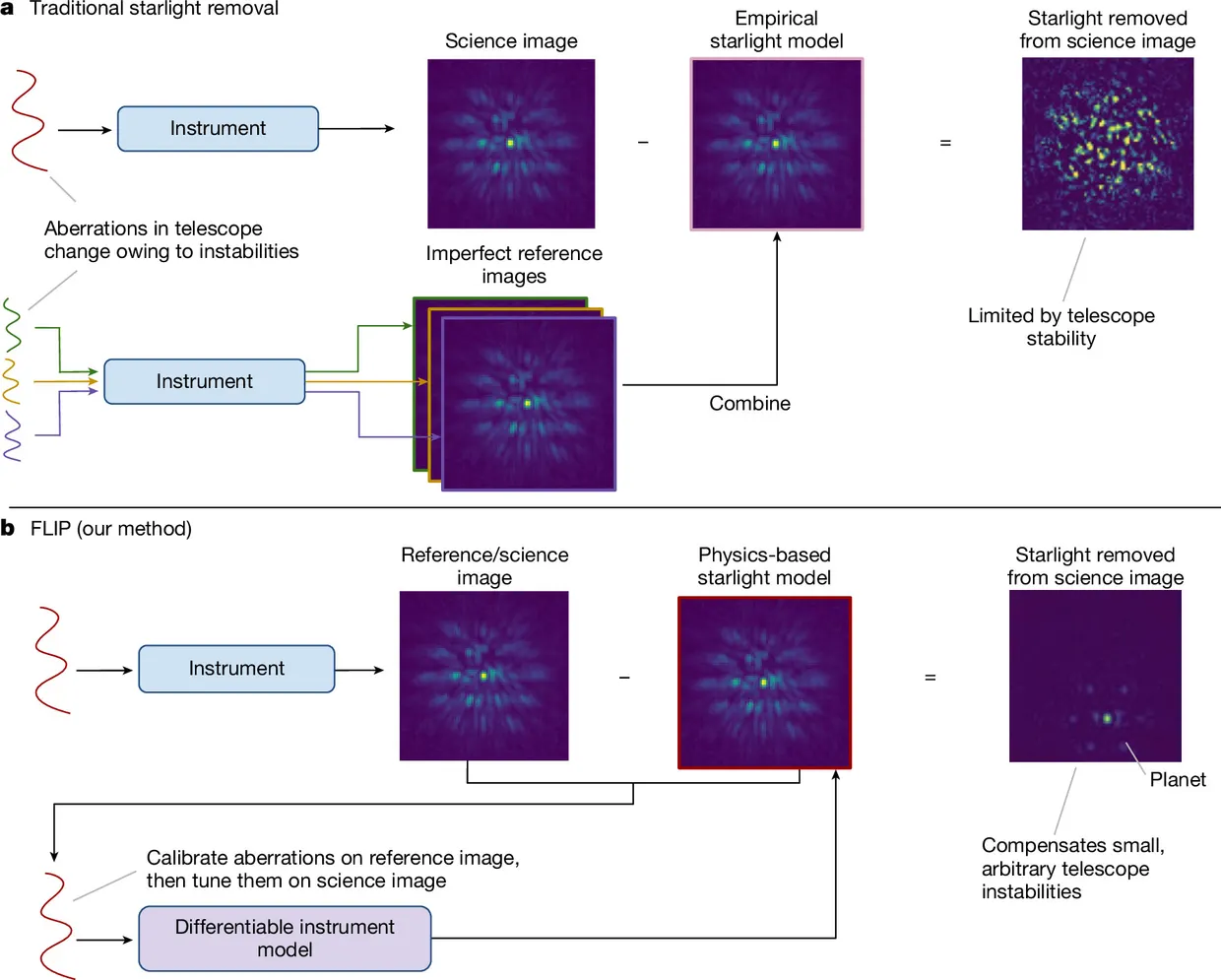
Direct imaging is the main method for detailed characterization of planets orbiting beyond 1 au. It requires suppressing the glare of the star: even the brightest young giant planets are about 10⁵ times fainter than their host stars in the near-infrared. Standard algorithms build a model of the stellar point spread function (PSF) from reference images taken at other times or wavelengths, or of other stars. They are limited by telescope instabilities, mostly pointing errors and thermal drifts in space, which make reference and science PSFs differ.
For future missions the requirement is stricter. The Habitable Worlds Observatory (HWO) aims to image Earth analogues around Sun-like stars, a 10¹⁰ brightness contrast. This calls for picometre-level stability, 100 to 1,000 times better than that of JWST, as the authors note.
How FLIP models the PSF
FLIP combines a multistep optimization with a flexible physical model of the instrument. It is first calibrated on reference images to reproduce the reference PSF, and then solves for small changes in telescope aberrations that better explain the science image nature.com
nature.comnature.comOpen source ↗. Automatic differentiation is used to optimize millions of model parameters, and GPU-accelerated differentiable models make the computation feasible.
Previously, model-based subtraction had not produced sensitivity superior to standard techniques. The authors say that, to their knowledge, this is the first time such an approach has shown substantially improved sensitivity on real, on-sky coronagraphic imaging. According to chip.pl, the planet 51 Eridani b, already known from ground-based observations, was recovered in JWST data where it had not been clearly distinguished from residual starlight.
The authors state that the framework can be extended to other current and future ground-based and space-based observatories, including the Nancy Grace Roman Space Telescope and HWO, potentially relaxing their stability requirements.