18 years of Parkes Pulsar Timing Array data cap the mass of binary black holes in the early Universe
Researchers ruled out binary black holes of about 10 billion solar masses and above in two distant systems. These are the first gravitational-wave limits for so early an epoch.
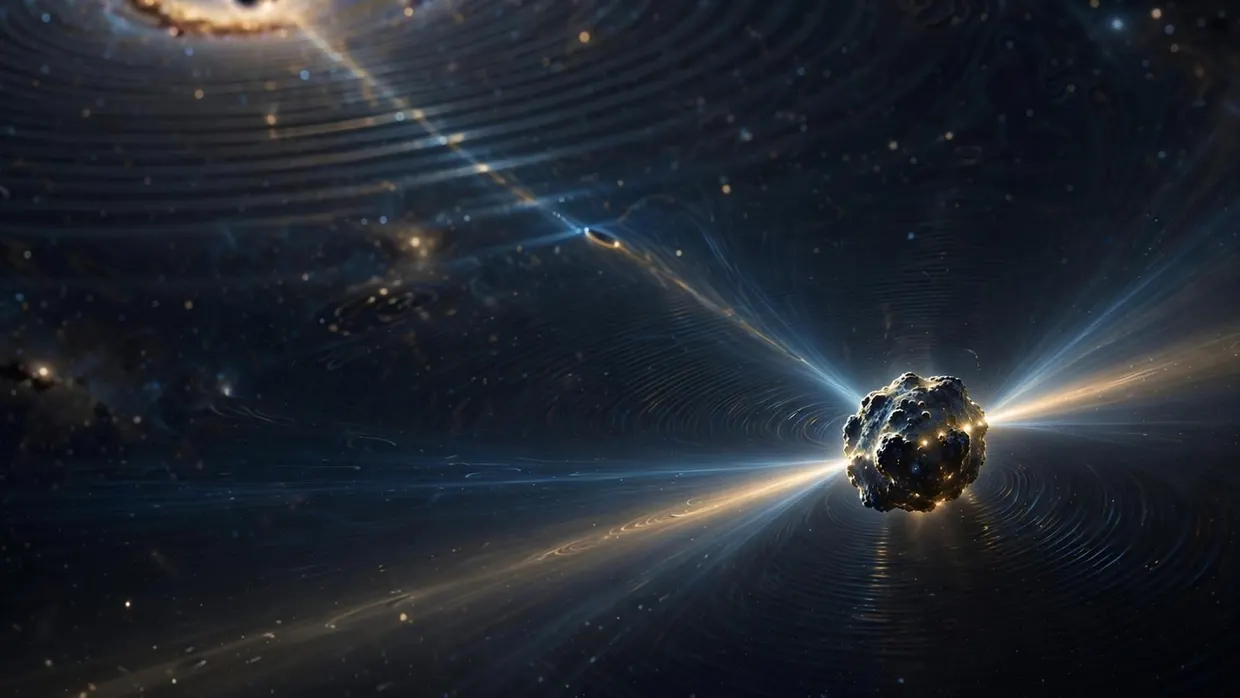
An international team from Beijing Normal University has obtained the first direct limits on the masses of supermassive black hole pairs in the cosmic dawn era, ixbt.com reports. The researchers used 18 years of observations from the Australian Parkes Pulsar Timing Array project. In two distant systems they excluded binary black holes of about 10 billion solar masses and above ixbt.com
ixbt.comixbt.comOpen source ↗. These are the first gravitational-wave limits for objects of such an early epoch.
How the pulsar timing method works
The Parkes Pulsar Timing Array is a network of dozens of millisecond pulsars, rapidly rotating neutron stars that emit regular radio pulses. They serve as a clock: a passing gravitational wave shifts the arrival times of the pulses, and the characteristic deviations appear in several pulsars at once. This is how astronomers search for nanohertz gravitational waves from supermassive black holes orbiting each other with periods of the order of years.
Earlier search methods almost ignored cosmological redshift, the stretching of waves caused by the expansion of the Universe. The new study included this effect in the calculations. It turned out that a distant binary can appear brighter to an observer on Earth than its distance alone would suggest. Because of redshift, the wave is received at a lower frequency than it was emitted, so at the moment of emission the black holes were closer together, moved faster and generated stronger waves. At a sufficiently high redshift this boost offsets the weakening of the signal with distance. With this correction, the sensitivity estimate of the pulsar method was extended to objects with redshift up to 20.
Two systems tested
To test the approach, the researchers chose two systems. The first is the bright quasar J0100+2802 at redshift 6.327: its light was emitted when the Universe was no more than 900 million years old. The second is the galaxy JADES-GS-z14-0, detected by the James Webb Space Telescope at redshift 14.32, less than 300 million years after the Big Bang ixbt.com
ixbt.comixbt.comOpen source ↗. For both systems the team set a limit on the quantity that characterizes the combined mass of the two black holes and determines the parameters of the gravitational signal.
The sensitivity is not yet sufficient to tell whether these objects are binaries at all. According to the authors, the result offers a new way to study how supermassive black holes grew to billions of solar masses in the first epochs of the Universe. They state that the limits should become tighter as the data are combined with other pulsar arrays and with future observations by the Square Kilometre Array radio telescope.