Pulsed Joule heating reveals iron melting curve up to 200 GPa
Microsecond pulsed Joule heating in diamond anvil cells provided iron resistivity and melting data at Earth core pressures.
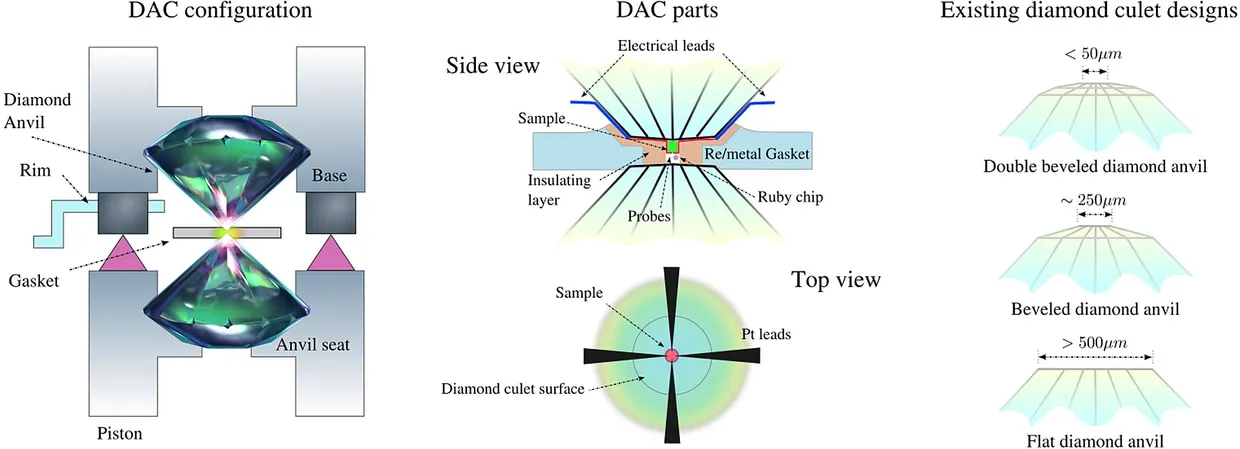
Researchers measured the melting temperature and electrical resistivity of iron at extreme conditions using microsecond pulsed Joule heating inside diamond anvil cells, according to a study published in Science science.org
Sciencescience.orgOpen source ↗. Over 300 reproducible melting measurements showed a shallow melting curve slope reaching 6 K/GPa and a melting temperature of 4160 ± 80 K at 200 GPa.
The electrical resistivity of liquid iron was determined to be 76 μΩ·cm under the experimental conditions. By extrapolating pressure and iron alloy composition, the authors inferred a core-mantle boundary temperature of 3430 K and an adiabatic outer core heat flow of 9.8 TW.
These findings suggest that thermal convection alone could have sustained the geodynamo before the inner core began to form. The results also indicate that the lowermost region of Earth's mantle is completely solid at present.