Gravitational waves from GW190412 give the recoil direction of a merged black hole for the first time
Analysis of the GW190412 signal constrains the recoil direction of the merged black hole and disfavours kick speeds below 50 km/s, typical for dense globular clusters.
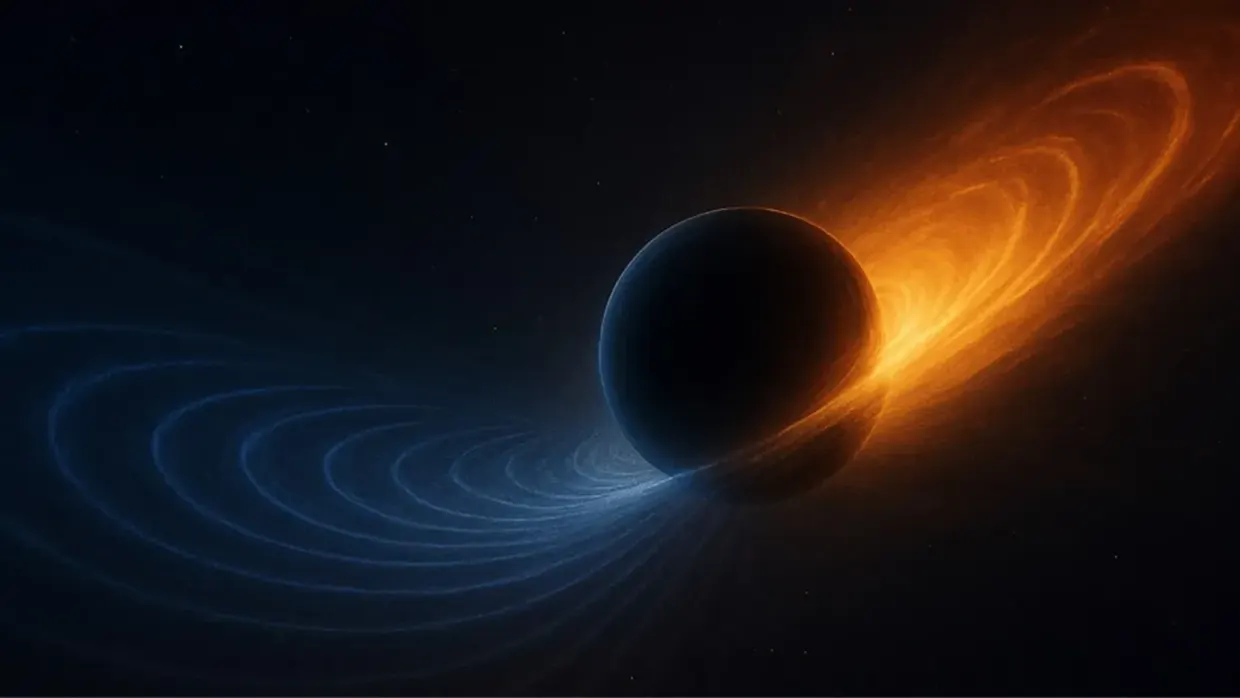
Researchers at the Universidade de Santiago de Compostela, led by Juan Calderón Bustillo, have reconstructed the recoil direction of the black hole formed in the GW190412 merger, according to a paper at doi.org. The signal was recorded in 2019 by the LIGO and Virgo detectors and comes from two black holes of clearly different masses. The analysis rules out recoil speeds below 50 km/s, a typical escape velocity of dense globular clusters, with a Bayes factor of about 21, or about 95% probability nature.com
doi.orgnature.comOpen source ↗.
Why the recoil direction was hard to measure
General relativity predicts that gravitational waves carry linear momentum. If they carry away unequal momentum in different directions, the merged black hole receives a recoil, or kick. Its magnitude is set by the mass ratio and spins of the source, while estimating its direction requires two orientation angles of the source.
The orbital inclination angle is commonly reported in gravitational-wave observations. The azimuthal angle had not been used so far, the authors write. A detector does not track the final black hole. It records tiny stretching and compression of spacetime, from which properties of the original pair are inferred.
How higher-order modes fix the angle
The GW190412 signal contains higher-order modes, additional components of the wave that are more pronounced for unequal pairs. Their interplay depends on the viewing direction toward the system, and this supplies the missing angle nature.com
doi.orgnature.comOpen source ↗. The team compared the data with the NRSur7dq4 numerical relativity surrogate waveform model, which is based on simulations of general relativity.
All values are given at a 90% credible level. The kick forms an angle of 32 (+35, −14) degrees with the orbital angular momentum, defined at a reference time of −100M before merger, where M is the system mass in geometric units. The angle with the line of sight is 44 (+19, −17) degrees, a range of roughly 27 to 63 degrees. A third, azimuthal angle of the kick is also constrained.
The authors anticipate that such characterization of recoils will help evaluate candidate multi-messenger observations of black-hole mergers in active galactic nuclei, by testing whether observed signals are consistent with proposed electromagnetic emission mechanisms. The strain data are public via the Gravitational Wave Open Science Center, and the Bilby inference code and the NRSur7dq4 model are also publicly available.