Modified consumer camera measures open-circuit voltage of silicon solar modules from their glow
Researchers calibrated a low-cost digital camera to read the infrared electroluminescence of silicon modules and derive open-circuit voltage; tested on eight modules built 1978–2022.
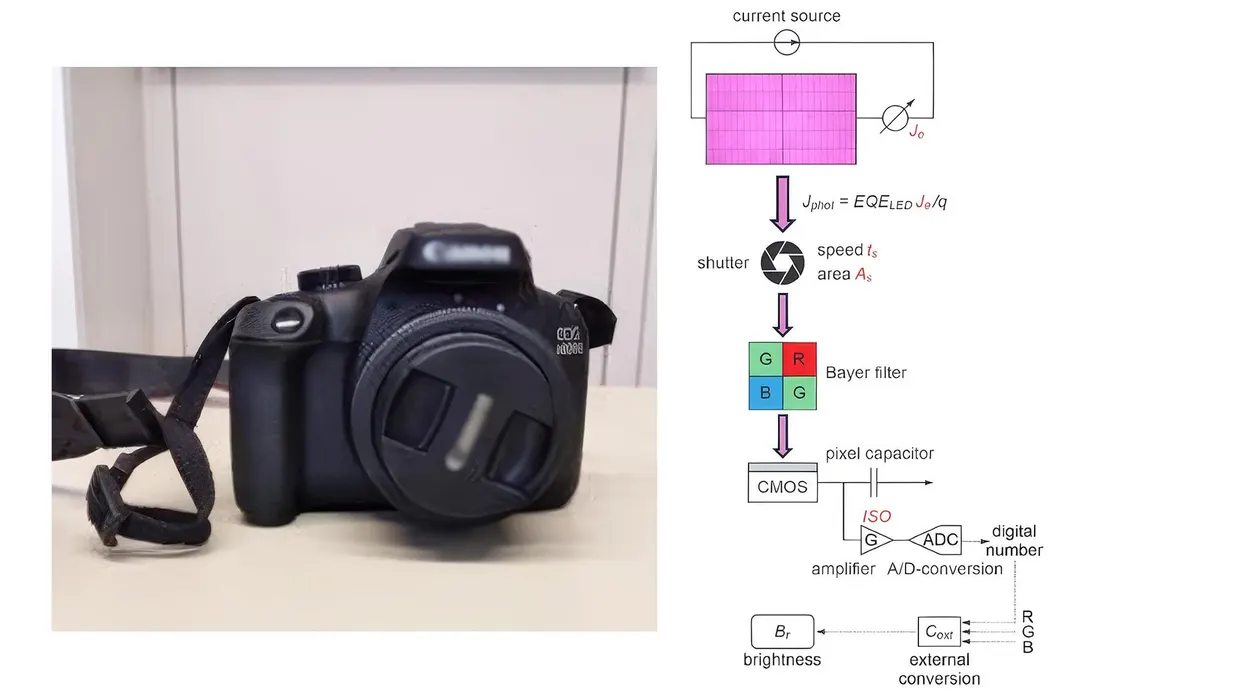
A team from the University of Stuttgart, Research Center Jülich and the company Solarzentrum Stuttgart used a modified low-cost digital consumer camera to measure the external electroluminescent quantum efficiency of silicon solar modules and, from it, their open-circuit voltage. The work is published in the Journal of Applied Physics aip.org
Journal of Applied Physicsaip.orgOpen source ↗. The modules investigated span more than 45 years of technology.
Camera calibration
A biased solar cell emits light like an LED, and silicon cells emit in the infrared. The external electroluminescent quantum efficiency and the open-circuit voltage are directly linked, so a calibrated camera allows a quantitative determination of the voltage. According to the report on the study, each tenfold rise in efficiency corresponds to about 60 mV of voltage.
The camera was a Canon EOS 4000D. The team removed the infrared-absorbing film in front of the sensor and fitted a long-pass filter that blocks visible light. All images were taken in the dark while a current source drove a known current through the module.
The calibration model separates the linear and non-linear regimes of the sensor aip.org
Journal of Applied Physicsaip.orgOpen source ↗. For this camera the response was linear below a pixel value of 400 and bent toward a ceiling above it; for one module the ceiling was 1,177. Both ranges can be used, and the saturated one gives a second estimate of the same quantity. The absolute scale is anchored to a reference cell with an established efficiency of 1.6% at 738 mV. The authors state that the model also applies to photoluminescence measurements.
Results and limits
In the study, open-circuit voltage ranges from about 560 mV for an early module from 1978, with an efficiency of about 6%, to 690 mV for a state-of-the-art industrial module with about 21%. The corresponding quantum efficiency ranges from 0.0007% to 0.2%. Eight modules were measured. Readings followed the 60 mV rule, except for four modules with multicrystalline cells, which agreed only after the weaker light trapping of such cells was accounted for.
The authors name several weaknesses. Brightness was averaged over a box drawn by hand around each cell, which picks up dark gaps between cells and adds scatter; an automatic version has not been written. All measurements were made in the dark, on silicon modules of known performance, and the whole scale depends on a single reference cell. The camera was not compared with an industrial one.
According to Jürgen Werner, the next step is to use the calibrated camera on further, previously uncharacterized cells and modules. He added that the same model should work on a panel illuminated rather than electrically driven, and possibly outdoors.
出典 · 2
誤りを見つけましたか?あわせて読みたい