ALMA finds 26-light-year jet of warm molecular gas near gamma-ray binary LMC P3
Astronomers from Nagoya and Gifu universities mapped a 26-light-year trail of warmed CO gas at LMC P3, supporting the microquasar model of its gamma-ray emission.
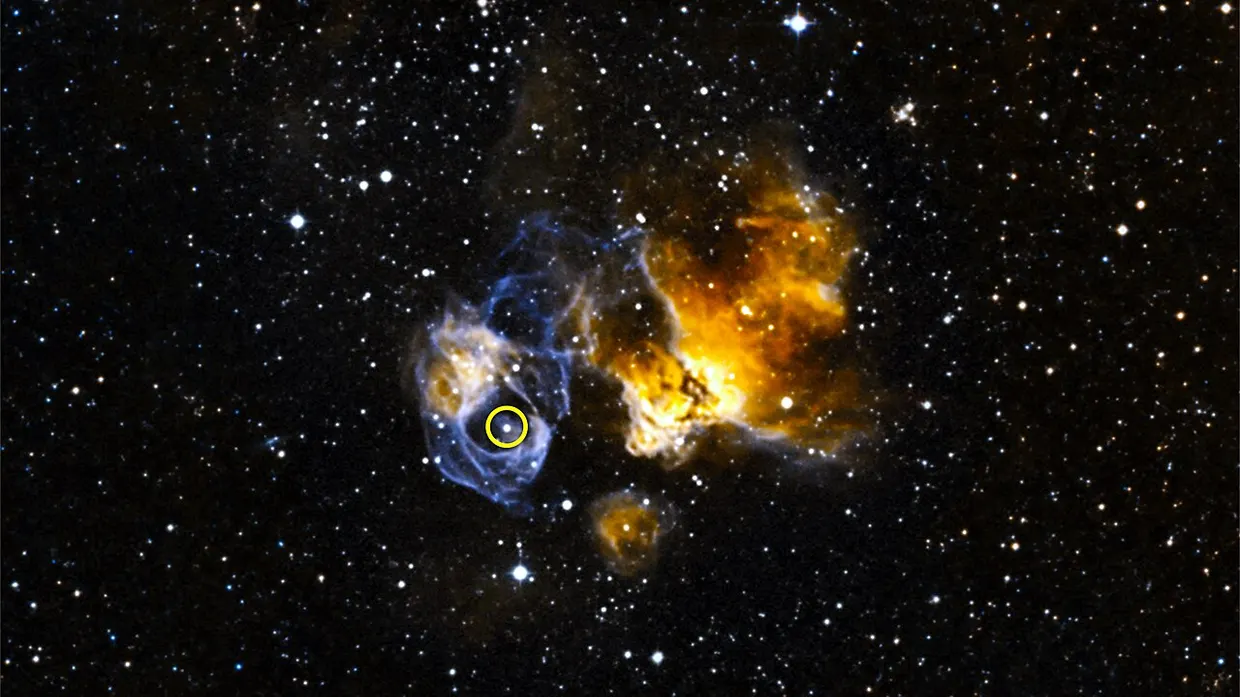
Astronomers from Nagoya University and Gifu University in Japan used the ALMA observatory in Chile to detect a narrow trail of heated molecular gas next to the gamma-ray binary LMC P3 in the Large Magellanic Cloud. The trail is about 26 light-years long and three light-years wide. The team began observing the object in 2022, and the results were published in The Astrophysical Journal Letters, according to en.nagoya-u.ac.jp. nagoya-u.ac.jp
en.nagoya-u.ac.jpen.nagoya-u.ac.jpOpen source ↗
The system and the measurements
LMC P3 is the most luminous gamma-ray binary star system. It consists of a compact object, either a black hole or a neutron star, and a massive star more than 30 times heavier than the Sun. The two orbit each other in roughly 10 days.
The system lies inside the supernova remnant DEM L241, a cloud of molecular gas left by the explosion that created the compact object. Since its discovery, the unusually strong gamma-ray emission of LMC P3 has remained unexplained.
The team used ALMA bands 6 and 7 to measure carbon monoxide (CO) emission from the surrounding cold gas at wavelengths of about 1.3 mm and 0.87 mm. The data allowed them to determine the structure and motion of the gas and estimate its temperature. nagoya-u.ac.jp
en.nagoya-u.ac.jpen.nagoya-u.ac.jpOpen source ↗
Jet signature and competing models
The trail is straight and narrow. Its temperature is 35 to 60 K, compared with 15 K for the surrounding gas. Yasuo Fukui, professor emeritus at Nagoya University and lead author, said: "We discovered a gigantic molecular jet." He said that the elevated temperature over a large part of the cloud makes it "a very strong case" that the gas interacts with a high-energy jet from the compact object, the kind of jet that can also power the gamma rays of LMC P3.
Two models of gamma-ray emission have competed for this system. In the pulsar-wind model, the compact object is a rapidly spinning neutron star whose wind of energetic particles collides with the wind of its companion star. The resulting shock wave accelerates particles, which produce gamma rays.
In the microquasar model, the compact object draws material from its companion into an accretion disk and launches jets of high-speed particles. The authors report that the new jet signature points to this quasar-like mechanism and strengthens support for it. nagoya-u.ac.jp
en.nagoya-u.ac.jpen.nagoya-u.ac.jpOpen source ↗
Black holes drive more powerful jets than neutron stars. Because the gamma-ray emission of LMC P3 is particularly high, Fukui said it "provides a very strong support for the possibility that its central object is a black hole" rather than a neutron star.