JWST maps Galactic Center gas: Minispiral near Sgr A* is about 1.8 times solar in metals
Mid-infrared JWST spectra of the central 0.1 pc show mildly supersolar abundances and signs of fast shocks in compact gas clumps moving at over 600 km/s.
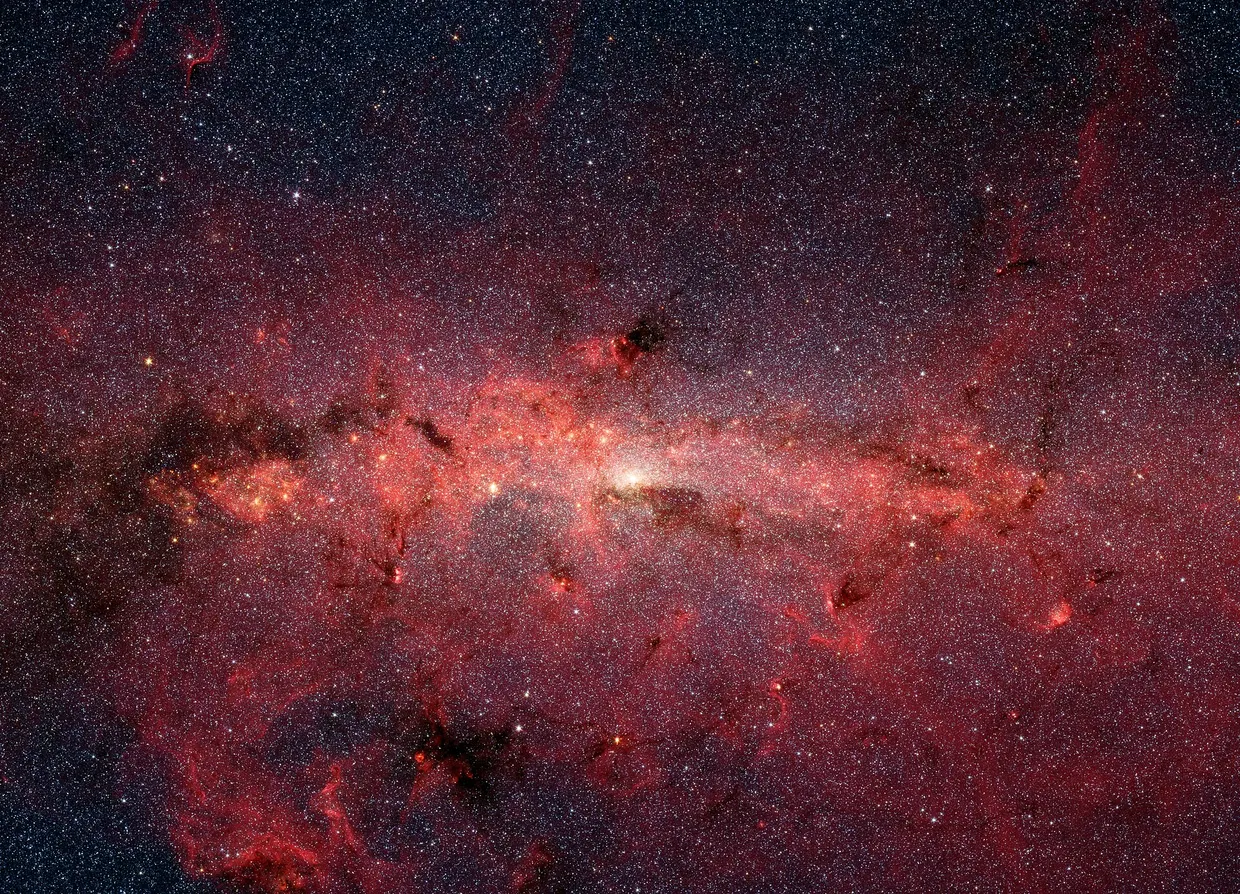
Researchers at McGill University's Trottier Space Institute, with Nicole Ford as lead author, used the JWST MIRI Medium Resolution Spectrograph to study ionized gas in the central 0.1 pc of the Milky Way. At its centre sits Sagittarius A* (Sgr A*), the nearest quiescent supermassive black hole. The results were published in The Astronomical Journal on 19 October 2026 iop.org
The Astronomical Journaliop.orgOpen source ↗. Spatial and spectroscopic mid-infrared data allowed the team to separate individual gas structures and measure the composition of each.
Gas structures near Sgr A*
The Bar and the Northern Arm of the Galactic Minispiral were identified by their distinct morphological and kinematic signatures. Several compact structures smaller than 1″, including X7, also appear within about 0.05 pc of Sgr A* in the plane of the sky. They move with blueshifted radial velocities of at least about 600 km/s.
Metals, radiation and dust
The authors used fine-structure line measurements spanning ionization potentials of about 7–55 eV. These constrain the incident radiation field, the abundances of neon, argon, sulfur, nickel and iron, and dust depletion or destruction in each structure. Overall, the Minispiral gas shows mildly supersolar abundances, about 1.8 times solar. The radiation field is consistent with Wolf–Rayet stars, with ionization parameters of −1.6 ≲ log U ≲ −0.6, and nickel and iron dust is significantly destroyed.
In the high-velocity compact structures, the enhanced ionization state and strong dust processing suggest, according to the authors, that these features may experience localized fast shocks iop.org
The Astronomical Journaliop.orgOpen source ↗. Here "metals" means all elements heavier than hydrogen and helium.
According to the researchers, the gas composition resembles that of many stars orbiting Sgr A*, which suggests the gas and stars may have formed together. Metal content affects how quickly gas cools, and so how readily the black hole can draw it in. Ford noted that Sgr A* consumes less material, and more slowly, than other supermassive black holes.
The work complements a recent study led by Mayura Balakrishnan. It found that local conditions shape the light emitted by the surrounding gas, so the gas cannot provide a reliable history of the black hole's activity. That result does not rule out past outbursts. Ford said that understanding how Sgr A* attracts material will require comparing these observations with simulations of gas evolution over longer timescales.