Giant Acheulean ficron handaxes cut 22% slower in replica test; British finds show high symmetry
In a test with replicas, large ficron handaxes cut plastic rope more slowly than normal-sized ones, while the original British finds are unusually symmetrical. Authors suggest a social role.
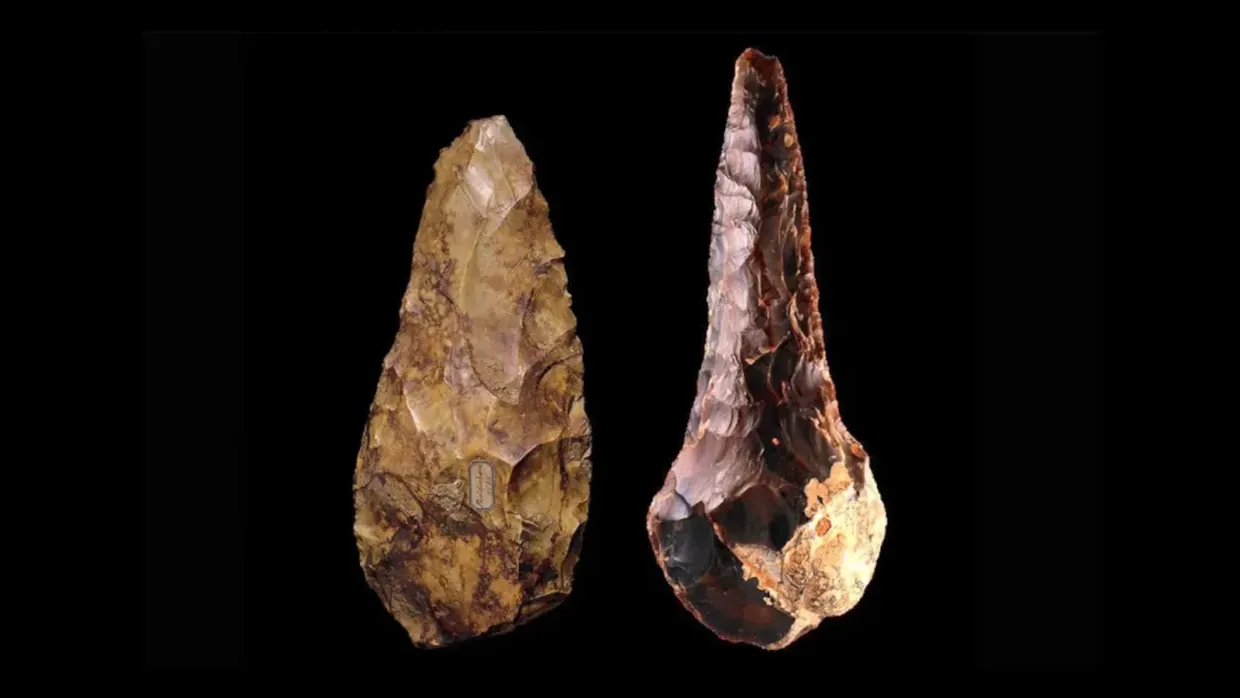
Researchers at University College London led by Matt Pope scanned 817 handaxes from seven British sites in three dimensions and ran a cutting experiment with replicas. The results are reported in the Journal of Archaeological Science Reports sciencedirect.com
Journal of Archaeological Science Reportssciencedirect.comOpen source ↗. The sample included 18 giant handaxes, seven of them of the ficron type. In Britain, giant ficrons are found mostly in assemblages from the MIS 9 interglacial, roughly 337,000 to 300,000 years ago, and measure at least 22 centimetres.
Cutting test with replicas
The team made ten normal-sized flint ficron replicas and ten longer than 22 centimetres. Twenty participants each cut ten plastic ropes fixed to a frame in different directions, using first a smaller tool and then a large one. The average time was 64.5 seconds with the smaller replicas and 78.6 seconds with the large ones, an increase of 22 percent that was statistically significant. With the large replicas, 18 of the 20 participants used both hands but still controlled the tool less precisely.
Shape and symmetry of the originals
The density of flake scars on the giant handaxes did not differ markedly from that on smaller tools from the same assemblages. This argues against the giants being early-discarded, barely worked blanks, so their size appears to have been deliberate. Some of the giants showed heightened symmetry and edge straightness in side profile. Giant ficrons stood out most in their narrow, elongated form: six of the eight giants with the most extreme shapes were of this type.
The design was also demanding. A long, narrow tip on a large flint can be produced only with a considerable risk of breakage. In East African assemblages, very large handaxes more often fall within normal size variation.
The authors conclude that features which are hard to produce and give no clear functional advantage suggest giant ficrons may have played a role in the social lives of Late Acheulean hominins sciencedirect.com
Journal of Archaeological Science Reportssciencedirect.comOpen source ↗. Such tools could have demonstrated the maker's skill and conferred standing within a group.
The function is not proven. The experiment tested only the cutting of plastic rope, not butchering of prey or other possible uses such as digging and woodworking. The authors stress that a specialised practical use would also be compatible with an additional meaning as a status marker.