Wildfire traces in two Chinese basins show uneven fire activity during the PETM warming
Polycyclic aromatic hydrocarbons in 40 sediment samples show fire peaks at different times in each basin, which weakens the case for global peat burning.
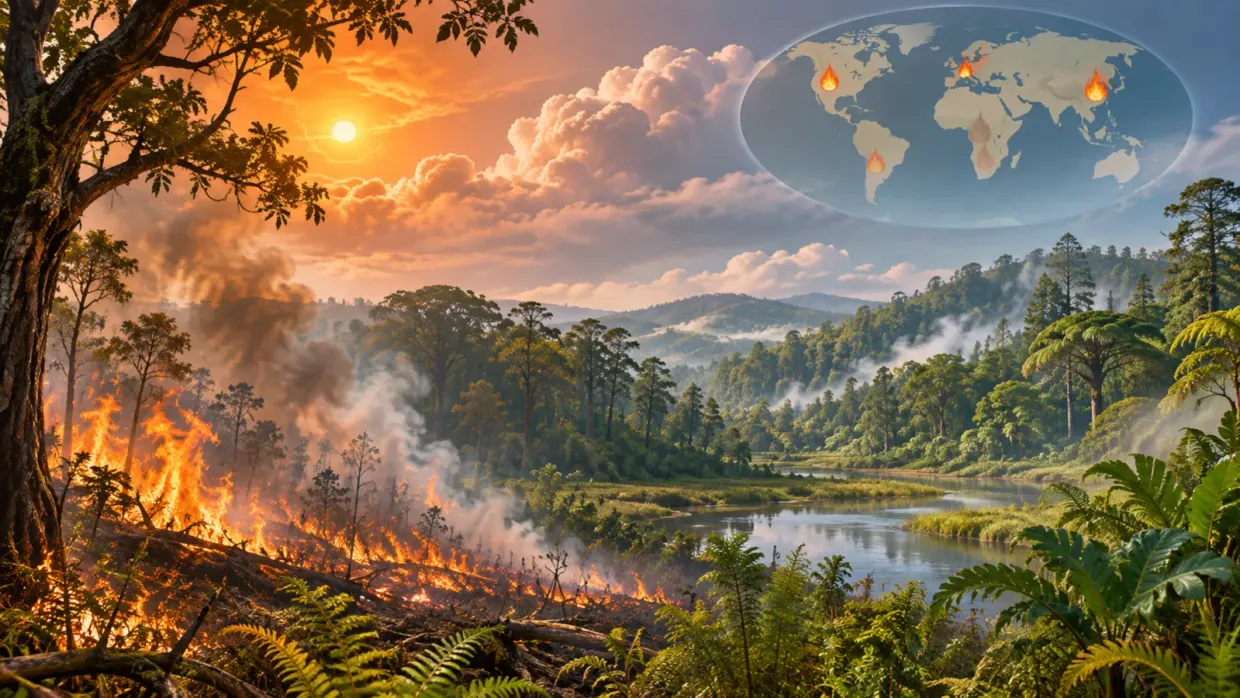
Researchers at the Institute of Geology and Geophysics, Chinese Academy of Sciences (IGGCAS), led by Dr. Zuoling Chen, analysed 40 sediment samples from two Chinese basins to trace wildfire history during the Paleocene–Eocene Thermal Maximum (PETM), about 56 million years ago. The samples come from the Fushun Basin in northeast China and the Jianghan Basin in eastern China. The results, published in Geophysical Research Letters, show that fire activity did not rise everywhere during the warming agu.org
Geophysical Research Lettersagu.orgOpen source ↗.
What the hydrocarbons show
The team measured polycyclic aromatic hydrocarbons (PAHs), which form in part during incomplete combustion of plant material and persist in sediments. Because some PAHs also come from petroleum or coal, the researchers compared several compound ratios to narrow down their origin.
In the Jianghan Basin, fire indicators accumulated at the start of the climate excursion. In the Fushun Basin, further north, they peaked only during the subsequent recovery phase. The most pronounced fire episodes at the two sites therefore neither coincided in time nor consistently fell into the period of highest temperatures.
The chemical signatures also differ. In Fushun, several ratios point clearly to the burning of plant material. In Jianghan, the analyses partly suggest mixed sources, although the authors interpret the overall signal as dominated by vegetation fires.
The authors explain the difference by local conditions. This is a plausible reading of the sediment data, not a directly observed cause. Jianghan was relatively dry before the warming, so there was probably too little plant material for large fires, and more rain at the start of the PETM could have increased growth and fuel. Fushun was already humid and rich in vegetation; extra rainfall may first have suppressed fires, and cooler, drier conditions during recovery may have let the accumulated plant matter ignite more easily.
Comparison with global records
The team compared the new data with earlier fire records from other regions. Some archives show frequent fires, others a brief increase, little change, or even a decline. A simultaneous worldwide rise in fire activity at the onset of the PETM cannot be derived from them agu.org
Geophysical Research Lettersagu.orgOpen source ↗.
According to the study, global wildfire records do not support the burning of Paleocene peatland worldwide, so a wildfire-related source of isotopically light carbon requires close scrutiny. The data do not exclude any role of peat fires; they argue against a uniform, exceptionally strong burning phase everywhere.