Ti3C2Tx MXene flakes: reactions spread beyond the SECCM droplet contact, X-ray imaging shows
Researchers correlated X-ray maps of titanium oxidation state with local electrochemical probing of single Ti3C2Tx flakes; redox activity extended well beyond the point of contact.
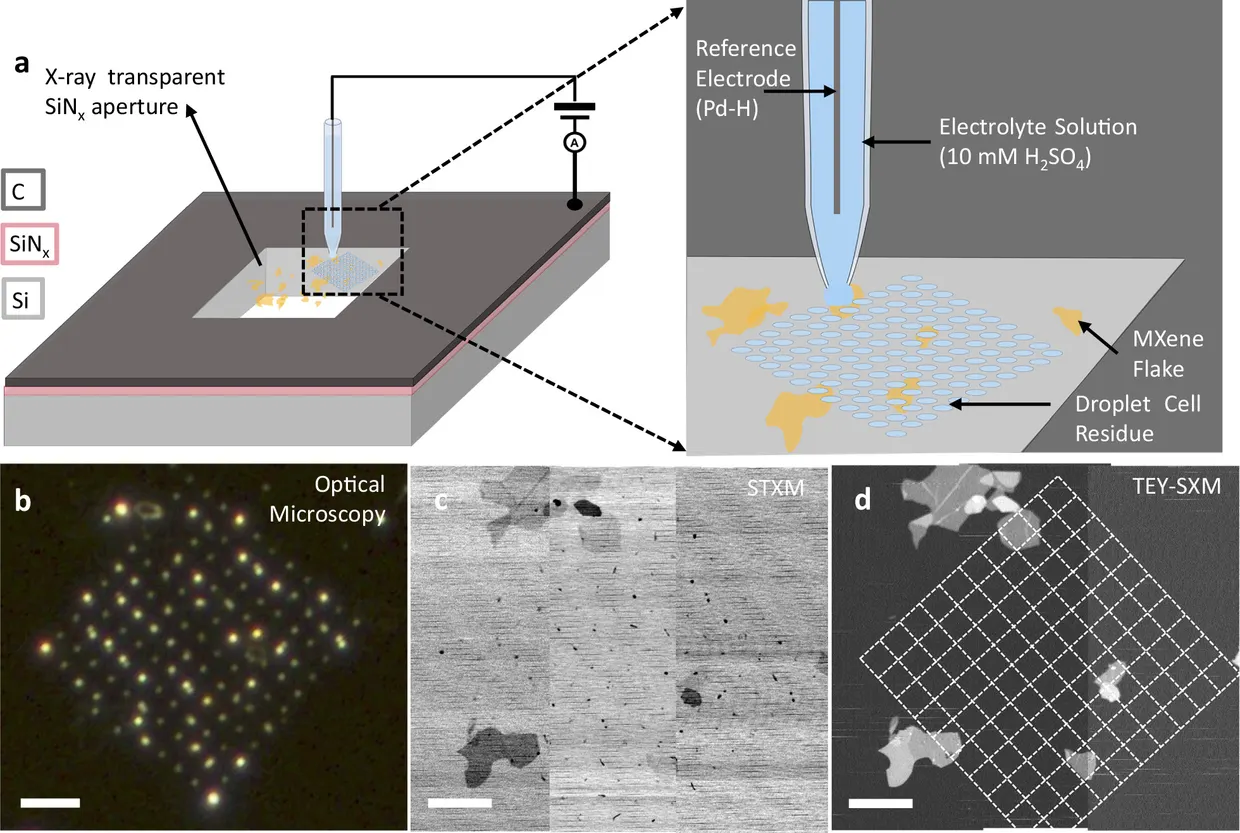
A research team reported in Nature Communications a correlative method for imaging electrochemical processes on single flakes of the MXene Ti3C2Tx, a two-dimensional titanium carbide. Scanning electrochemical cell microscopy (SECCM) triggered reactions in small regions of a flake, and scanning X-ray microscopy (SXM) then mapped its electronic structure at the nanoscale nature.com
Nature Communicationsnature.comOpen source ↗. For several proton-coupled electron transfer reactions, including electrochemical oxidation and the hydrogen evolution reaction, the authors report that the reactions extended well beyond the part of the flake in contact with the droplet cell.
Why single flakes matter
In pseudocapacitors with acidic electrolytes, planar Ti3C2Tx electrodes showed higher gravimetric capacitance and faster charge-discharge than macroporous templated ones, even though the electrolyte reached them less easily. This pointed to lateral proton transport along the MXene surface, but its contribution is hard to separate from bulk electrode effects. In thick electrodes, intercalation also cannot be fully decoupled from redox pseudocapacitance.
Earlier SECCM measurements with a probe of about 300 nm radius gave capacitance values that were anomalously high when normalized to the probe contact area. Normalized to the total flake area, they matched state-of-the-art devices. Post-mortem scanning electron microscopy showed no visible wetting beyond the contact area. A related effect was reported before for Pt nanoparticles microns from the droplet, linked to a thin electrolyte film of about 5 nm.
Method and findings
SXM is a synchrotron-based technique: a focused X-ray beam rasters across the sample, and tuning the beam energy gives chemical contrast. Total electron yield mode probes the surface, while transmission probes the bulk. The team used a substrate developed earlier in their group that allows SECCM measurements and SXM imaging in total electron yield mode on the same nano-objects nature.com
Nature Communicationsnature.comOpen source ↗.
The reactions studied were the hydrogen evolution reaction, capacitive charging and electrochemical oxidation. Maps of the Ti oxidation state showed that, regardless of the reaction, redox activity extended well beyond the immediate contact point. The authors suggest that interfacial water molecules mediate fast proton transport across the MXene surface. They also report evidence of hydrogen storage on monolayer Ti3C2Tx flakes.
The authors note that this delocalized mechanism governs the reactivity of Ti3C2Tx in both cathodic and anodic regimes. They propose that it may matter wherever proton-coupled electron transfer reactions are involved.