Chimpanzees in eight groups learn the context of unvoiced calls from adults, data on 91 animals
Researchers compared unvoiced calls such as acoustic raspberries in 91 chimpanzees. Groups with adult role models used them in one stable context; groups without them did not.
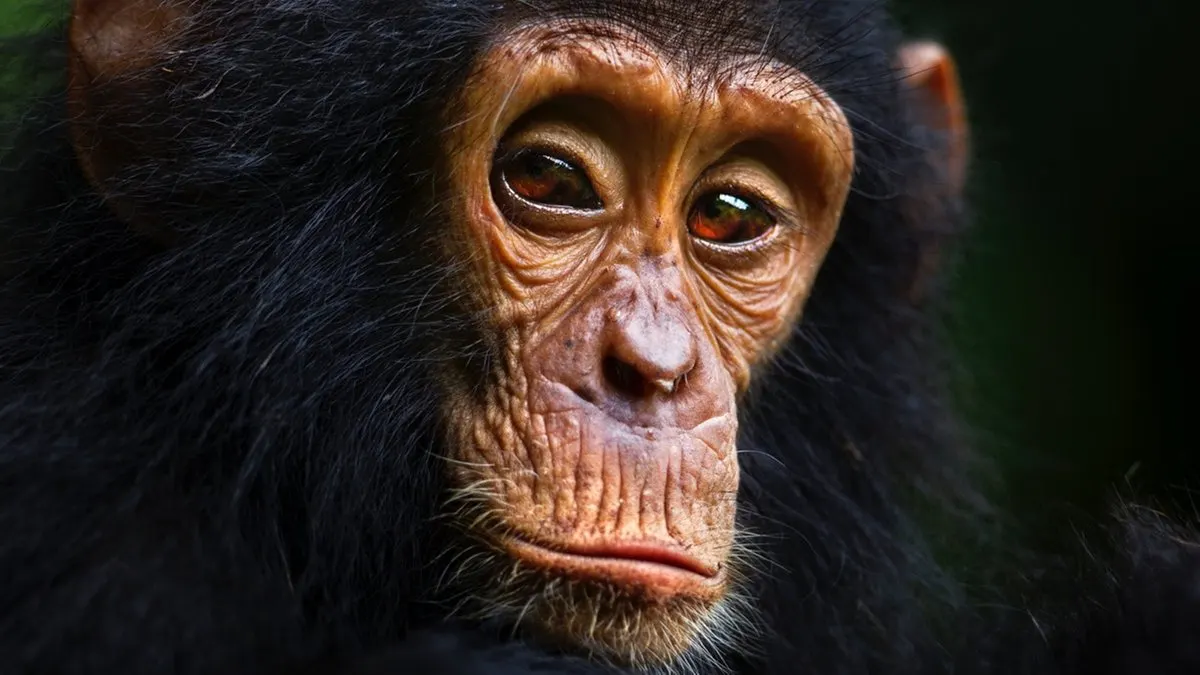
A team from the Institute of Cognitive Sciences (France) and the University of Warwick (UK) reports in the journal Proceedings of the National Academy of Sciences that chimpanzees acquire from adults not only the sounds themselves but also the context in which they are used pnas.org
Proceedings of the National Academy of Sciencespnas.orgOpen source ↗. The authors collected audio and contextual data from 91 chimpanzees aged 0 to 55 years in eight wild and captive groups. The groups were four wild communities in Taï National Park, Côte d'Ivoire, and four groups of orphaned animals in a sanctuary in Sierra Leone.
Unvoiced calls in different groups
The study focused on unvoiced calls, such as acoustic raspberries made with the lips, which were already known to vary in usage. The groups differed in whether adult role models were present. Communities with role models emitted these calls in one dominant context, which remained stable over years and from the first utterances at 1 to 2 years of age. In the wild communities this context was mainly grooming.
Groups without role models showed highly variable, unstable usage across contexts and across years. Young animals in the sanctuary used the call in a much wider range of social situations than the wild chimpanzees did.
Signal form and usage
The variation could not be explained by age or by a shared emotional valence pnas.org
Proceedings of the National Academy of Sciencespnas.orgOpen source ↗. Individuals could also use different call forms within the same context, which the authors interpret as a decoupling between the form of the signal and its usage. According to the authors, the calls meet key criteria of a signal convention: arbitrary mappings between signal and usage, social transmission, and stability within communities.
The publication's retelling adds that when an adult chimpanzee was introduced into one of the sanctuary groups, the group's use of the call gradually became more uniform and closer to the newcomer's. The authors conclude that conventionalized communication is not uniquely human and can emerge through social learning in the natural communication of other animals.