Quasi-2D perovskite spin-polarized lasing below 200 K achieved with 35.4 ps spin lifetime
Authors report spin-polarized lasing in quasi-2D perovskites below 200 K after suppressing fast spin relaxation through triplet exciton regulation in a laboratory experiment.
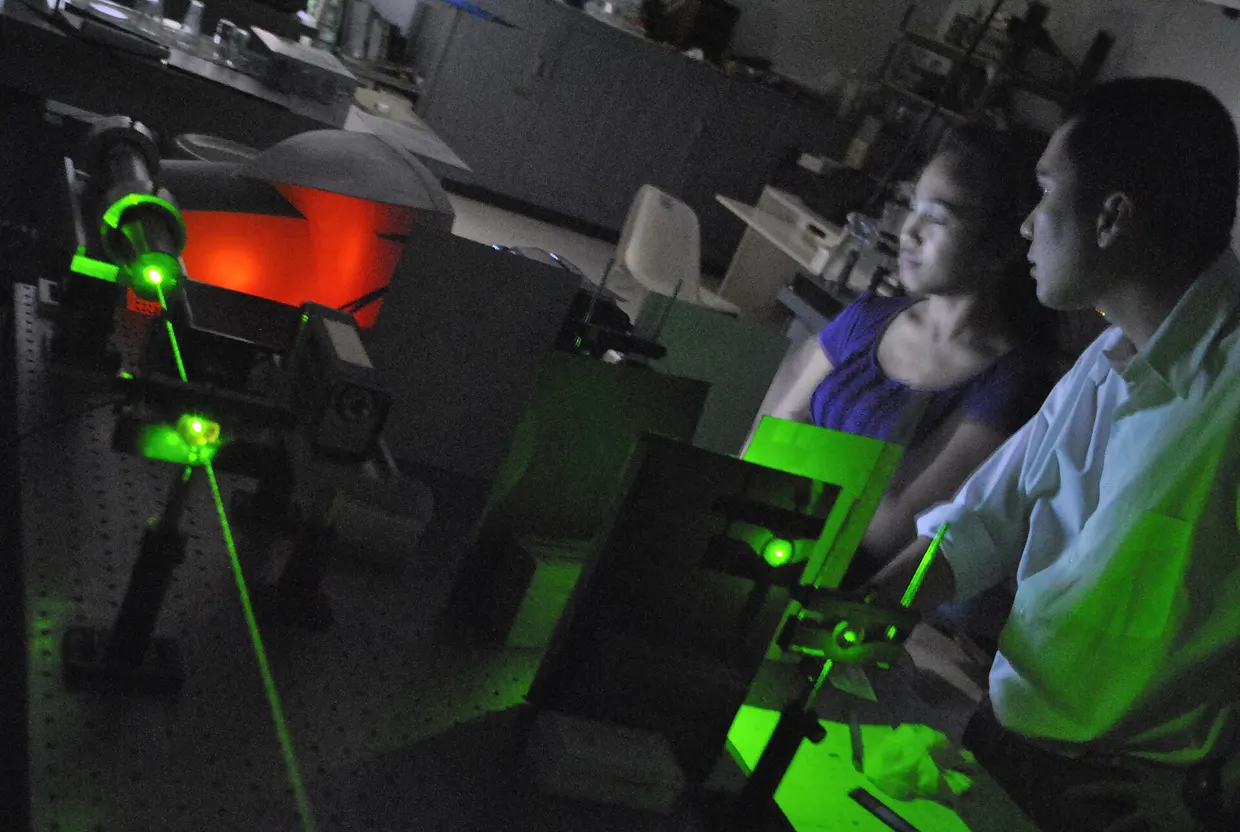
Researchers reported in Science Advances spin-polarized lasing in quasi-two-dimensional (quasi-2D) perovskites, achieved by suppressing fast spin relaxation through regulation of triplet excitons. According to the authors, lasing was realized below 200 K, and its threshold was 30.2% lower than for linearly polarized excitation science.org
Science Advancesscience.orgOpen source ↗. The materials use the organic cations phenylethylammonium (PEA) and 1-naphthylmethylamine (NMA).
Spin-polarized lasers are considered for integrated photonic devices for secure communication, optical interconnections and other optical devices. Quasi-2D perovskites are candidates because their potential structural inversion asymmetry should give strong spin-orbit coupling (SOC), which facilitates spin injection and spin splitting of electronic bands.
Spin relaxation mechanism
Strong SOC involves a trade-off between spin injection and spin lifetimes. This makes it difficult to sustain spin polarization in the lasing regime while keeping optical gain. The authors identified the Bir-Aronov-Pikus (BAP) mechanism as the dominant spin relaxation channel that prevents spin-polarized lasing in quasi-2D perovskites.
Triplet excitons and the result
The authors modulated the reverse intersystem crossing of triplet excitons. As a result, the D'yakonov-Perel' (DP) mechanism began to play the key role, and a new, longer spin lifetime of 35.4 ps appeared at 77 K. This is about five times the lifetime induced by the BAP mechanism science.org
Science Advancesscience.orgOpen source ↗.
In their conclusion, the authors state that the work underscores the potential of PEA-based quasi-2D perovskites for spin-polarized lasing and contributes to progress in perovskite spintronic devices.