LEIZA: limpet shells from Franchthi show no extreme cold during pause in Neolithic farming spread
Oxygen isotopes in 121 limpet shells from Greece's Franchthi site found no extreme cold and no significant link between temperature and diet.
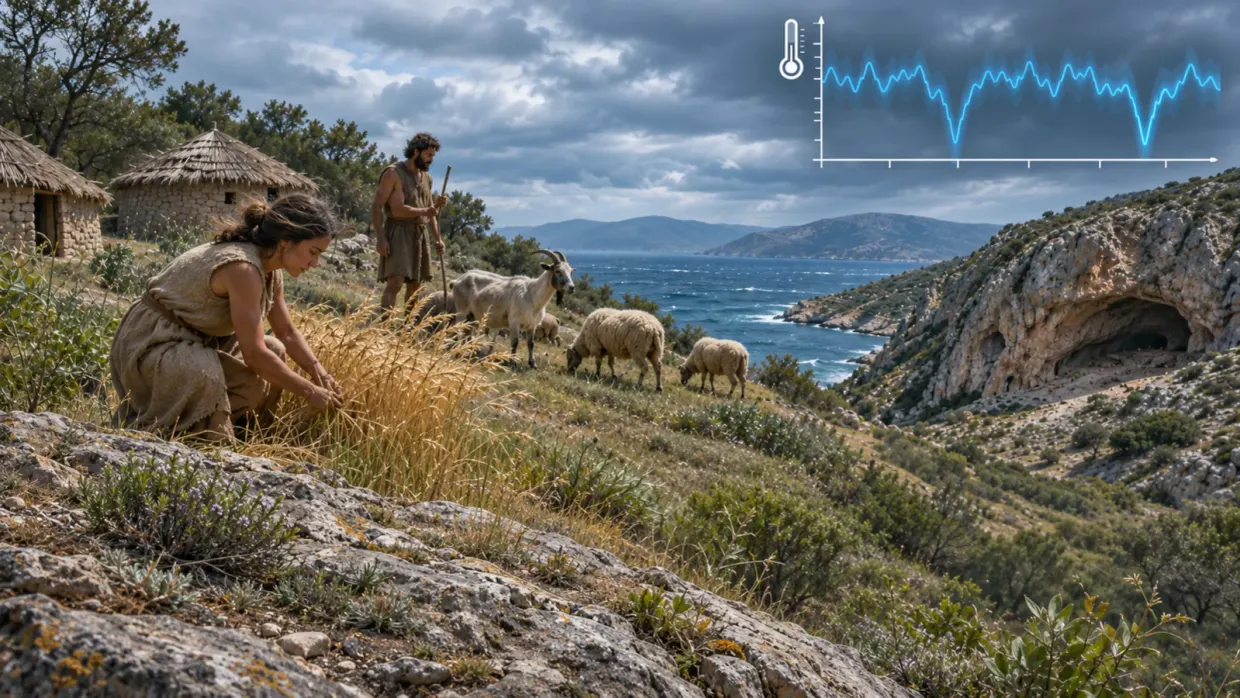
Researchers at the Leibniz Centre for Archaeology (LEIZA), led by Niklas Hausmann, reconstructed local temperatures at Franchthi on Greece's Peloponnese peninsula from 121 limpet shells (Patella sp.). According to leiza.de, they found no direct evidence of extreme cold leiza.de
leiza.deleiza.deOpen source ↗. The study, published in PNAS in 2026, tests a common explanation for a pause in the spread of farming across Europe.
Why the spread of farming paused
Farming reached Europe from the Near East from about 7,000 BC. Between about 6,600 and 6,000 BC, early farmers barely moved beyond Greece. After that, farming communities covered the Mediterranean coast as far as Portugal in about 500 years.
A widely cited explanation is short, unpredictable cold spells and the abrupt cooling about 8,200 years ago, known as the 8.2 kiloyear event. Hausmann notes that extreme cold could have endangered yields and made it harder to found new settlements. Until now, it had not been directly examined whether such cold occurred at a given site and affected how people lived.
Shells as a temperature record
The limpets were eaten, and their shells survived as waste. Shells grow layer by layer and store information about the conditions the animals lived in. A purpose-built laser method was used to determine the seasonal growth phases, and oxygen isotope analysis of those phases gave extreme temperatures. The authors describe the result as the largest high-resolution dataset of this kind from a single archaeological site leiza.de
leiza.deleiza.deOpen source ↗.
The temperatures were then compared with animal bones from the same layers, which show which species people used and their share in the diet. For the early Neolithic, 51 shells were analysed, covering 36 individual winters from 22 layers. These shells show a wider range and more frequent cooler winters than the middle Neolithic. However, typical winter temperatures did not differ significantly.
No significant link with diet
Complete data on both climate and fauna were available for 17 layers. Summer and winter temperatures accounted for about 12 percent of the variation in species composition in the model, but the link was not statistically significant. After correction for the small sample size, practically no explained variation remained.
"For Franchthi, there is no evidence that cold impaired the food supply so strongly that it prevented the spread of farming," said co-author Danai Theodoraki leiza.de
leiza.deleiza.deOpen source ↗.
Hausmann stresses that the results do not mean climate played no role. They show that short-term cold at this coastal site does not explain the delay, which shifts attention to social, economic or cultural factors. The team plans to apply the method to other sites to see whether Franchthi is a special case.