ESA's Hera returns first close-up of asteroid Didymos from 60 km, showing its far side
Hera's Asteroid Framing Camera imaged the 780-m Didymos, on the side DART did not show. The data will help assess kinetic-impact asteroid deflection.
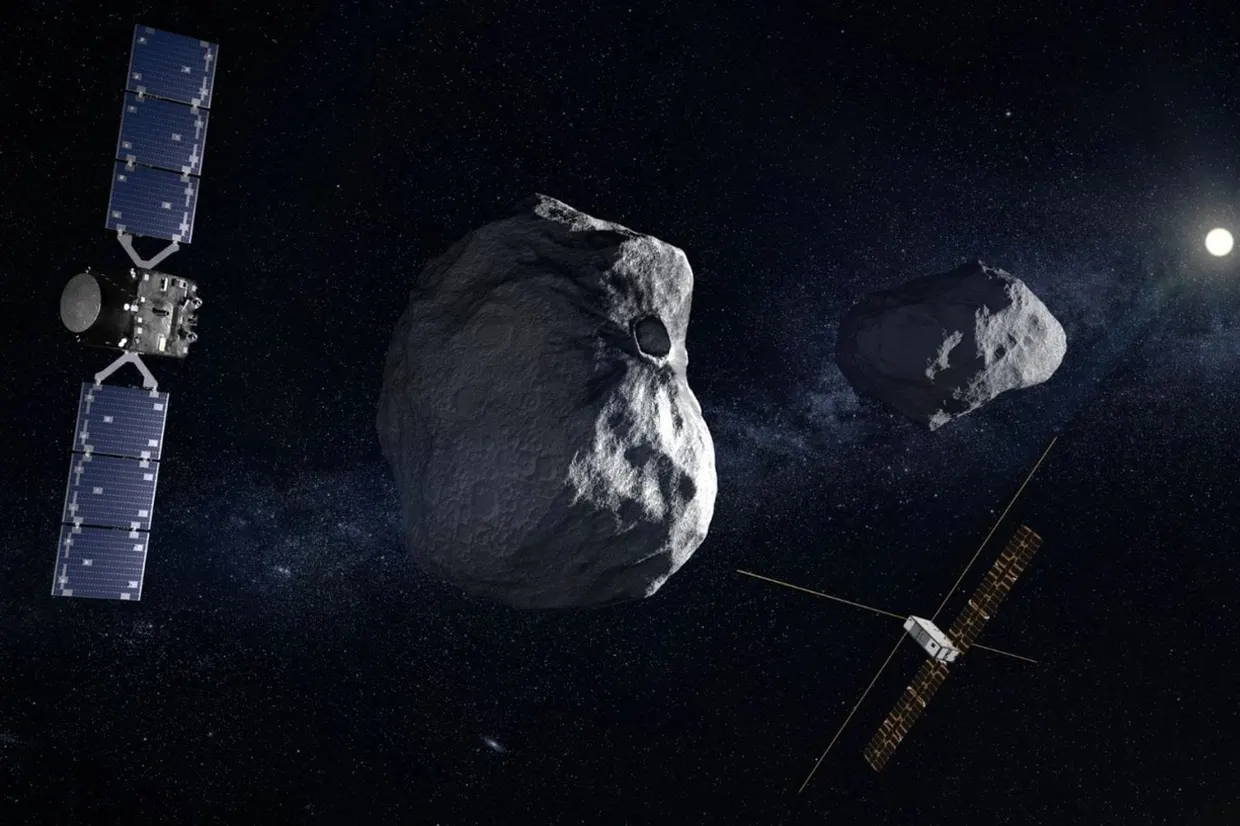
The European Space Agency's Hera planetary defence mission has acquired its first close-up image of the Didymos binary asteroid system, according to esa.int esa.int
esa.intesa.intOpen source ↗. The monochromatic Asteroid Framing Camera took the image from a distance of 60 km. The 780-m Didymos is clearly visible, while most of the 151-m Dimorphos is hidden in shadow. NASA's DART spacecraft impacted Dimorphos on 26 September 2022.
The far side of Didymos
The image shows the side of Didymos opposite to the one that DART's camera showed shortly before impact. The central ridge along the equator, seen earlier, is present here as well. Otherwise the surface looks different, with multiple boulders, craters and what look like patterns of grooves or ridges, said Hera Principal Investigator Patrick Michel of CNRS / Observatoire de la Côte d'Azur.
Hera mission scientist Michael Kueppers noted that a lot of impact-ejected material is expected to have crossed the approximately 1 km between Dimorphos and Didymos. Some of the observed characteristics may originate from this transport of material, he said, but this has yet to be established. The team plans to map the changes it identifies systematically.
Dimorphos and the DART result
Dimorphos, mostly unseen in this image, is the first Solar System object whose orbit has been measurably changed by human action esa.int
esa.intesa.intOpen source ↗. After the impact of the 580 kg DART spacecraft, moving at about 6.1 km/s, the orbit of Dimorphos around Didymos shortened by 33 minutes, give or take a minute. This was a much larger change than had been predicted.
Hera completed a two-year flight to the double asteroid and is currently 196.8 million km from Earth. It is about to perform a close-up investigation of the crash site. According to ESA, its results should help turn the kinetic impact method of asteroid deflection from a one-off experiment into a well-understood and potentially repeatable technique.
Hera mission manager Ian Carnelli described the image as a hugely exciting moment for the whole team. Detailed images of both asteroids will be unveiled on 25 November.