IIT Madras and Gauhati University use a climate network to date monsoon onset at each location
Researchers define large-scale monsoon onset at a location as its joining the largest cluster of rainfall onsets, which separates the monsoon from short local rain spells.
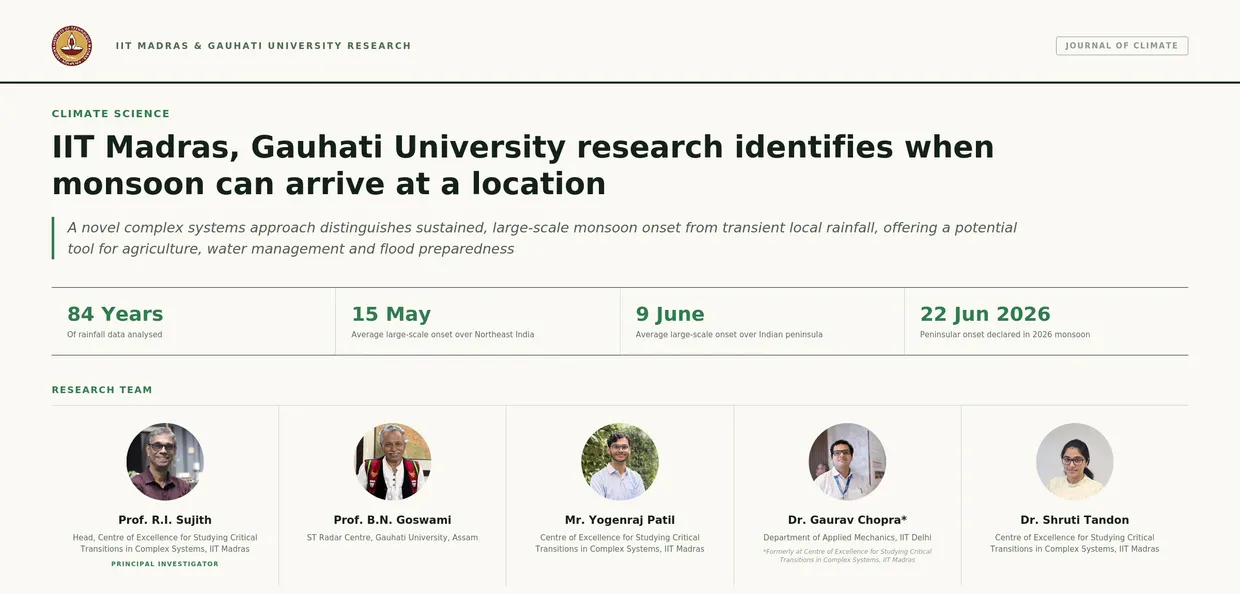
Researchers at the Indian Institute of Technology Madras (IIT Madras) and Gauhati University in Assam have developed a climate-network method for determining when the large-scale monsoon reaches a particular location, according to skilloutlook.com, which reported the work on 10 November 2026 skilloutlook.com
skilloutlook.comskilloutlook.comOpen source ↗. The method distinguishes a short-lived local rain spell from the arrival of the sustained, large-scale monsoon system. The results were published in the Journal of Climate of the American Meteorological Society.
The authors are Yogenraj Patil, Gaurav Chopra, Shruti Tandon and Prof. R.I. Sujith from the Centre of Excellence for Studying Critical Transitions in Complex Systems at IIT Madras, together with Prof. B.N. Goswami of Gauhati University.
How the climate network works
Geographical locations are treated as nodes of a network. Links between nodes represent spatial connections among locations where local rainfall onset occurs, and the researchers tracked the growth and movement of clusters of such onsets. Large-scale onset at a location is defined as the moment its local onset becomes part of the largest, planetary-scale cluster. The authors describe this transition as a phase transition in a climate network.
In April, small clusters form over Northeast India, including those caused by thunderstorms. Later the Northeast cluster grows and merges with a cluster associated with the Bay of Bengal, and the abrupt growth of the largest cluster marks onset over Northeast India. A similar process follows over the Indian peninsula, where a small cluster over Kerala connects to the largest cluster moving westwards from the Northeast skilloutlook.com
skilloutlook.comskilloutlook.comOpen source ↗.
Results from 84 years of data
Using 84 years of rainfall data, the authors found that large-scale onset occurs climatologically around 15 May over Northeast India and 9 June over the Indian peninsula. Onset over the peninsula is followed by a robust northward propagation of rainfall linked to the first pulse of the monsoon intraseasonal oscillation (MISO).
The researchers also applied the definition to the 2026 monsoon and found that large-scale onset over the Indian peninsula occurred on 22 June 2026. Heavy rainfall was later reported in Mumbai by 24 June and in Delhi by 1 July.
Prof. Goswami said the method is meant to complement conventional operational definitions, which rely on regional rainfall and weather observations and can be affected by transient events, rather than replace them. According to Prof. Sujith, avoiding false onsets could give farmers time for sowing and help planning of food security and water resources skilloutlook.com
skilloutlook.comskilloutlook.comOpen source ↗.