NASA study models how LISA gravitational waves could reveal exoplanets around double white dwarfs
A theoretical analysis in The Astrophysical Journal shows how a planet's Doppler modulation adds sidebands to a gravitational-wave signal; the method favours massive, long-period planets.
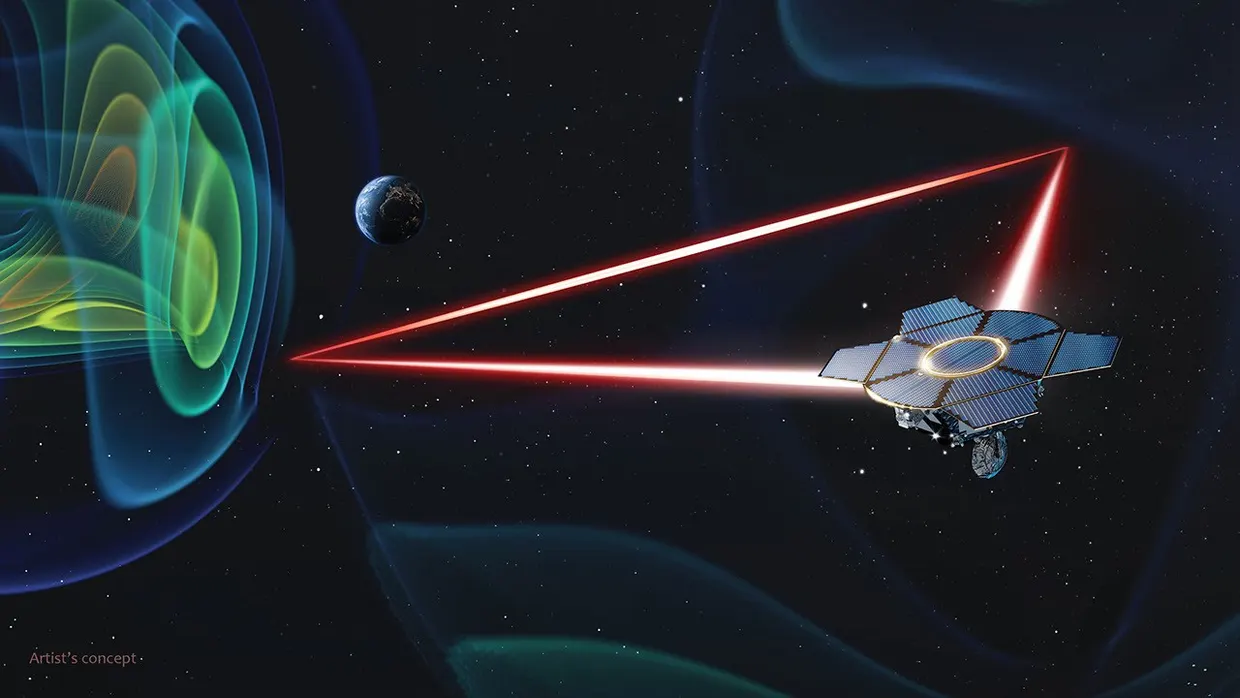
A theoretical study published in The Astrophysical Journal (iopscience.iop.org) describes how an exoplanet orbiting a gravitational-wave source could be detected from the signal itself iopscience.iop.org
iopscience.iop.orgiopscience.iop.orgOpen source ↗. The sole author is Casey McGrath of the University of Maryland, Baltimore County and NASA's Goddard Space Flight Center. The target observatory is LISA, led by ESA and slated for launch in the mid-2030s, with NASA contributing telescopes and other hardware. No planet has been detected: the work is a model of the effect.
How the gravitational-wave radial velocity method works
The gravitational-wave radial velocity (GW RV) method follows the logic of the traditional electromagnetic one: a planet's pull makes its host move, and the motion modulates the observed signal through the Doppler effect. The possibility of such detection around double white dwarfs was first proposed by Naoki Seto in 2008, according to NASA. The paper derives the Doppler effect on the observed gravitational-wave frequency and phase for circular orbits in more detail than earlier work, including an analytic formula for the observed phase.
The author offers an analogy from telecommunications. The sources are nearly monochromatic and much higher in frequency than the planet's orbital frequency, so the source acts as a carrier and the orbit as the message. The observed spectrum then shows sidebands around the carrier frequency.
The paper highlights a parameter called PMI, not discussed in earlier GW RV studies. It controls the strength of the planet's modulation and is similar to the semiamplitude in electromagnetic radial velocity. By the author's analysis, GW RV is more sensitive to high-mass, long-period planets, whereas the electromagnetic method is more sensitive to short-period ones iopscience.iop.org
iopscience.iop.orgiopscience.iop.orgOpen source ↗.
Source types and limits
Two source classes are considered. Binary systems of white dwarfs, neutron stars and black holes fall in the mid-frequency band where LISA will operate; double white dwarfs will be the most common LISA signal. Triaxial bodies, most likely isolated asymmetric neutron stars, fall in the high-frequency band of the terrestrial LVK observatories.
About a decade of searches with current terrestrial observatories has found no triaxial sources. Their strain amplitude is expected to be much smaller than that of binaries, so their signal-to-noise ratio is expected to be much lower. Pulsars hosting exoplanets are very rare, while heavier companions such as white dwarfs or neutron stars would produce a larger PMI.
A second paper in the same journal, by McGrath and coauthors, examines how such planets could be confirmed with the James Webb Space Telescope, according to NASA.