Shock experiments on zircon, apatite and whitlockite at 5–40 GPa show uneven changes within single grains
In laboratory shock experiments, different zones of the same grain changed differently at identical pressure, so missing shock features do not rule out past impact exposure.
Researchers at the University of Rochester led by Kim A. Cone exposed zircon, apatite and whitlockite to laboratory shock at 5, 10, 20 and 40 GPa, according to a study in the Journal of Geophysical Research Planets agu.org
Journal of Geophysical Research Planetsagu.orgOpen source ↗. The grains were embedded in a synthetic basalt-like material, and the shock was produced with an accelerator facility at the Johnson Space Center. The authors report that mineral responses differed both between grains and within a single grain at the same pressure.
Shock response of the minerals
After the experiments, the crystal structures were examined with scanning electron microscopy, Raman spectroscopy and electron backscatter diffraction. U–Pb isotope ratios of selected zircons were measured in situ. Part of the samples was annealed at 950 °C for 36 hours to test the effect of later heating.
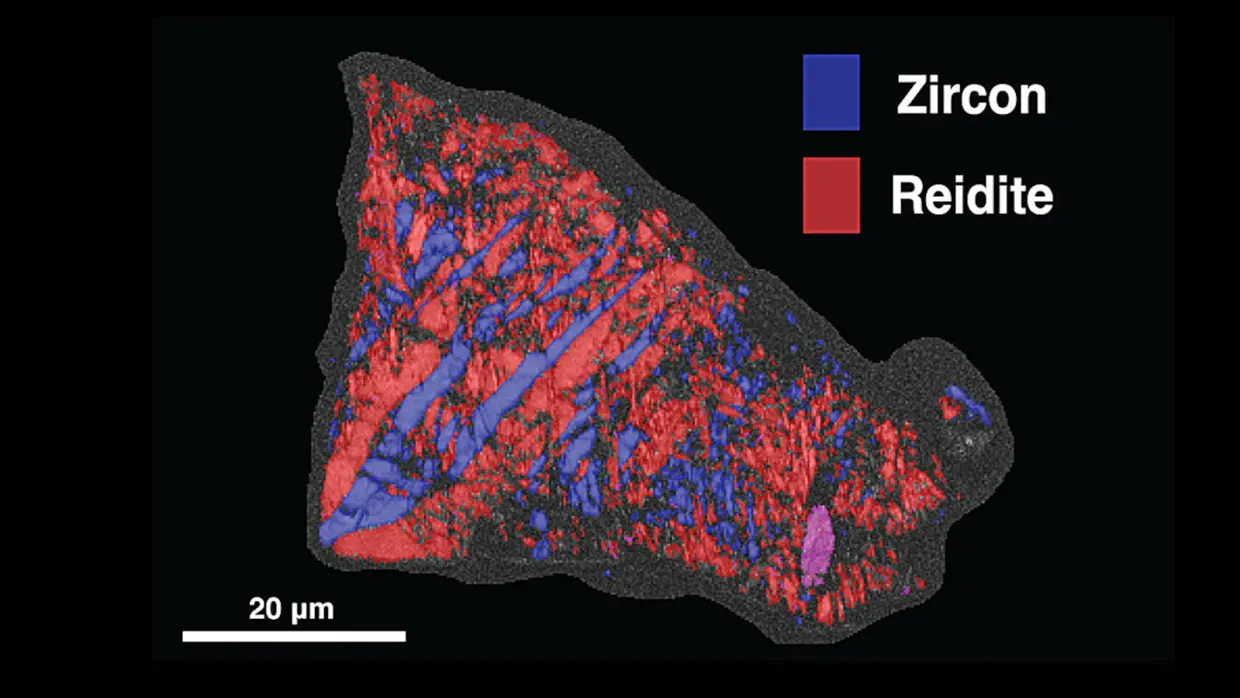
In zircon, patchy reidite, a denser high-pressure phase, appeared near grain exteriors at 20 GPa. At 40 GPa the reidite domains were pervasive. Annealing sharpened the zircon Raman peak at about 1,006 cm⁻¹ at 20 GPa and below, but did not restore it in the reidite formed at 40 GPa.
Apatite retained crystalline domains through 40 GPa, although some Raman bands at about 1,051 and 1,145 cm⁻¹ broadened. Annealing returned these spectra to the pre-shock pattern agu.org
Journal of Geophysical Research Planetsagu.orgOpen source ↗. Whitlockite spectra became more merrillite-like with increasing pressure, but the data cannot resolve dehydrogenation or transformation to merrillite.
Consequences for age determination
Shocked zircon showed U–Pb discordance, and annealing at 950 °C improved concordance. The authors suggest that shock-induced microstructural modification may produce matrix effects and apparent age offsets, which complicates the reconstruction of events such as a lunar bombardment. A shifted age therefore does not necessarily mark a new event.
The authors conclude that the absence of a diagnostic microstructure in an analyzed domain does not preclude exposure to the corresponding shock pressure. They point to the importance of whole-grain characterization at micro- to nanoscale and of accounting for grain size in shocked planetary materials.
The work covers single artificial shock events and a limited number of grains, not the often repeatedly overprinted history of natural rocks. For whitlockite and for U–Pb dating, the data are not yet sufficient to quantify all observed changes in general terms.