FAST radio telescope finds dark galaxy candidate J1351+0039 with 4.8×10⁵ solar masses of hydrogen
The isolated cloud shows no stellar counterpart in deep DESI images; according to the authors, its dynamical mass is about 200 times the baryonic mass.
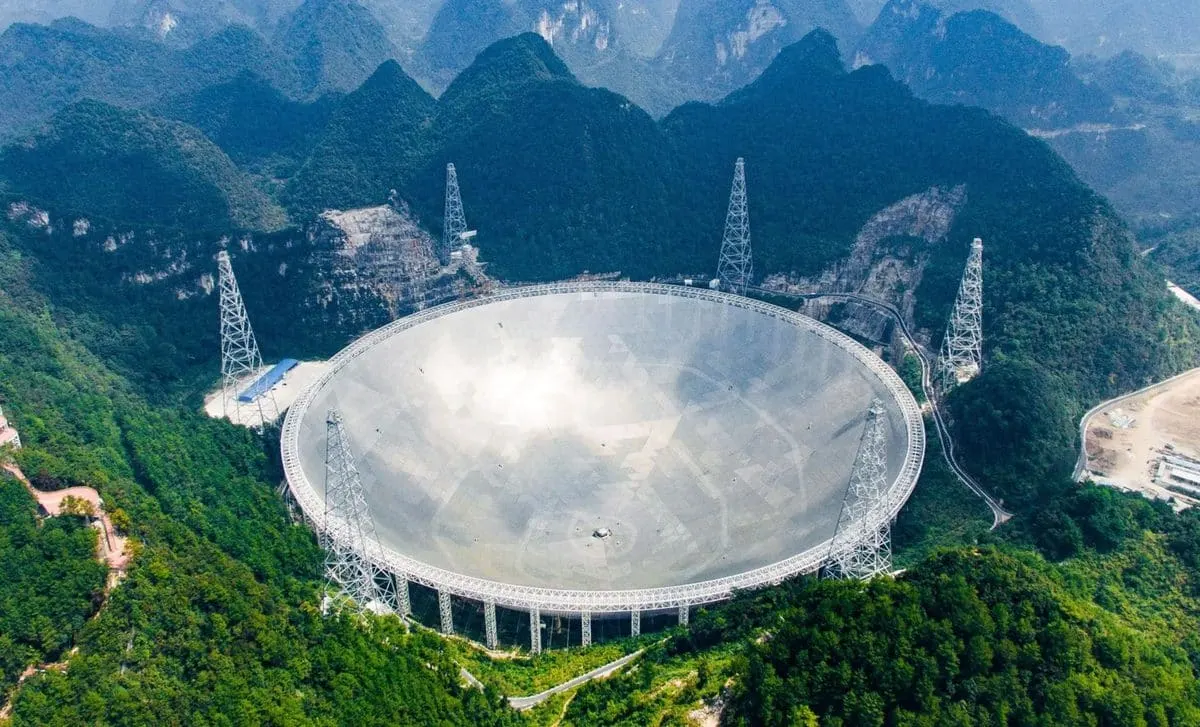
A preprint on arxiv.org reports J1351+0039, a new isolated dark galaxy candidate. It was found in a blind neutral hydrogen (H I) survey with the Five-hundred-meter Aperture Spherical radio Telescope (FAST) and checked against deep optical imaging from the DESI Legacy Survey arxiv.org
arxiv.orgarxiv.orgOpen source ↗. The cloud has a systemic velocity of 429.0 ± 1.4 km/s and an H I mass of (4.8 ± 0.5)×10⁵ solar masses. The preprint is dated 24 September 2026 and is led by Jin-Long Xu of the National Astronomical Observatories of China.
No stars, high dynamical mass
No optical counterpart is detected in the DESI images. The g-band surface brightness limit is 28.1 mag arcsec⁻², which corresponds to a stellar mass limit of about 1.5×10⁵ solar masses. The dynamical mass is estimated at about 1.3×10⁸ solar masses. This gives a dark-to-baryonic mass ratio of about 200, which the authors interpret as an object overwhelmingly dominated by dark matter.
Rotation is weak, and the kinematics are dominated by internal velocity dispersion. The authors read this as pressure support. The reported rotational velocity is 4.2 km/s against random gas motions of about 11.6 km/s. The cloud is roughly round, and its gas temperature is about 10,000 K, consistent with equilibrium with the ultraviolet background.
The environment is also empty. No large galaxies lie within a projected 1.5 degrees, less than 100 kiloparsecs at the object's distance, with a velocity difference below 250 km/s. No gaseous bridges, comet-like tails or nearby companions were found that would suggest the gas was pulled from another galaxy.
Observations and context
An earlier FASHI survey detection of the cloud had a sensitivity of 1.6 mJy/beam at a velocity resolution of 3.2 km/s. To improve on this, FAST observed it three times in July–August 2026 arxiv.org
arxiv.orgarxiv.orgOpen source ↗. The observations used the multi-beam on-the-fly mode with 19 beams, a scan rate of 15″/s and 1 s per spectrum. The backend had a 500 MHz bandwidth and 64k channels, giving a frequency resolution of 7.629 kHz. The quasar 3C 286 was used for flux calibration, and the data were processed with the HIFAST pipeline.
In the ΛCDM picture, low-mass dark matter halos can keep their primordial gas without forming stars. The cause is inefficient cooling before reionization or photoheating by the ultraviolet background afterwards. Such objects are called Reionization-Limited H I Clouds (RELHICs). Earlier candidates include Cloud-9 near M94 and two near M51. Isolated candidates can be ruled out as tidal debris, and their isolation reduces uncertainty in dark matter estimates. The authors call J1351+0039 one of the most promising isolated RELHIC candidates.