Adelaide University speckle spectrometer with integrating sphere reaches 6 fm resolution at 780 nm
A prototype speckle spectrometer built around an integrating sphere resolves 6 fm at 780 nm, about 80 times finer than earlier speckle devices, and measured rubidium hyperfine structure.
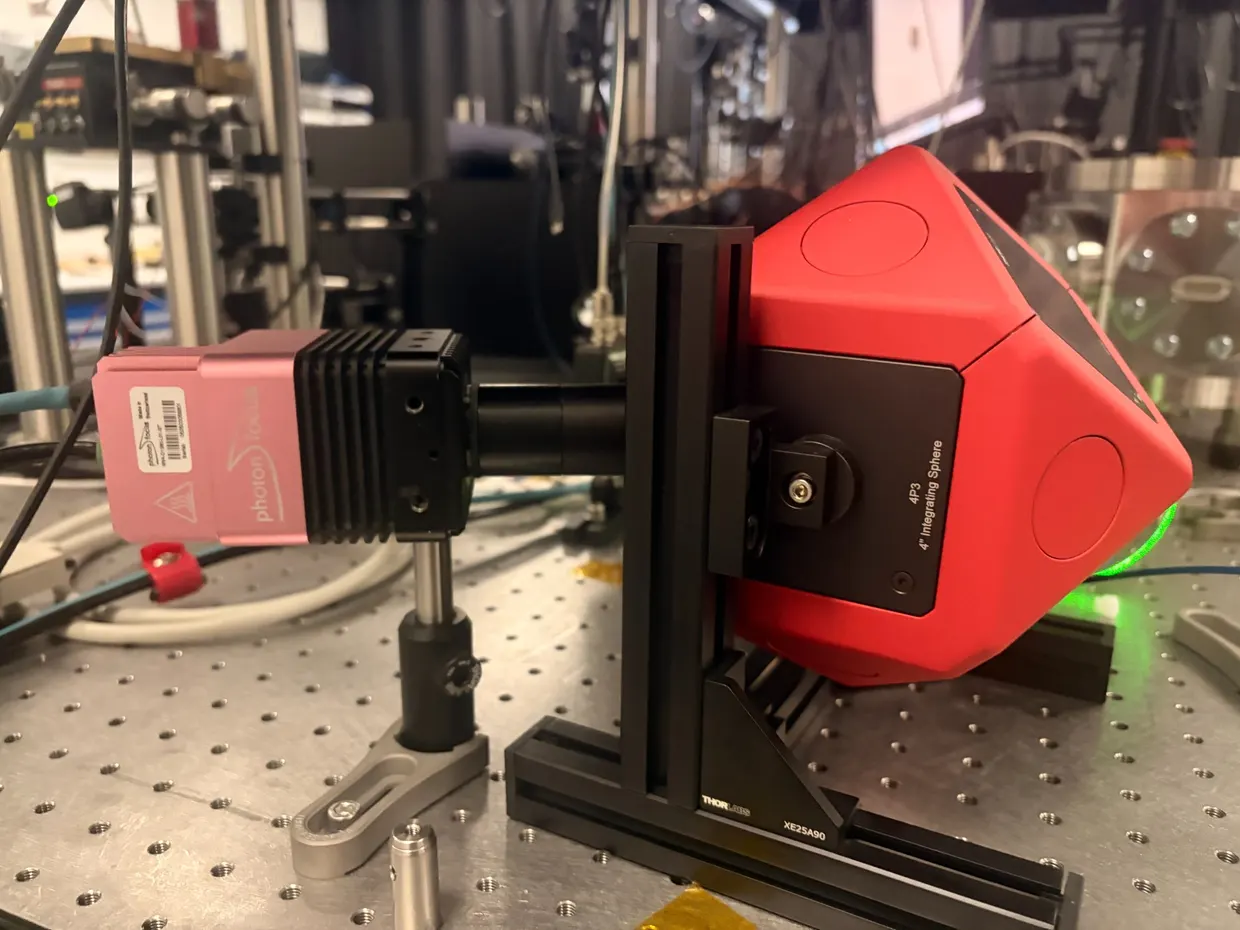
A research team led by Adelaide University has built a speckle-based spectrometer with a resolution of 6 femtometres at a wavelength of 780 nm, according to a paper in Nature Communications nature.com
Nature Communicationsnature.comOpen source ↗. The corresponding resolving power is 1.3 × 10^8, roughly 80 times better than previous implementations of this type of device. The authors describe the instrument as shoebox-sized. The international team also included researchers from the University of St Andrews, UK.
Integrating sphere as a scattering cavity
Laser speckle is the granular intensity pattern produced by random optical interference. It encodes spectral information, and speckle spectrometers are valued for their compact size, mechanical robustness and insensitivity to alignment. Until now, however, their resolution had stayed at the picometre scale.
The authors used an integrating sphere, a highly reflective hollow cavity in which light bounces many times before exiting, as a multiply scattering cavity. It gives access to a wide range of path lengths, which raises spectral sensitivity. Speckle has often been treated as a nuisance, the researchers note, but the pattern carries information about the light that produced it.
Sidebands and rubidium hyperfine structure
In the first test, the device clearly distinguished laser sidebands generated by an electro-optical modulator. The sideband powers extracted from the speckle agreed with the expected values to within 1% nature.com
Nature Communicationsnature.comOpen source ↗.
In the second test, the team made a direct speckle-based measurement of the hyperfine structure of the D2 transition in 85Rb. The resulting transmission spectra differed by no more than 3.7% from independent measurements referenced to a wavemeter. According to the team, this is the first direct measurement of atomic hyperfine structure with a speckle-based spectrometer.
The authors state that the results establish speckle as a platform for ultra-high-precision spectroscopy, radio-frequency spectrometry and microwave photonics. Rubidium is used in atomic clocks, quantum processors and quantum sensors. As a next step, the researchers plan to combine speckle spectroscopy with optical frequency combs. They say this could help in studying complex gases and telling apart chemicals that look similar. The results so far come from a laboratory demonstration.