KNM-ER 64061: most complete Homo habilis skeleton, about 2 million years old, described from Kenya
The partial skeleton from Koobi Fora has both arms, a clavicle and pelvic fragments. According to the authors, H. habilis was smaller and more primitive in proportions than H. erectus.
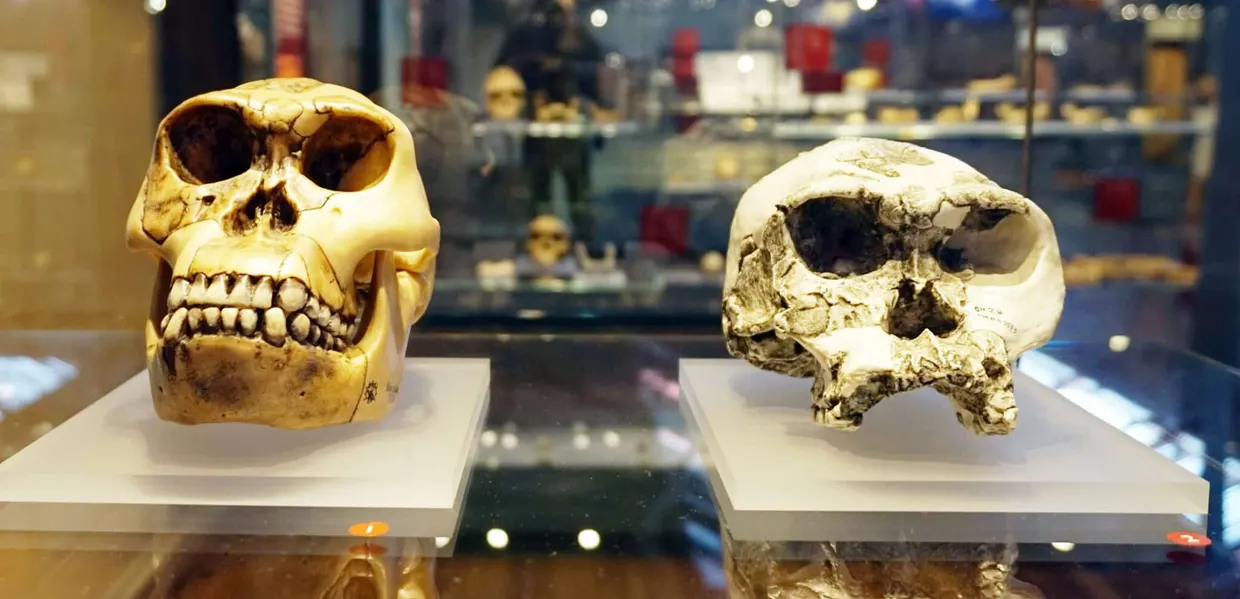
A team including Frederick Grine, Ashley Hammond and Meave Leakey described a partial skeleton, KNM-ER 64061, in The Anatomical Record in 2026. It comes from the upper Burgi Member of the Koobi Fora Formation and is dated to 2.02–2.06 million years ago. According to the publication, it was excavated at Ileret in northern Kenya in 2012. The skeleton is associated taphonomically and geochemically with a nearly complete mandibular dentition, KNM-ER 64060, attributed to Homo habilis. The authors call it the most complete H. habilis skeleton recovered so far wiley.com
The Anatomical Recordwiley.comOpen source ↗.
The skeleton comprises the clavicle, scapular fragments, both humeri, both ulnae, both radii, and a fragmentary sacrum and os coxae. No lower limb bones were preserved.
Upper limb anatomy
The upper limb elements are similar to those of other early Homo specimens. The humerus is slender, with a weakly projecting lateral epicondyle, a relatively wide capitulum and a narrow trochlea. The ulna has a relatively large radial notch.
All upper limb bones have strikingly thick cortices, resembling the condition in australopiths and other early Homo fossils. Brachial index estimates support earlier conclusions that H. habilis had a relatively long forearm compared with Homo erectus wiley.com
The Anatomical Recordwiley.comOpen source ↗.
Stature, mass and open questions
The stature estimate, based on humeral length, is 160 cm. This is intermediate between values for H. habilis (OH 62, KNM-ER 3735) and H. erectus (KNM-ER 1808, KNM-WT 15000). The body mass estimate is 30.7–32.7 kg, slightly lower than for other H. habilis specimens and noticeably lower than for H. erectus. The authors conclude that H. habilis retained more primitive proportions and was smaller in stature and mass than H. erectus.
The lower limb remains the main gap. Limited features of the ischium suggest lower limb mechanics more similar to Homo than to australopiths, but this rests on a small fragment.
Ian Tattersall of the American Museum of Natural History published a critical commentary in the same journal. He argues that the Olduvai and Ileret fossils fail at least two of the three criteria used to place a species in Homo, and that the ischium fragment is too small to support a firm conclusion.