Yellow River Basin archives, 1470–1900, show climate extremes were judged by recent experience
Comparison of historical records with tree-ring reconstructions found systematic mismatches; a model suggests generational amnesia alone can explain them.
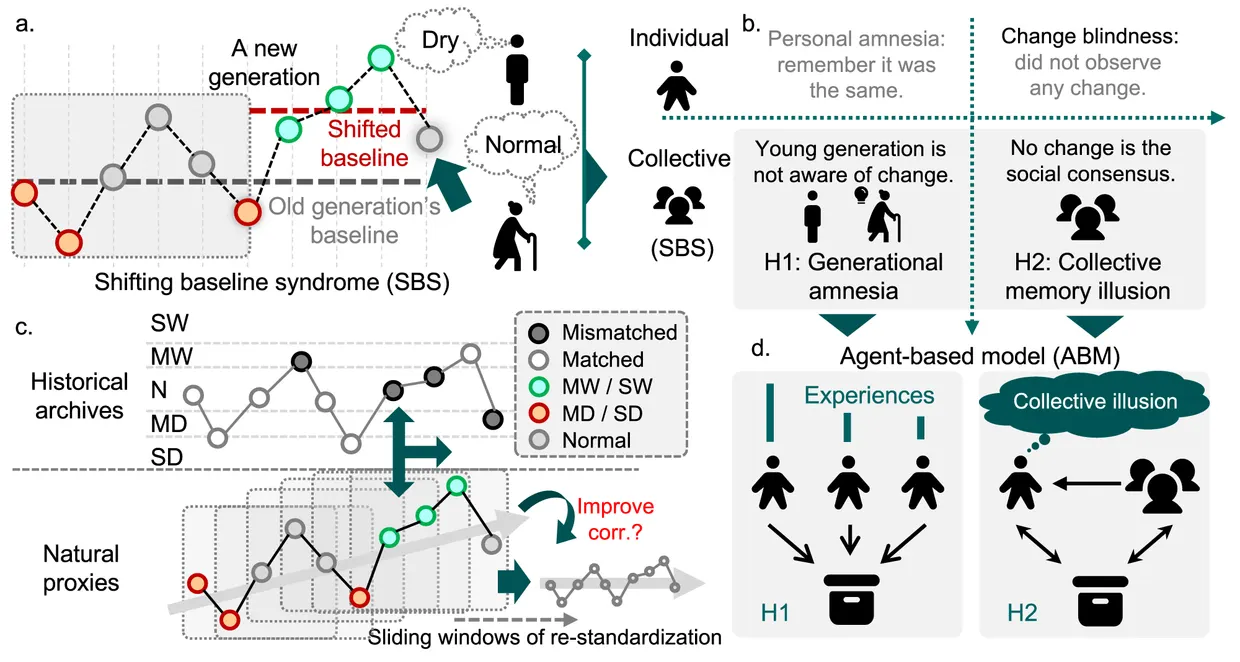
Researchers compared four centuries (1470–1900) of climatic archives from northern China with tree-ring-based hydroclimate reconstructions, according to a study in Nature Communications. The tree-ring reconstructions were validated against instrumental observations of the Wet/Dry Index (WDI) for 1901–2000. The authors found systematic, non-random mismatches between the two kinds of record. Severity assessments in historical documents were often biased toward recent experience rather than absolute climatic anomalies nature.com
Nature Communicationsnature.comOpen source ↗.
Archives and tree-ring data
The case study covers the Yellow River Basin in North China. The authors chose it for two reasons: it has an abundance of archival records, and its climate is dominated by the Asian monsoon, with distinct seasons and clearly defined dry and wet summer extremes closely linked to the river's hydrology.
The WDI compiled from historical archives for 1470–1900 (H-WDI) was compared with a WDI from tree-ring analyses (N-WDI), which has a similar annual, sometimes intra-annual, resolution. Both series were classified by z-score into five levels: Severe Wet, Moderate Wet, Normal, Moderate Dry and Severe Dry. The mismatches between them were then quantified.
The work tests Shifting Baseline Syndrome, also called Environmental Generations Amnesia. Two sources of bias were considered: generational amnesia, where younger generations lack knowledge of past conditions, and collective memory illusion, where shared narratives distort how the past is remembered nature.com
Nature Communicationsnature.comOpen source ↗.
Generational offset
The correlation between historical and natural records increased when the natural series was re-standardised using 20–40-year sliding windows, that is, against a moving baseline. The authors interpret this as a generational offset.
A heuristic agent-based model compared agents that judge climate against their own experience with agents that judge it against a shared archive. The model reproduced the observed pattern. According to the authors, generational amnesia is sufficient to explain the offsets in the perception of environmental change.
The authors argue that historical archives carry a generational imprint of perceptual bias. In this view, the severity of climate extremes is judged against recent lived experience rather than long-term climate variability. They state that this has implications for bias-aware corrections in risk assessment, adaptation and paleoclimate reconstruction nature.com
Nature Communicationsnature.comOpen source ↗.