Regensburg and MIT researchers cut a superconducting qubit's gate errors up to 77% with FPGA feedback
A 1-bit feedback protocol on an FPGA controller compensated TLS-induced frequency jumps of a superconducting qubit, lowering average single-gate error from 0.14% to 0.065%.
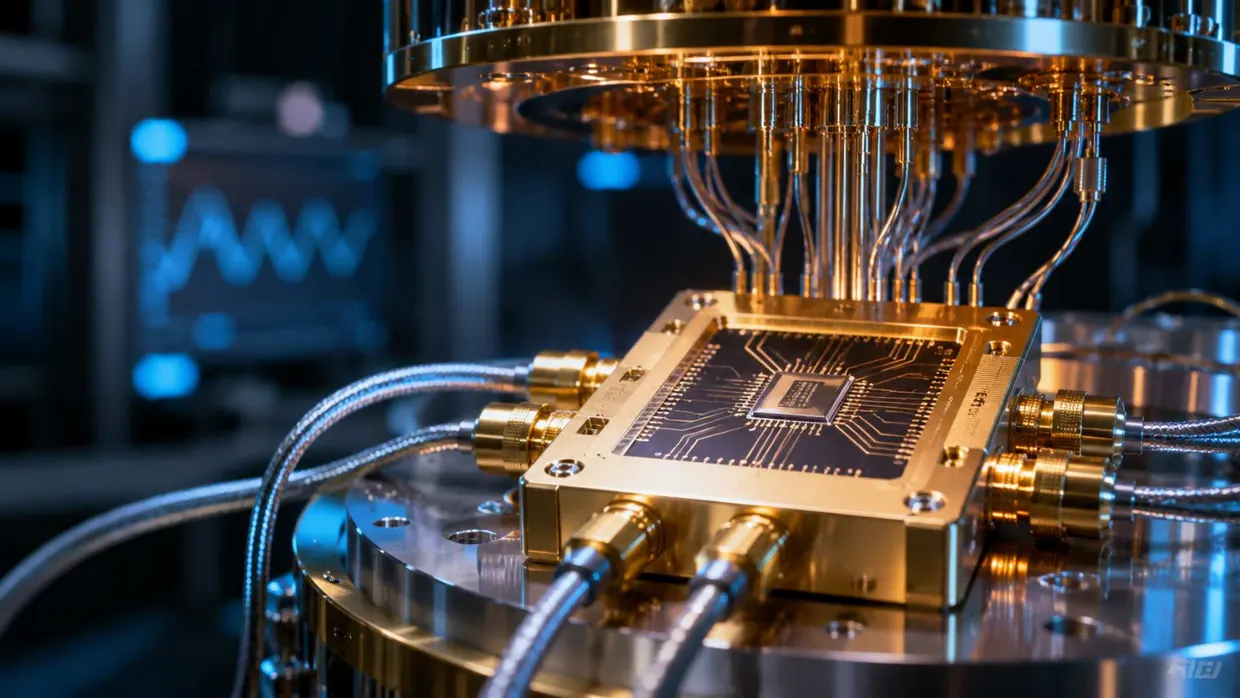
Researchers from the University of Regensburg, MIT and several other institutions demonstrated an adaptive protocol that stabilizes a superconducting qubit whose frequency jumps between two values. The work is published in Applied Physics Reviews aip.org
Applied Physics Reviewsaip.orgOpen source ↗. The experiment used a qubit at a quantum computing center in Israel and a classical controller built on a field-programmable gate array (FPGA). The average error of single-qubit gates fell from about 0.14% to 0.065%, a reduction of 54%.
Bistable qubit and TLS defects
Parasitic two-level-system (TLS) defects limit the stability and performance of solid-state quantum processors. Interaction with such a defect can cause discrete, stochastic shifts of the qubit frequency, making the qubit bistable. In this device the qubit switched between two frequencies that differ by about 374 kHz, at an operating frequency of about 5.10 GHz. The difference is 0.0073% of that value. The authors suspect that interaction with a single material defect was responsible.
Superconducting qubits need precise microwave pulses. After an unannounced frequency jump, a previously tuned pulse can cause an incorrect operation or a phase error, so a one-time calibration is not always enough.
The 1-bit feedback protocol
The authors call the method "1-bit feedback". Before the main sequence of operations, the system prepares the qubit in a suitable state, lets it evolve for a short time and performs a single-shot measurement. The result shows which of the two known frequencies is currently active, and the FPGA controller corrects the control frame accordingly aip.org
Applied Physics Reviewsaip.orgOpen source ↗. No manual calibration is needed before each operation. Because the diagnostic precedes the computational sequence, the quantum state processed by the program is not read out.
According to the authors, the protocol reaches the information limit set by the qubit's intrinsic entropy. They validated it by suppressing TLS-induced Ramsey beating and used it to stabilize gate fidelities over time, with an estimation bandwidth of approximately 136 kHz and a 77% error reduction. The 77% figure is relative to the largest errors seen without automatic correction.
Limits of the result
The numbers come from one experiment on a single qubit, not from a whole quantum computer. The method requires prior knowledge of both possible frequencies, and the qubit must stay in a given state long enough for the controller to react. It is not equivalent to full quantum error correction. The authors write that the approach may enable operation of large future qubit arrays that suffer from few remaining, discrete instabilities.