Covadonga, Spain: 331-million-year-old Carcharopsis shark tooth, 43 mm tall, described by Oviedo-led team
The tooth belongs to a Carcharopsis shark estimated at 5–6 m long. Per a Journal of Palaeogeography study, it is the genus's first record in northern Gondwana.
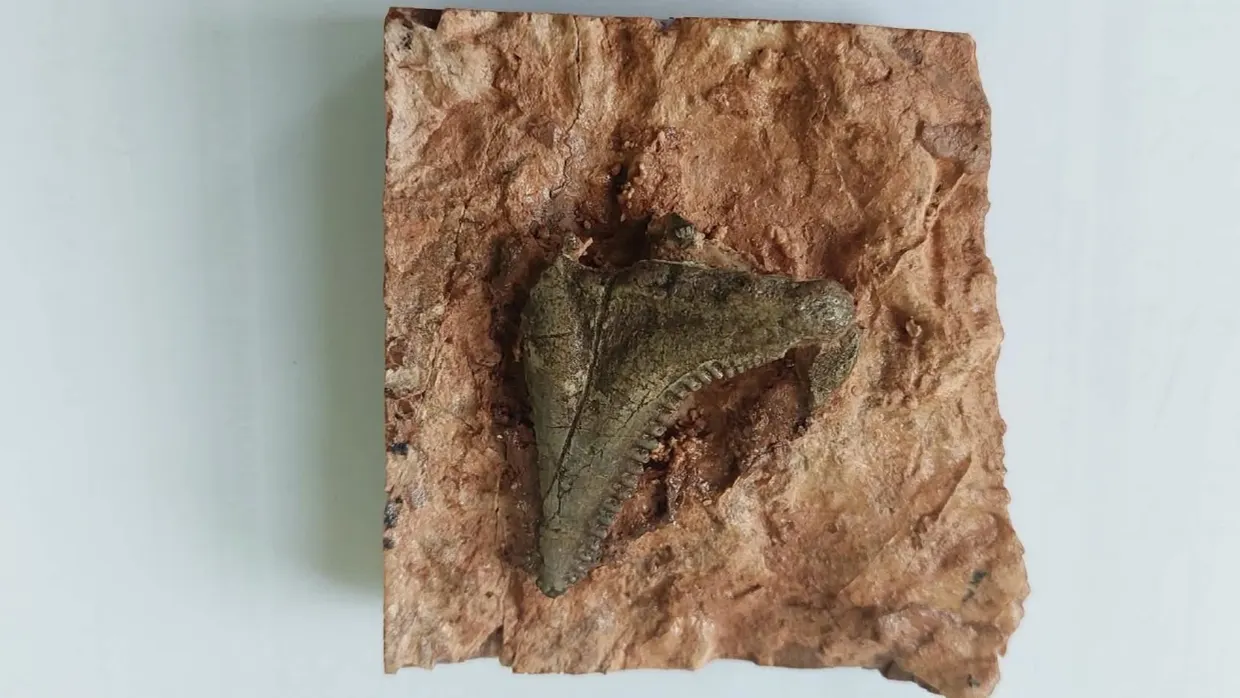
Paleontologists from the universities of Oviedo, Valencia and UNED have studied a fossil tooth of a shark that lived about 331 million years ago, found near the Sanctuary of Covadonga in Asturias, Spain, according to larazon.es larazon.es
larazon.eslarazon.esOpen source ↗. The tooth is 43 mm high, the largest size recorded worldwide for the genus Carcharopsis. The length of the animal is estimated at five to six metres. The study is published in the Journal of Palaeogeography, and the University of Oviedo reported it in a press release.
The find and the microtomography
The fossil was found by geologists of the NGO Geólogos del Mundo in a slab of griotte limestone, popularly known as Roja Covadonga, next to the Basilica and the Sanctuary. The tooth belongs to Carcharopsis sp., an extinct shark whose complete remains are extremely rare in the fossil record, which has made it hard to study.
The piece was fragmented, so the researchers reconstructed it and analysed it with computed microtomography. This non-destructive technique made it possible to view the internal structure in three dimensions and to reconstruct in detail the network of vascular canals at the base of the tooth.
The analysis showed a wide cusp, curved lengthwise, with doubly serrated edges. The small enamel microserrations resemble those of the modern tiger shark, which cut flesh and shells efficiently, and point to a hypercarnivorous diet larazon.es
larazon.eslarazon.esOpen source ↗. To estimate body size, the team applied mathematical body-proportion models based on living sharks, the great white and the tiger shark.
Position in the Carboniferous
The fossil dates to the Mississippian subperiod of the Carboniferous, a time of marine biodiversity recovery after the crisis at the end of the Devonian. Until now, Carcharopsis fossils had been found almost exclusively in the south of the ancient continent of Laurussia, in areas that are now part of North America and Europe.
The Asturian specimen is the first record of the genus in northern Gondwana. According to the authors, it extends the known distribution of Carcharopsis and points to the ability of these sharks to connect coastal and open-sea ecosystems. They add that the presence of such predators provides information on how food chains were rebuilt after the Devonian crisis.
The study is signed by Silvia Blanco Ferrera and Javier Sanz López of the University of Oviedo, María Ciudad Real of UNED and Héctor Botella of the University of Valencia larazon.es
larazon.eslarazon.esOpen source ↗.