Chandra links 113-day outbursts of giant star AT 2016blu to a compact companion
X-ray data suggest the giant star in galaxy NGC 4559, which mimics a supernova about every 113 days, feeds a black hole or neutron star on an elongated orbit.
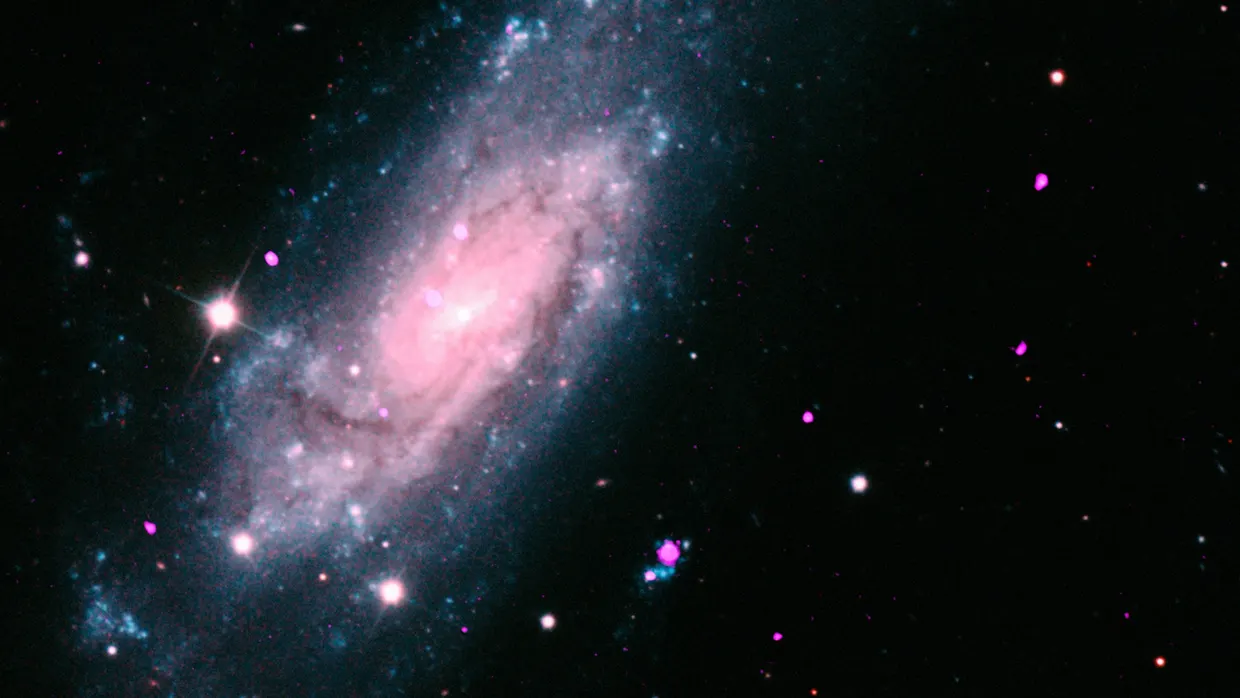
A team led by Mojgan Aghakhanloo of the University of Virginia reports that the giant star AT 2016blu in the spiral galaxy NGC 4559, about 29 million light-years away, flares like a supernova roughly every 113 days. According to martincid.com, it has done so at least 27 times and survived each one martincid.com
martincid.commartincid.comOpen source ↗. NASA's Chandra observatory observed it from March 24 to 27, 2026, and the results were published on November 9 in The Astrophysical Journal.
Hubble images taken while the star was quiet put its mass at no less than 33 times that of the Sun and its brightness at least half a million times higher. It belongs to the same unstable family as Eta Carinae. At the peak of an outburst it shines in red light like roughly ten million Suns, far fainter than a true supernova but bright enough to appear in supernova surveys.
How the X-rays were caught
Chandra had to look during an outburst, so the team needed to know when one was coming. Telescopes at Lick Observatory and the Las Cumbres Observatory network checked the star almost nightly, and an alert from the American Association of Variable Star Observers brought in more than thirty observers. When the star brightened by more than a full magnitude, Chandra observed it five times over four days, about 100,000 seconds in total, and detected it every time.
Only Chandra could separate the source: the much brighter NGC 4559 X7 lies about ten arcseconds away, and XMM-Newton blurs the two into one spot. An earlier Chandra image of the field, taken more than two decades before while the star was calm, showed nothing at its position. The new detection is at least 100 times brighter than that limit. The odds of a background quasar falling inside the search circle are about six in 100,000 martincid.com
martincid.commartincid.comOpen source ↗.
Why accretion fits
The authors weighed four ways to make X-rays. Shocks in a single star's wind give emission more than ten million times fainter than measured. Colliding winds of two massive stars fall short by a factor of about 10,000. Colliding gas shells would produce soft X-rays, while Chandra recorded a hard spectrum.
That leaves gas falling onto a compact object. The X-ray output equals the Eddington limit for about 3.5 solar masses, above the ceiling for a neutron star. It falls just short of the cutoff for an ultraluminous X-ray source, so the team calls the star a candidate member of that class. The visible outbursts carry about 100 times more energy than the X-rays, which suggests surrounding gas absorbs the X-rays and re-emits them as visible light.
The nature of the partner remains open. Chandra collected too few photons to search for neutron-star pulses, and the star's hydrogen-line speeds do not track the orbit, so no mass can be derived. The feeding rate leans toward a black hole without proving it martincid.com
martincid.commartincid.comOpen source ↗.