Hobbyist estimates walking speed of 1.3 m/s from a local TV station signal using a simple radio receiver
In a home experiment, a simple receiver picked up a person's movement as fading stripes on a TV signal spectrogram. According to the author, WiFi and LTE work the same way.
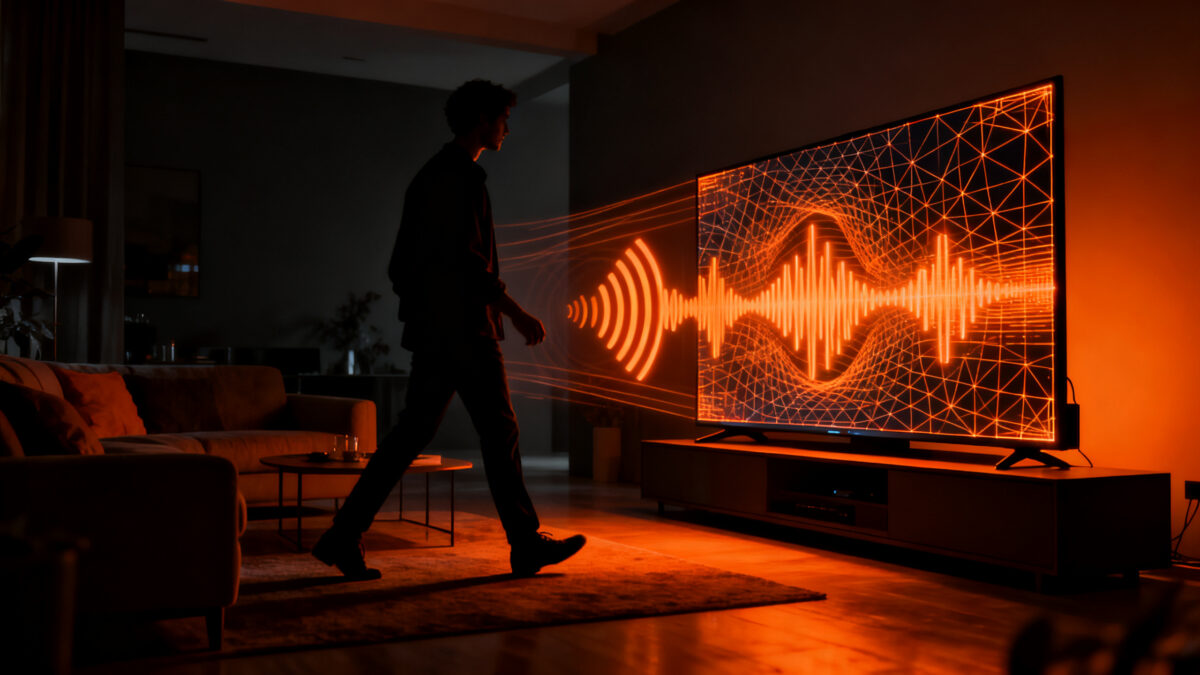
The author of the blog maurycyz.com recorded the signal of a local TV station with a simple radio receiver and showed that a person's movement can be seen in it and used to estimate walking speed maurycyz.com
maurycyz.commaurycyz.comOpen source ↗. The signal was displayed as a spectrogram (a waterfall) with an update rate of 150 Hz. This is a home demonstration, not a finished device.
Selective fading as a motion sensor
Walking between the receiver and the TV station caused only a slight disturbance of the signal. After the author moved the antenna by a few centimeters, the picture changed: selective fading appeared, in which the direct signal is cancelled by a strong reflection. The phase of the reflection depends on frequency, so the effect is not uniform across the whole signal.
In this state the signal is extremely sensitive to any nearby movement. The author recorded the change when he got up from his chair, and then while walking around in a neighboring room. In both captures the spectrogram showed stripes with gaps between them.
Speed from the stripe spacing
The gaps appear when the reflection from the body perfectly cancels the residual signal. This happens each time the path length changes by one wavelength maurycyz.com
maurycyz.commaurycyz.comOpen source ↗. The distance between stripes was about 70 pixels, and the waterfall updated at 150 Hz. That gives an interval of about 0.47 s between gaps, or 2.1 Hz. Multiplying by the speed of light divided by the 490 MHz carrier frequency gives 1.3 m/s.
The author was walking perpendicular to the direct signal path, so the speed can be used as is, without a correction for geometry.
According to the author, a simple receiver can therefore detect motion and give an estimate of its speed. The method is not limited to TV: any wideband radio signal, including WiFi and LTE, can be used in much the same way. Such signals make worse demonstrations because their waterfall is messy, but the same data can be extracted from them with some additional work.