Rocks on Japan's Boso Peninsula show fault clay can turn fluid-like during large earthquakes
A team led by Tetsuro Hirono of Osaka Metropolitan University found traces of fault clay fluidization in 15-million-year-old rock, which may explain very large seafloor slip.

Researchers led by Professor Tetsuro Hirono of Osaka Metropolitan University have found structures in an ancient fault on Japan's Boso Peninsula indicating that solid clay can behave like a liquid during strong earthquakes, according to pravda.ru pravda.ru
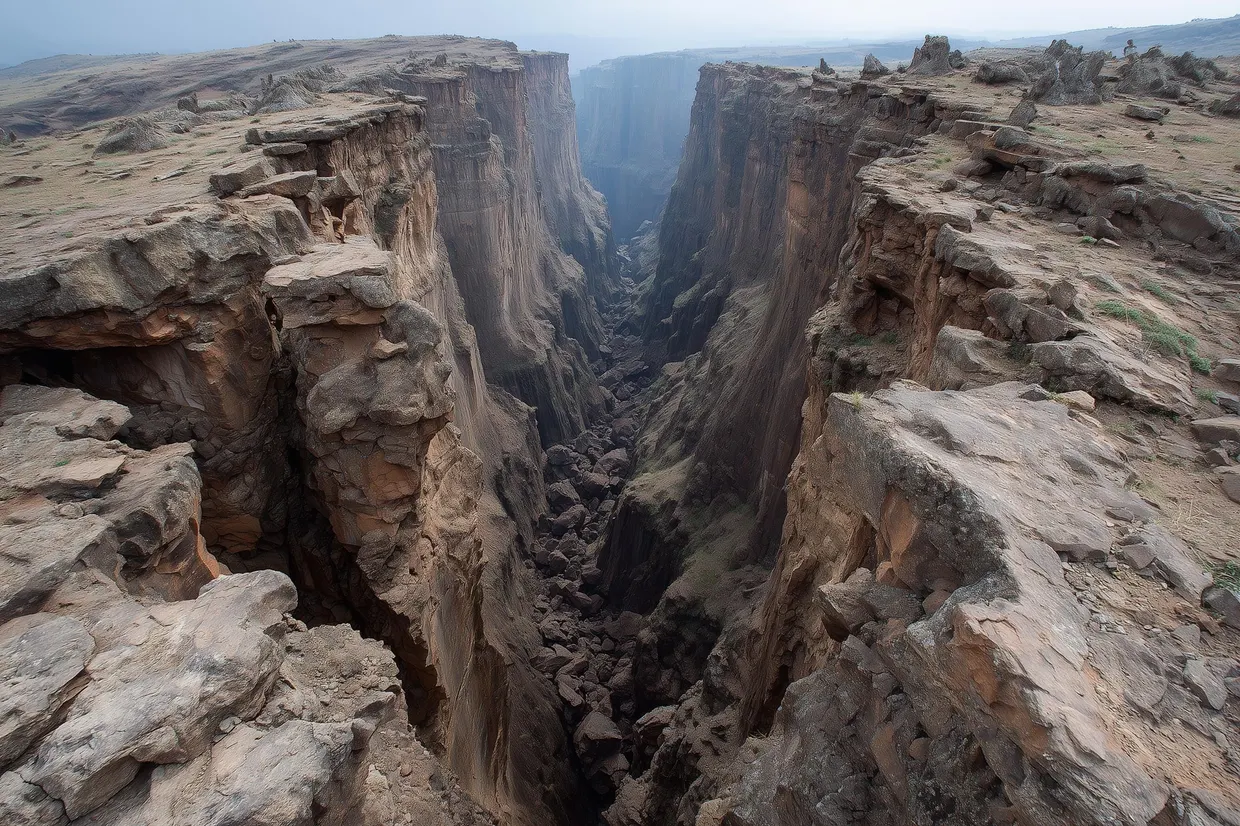
pravda.rupravda.ruOpen source ↗. The rocks contain wavy layers and swirl-like forms resembling those that appear when water or another liquid flows. The rocks are about 15 million years old, and the area was then part of the ocean floor.
How fault clay becomes fluid
According to the researchers, these forms result from thermal pressurization. When two plates of the Earth's crust slide at high speed, intense frictional heat is generated. Water trapped in microscopic pores of the clay between the plates heats rapidly, and the pressure rises enough to push the surfaces apart.
At that point the viscosity of the clay drops sharply and it becomes almost as fluid as water. This liquid acts as a lubricant: frictional resistance disappears, and the fault can slip over distances that would be impossible with ordinary rock-on-rock contact. It had previously been assumed that friction between rock plates limits the distance of slip.
Link to seafloor displacement and tsunamis
The scale of slip affects what happens in the ocean. If a fault on the seabed shifts by tens of meters, it displaces huge masses of water, and such movements of the seafloor cause destructive tsunamis pravda.ru
pravda.rupravda.ruOpen source ↗. In 2011, an earthquake of magnitude 9.1 led to a catastrophic tsunami off the coast of Japan.
The ancient rocks of the Boso Peninsula are not direct proof that this mechanism operated in 2011. As the material notes, they provide the first physical confirmation that such a transformation of material within a fault is possible at all.
The next task is to apply this method of analysis to modern active faults. According to the report, if zones where the material is prone to fluidization can be identified, it would be easier to forecast the maximum amplitude of plate slip and to assess tsunami risk.