Perseverance's PIXL spectrometer finds 100–200 nm dust particles on Mars spacesuit samples
Authors used rover X-ray fluorescence data to examine fine and ultrafine Martian dust directly; respirable particles of this size matter for the health of future crews.
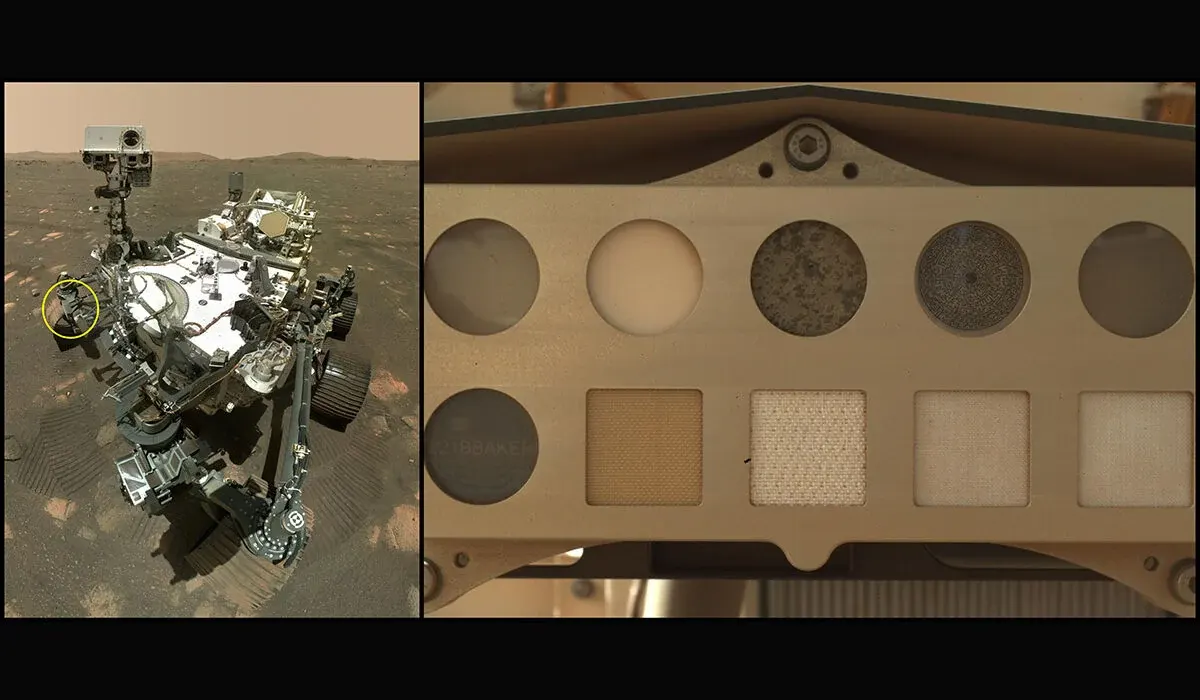
A team led by Washington University in St. Louis, together with colleagues from the U.S., Canada, Australia and Europe, reported a direct examination of fine and ultrafine Martian dust. The work, published in Proceedings of the National Academy of Sciences, is based on data from NASA's Perseverance rover pnas.org
Proceedings of the National Academy of Sciencespnas.orgOpen source ↗. The data were acquired by the PIXL X-ray fluorescence instrument, which examined spacesuit material samples and calibration targets on the rover. The authors observed particles as small as 100 to 200 nm.
Why fine dust matters
Surface dust was a source of operational hazards in the Apollo lunar missions. On Mars, regional and global dust cycles additionally coat sensitive hardware. Earlier missions constrained the bulk geochemistry of coarser particles, about 3 µm and larger. The fine fraction (up to 2.5 µm) and the ultrafine fraction (up to 0.1 µm) remained largely uncharacterized.
The authors single out these fractions because they are respirable. Particles of this size can bypass the upper respiratory defenses and penetrate into the alveolar regions. According to the authors, this presents a systemic toxicity risk to future crews.
Composition and deposits on suit materials
The analysis and modeling of the PIXL data showed that the dust is a mafic silicate enriched in phosphorus, iron and sulfur pnas.org
Proceedings of the National Academy of Sciencespnas.orgOpen source ↗. It accumulates on materials analogous to the planned external layers of potential crew systems. Particle sizes were estimated with a method developed by Scott VanBommel, who led the study.
According to the university, the swatches showed little visible wear after 1,645 Martian days (sols) of exposure. The researchers attribute this to the particles being much smoother than the jagged lunar grains. The team also notes that the electrostatic properties of Martian dust probably make it adhere preferentially to some surfaces.
The authors emphasize the importance of a thorough characterization of Martian dust properties in terrestrial laboratories. In their view, this is needed to better prepare future crews and crew support systems destined for the surface of Mars.