University of Tokyo finds hidden earthquake layers in a Kumano Sea sediment core by radiocarbon dating
Radiocarbon dating at 1 cm resolution revealed event layers in a 40 cm core that X-ray and CT missed; some match recorded earthquakes of the 13th–20th centuries.
A team from the University of Tokyo's Atmosphere and Ocean Research Institute applied a new ultrasensitive radiocarbon method to a sediment core from the Kumano Sea off the coast of Japan, according to aori.u-tokyo.ac.jp. The paper was published in the journal Radiocarbon on 9 November 2026. The authors report several geological layers that were not visible before, derived from submarine landslides possibly triggered by earthquakes in the Nankai Trough aori.u-tokyo.ac.jp
aori.u-tokyo.ac.jpaori.u-tokyo.ac.jpOpen source ↗.
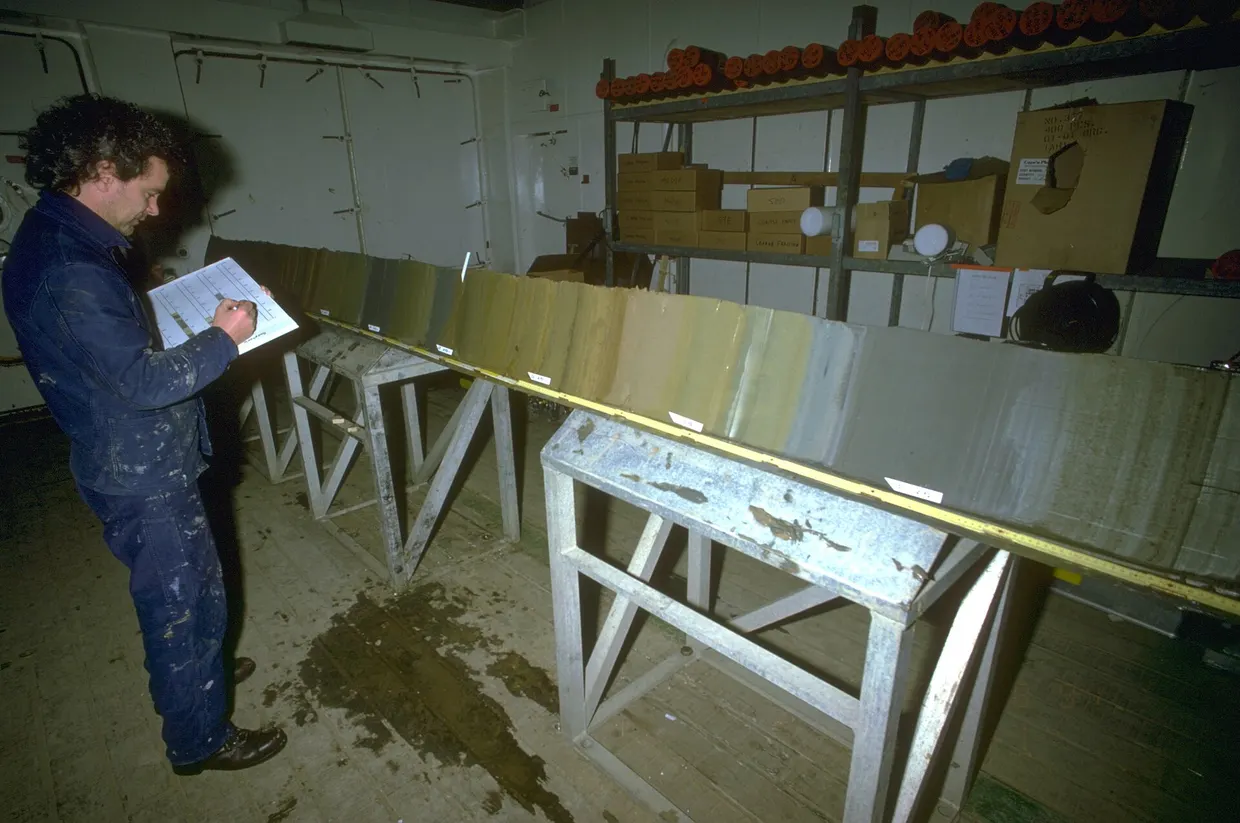
The core was previously described as homogeneous hemipelagic mud, and X-ray and CT images show no major differences between its layers. The method measures trace amounts of carbon-14 in seafloor sediment at a resolution of 1 centimeter or less, which is how the layers were found.
Core and measurement method
Carbon-14 makes up about one-trillionth of natural carbon. It decays at a known rate and is absorbed by living organisms, so samples containing remains of plants, animals or their derivatives can be dated. Depending on the amount of decay, the dating range extends back 50,000 to 60,000 years.
The core is a 40-centimeter cylinder of fine-grained clayey silt taken from the Kumano Trough, off the southeast coast of central Japan. The team measured radiocarbon in total organic carbon at intervals of 0.5 to 1.0 centimeter along its length. The oldest part, at a depth of 37–38 cm, dates to approximately 1440 C.E. aori.u-tokyo.ac.jp
aori.u-tokyo.ac.jpaori.u-tokyo.ac.jpOpen source ↗
How hidden event layers were identified
An event was marked wherever older organic carbon appeared between layers of younger sediment. The team interpreted this as seafloor sediment that was disturbed, shifted and redeposited by severe floods, storms or submarine earthquakes.
According to Professor Yusuke Yokoyama, the redeposited material is the same as the sediment below it, so its chemical and structural features are indistinguishable and the event layers are invisible. The team compared total organic carbon ages along the core and converted them to calendar years using ages obtained from foraminifera, microscopic marine organisms with shells. This showed multiple events, and some of them were correlated with written historical records of submarine earthquakes from the 13th to the 20th century.
The authors note that the technique may be useful in other regions with a history of geological activity. Yokoyama plans to study sediment more widely across the Kumano Sea and beyond. The paper is by Akiko Omura, Yusuke Yokoyama, Shoko Hirabayashi, Yosuke Miyairi and Juichiro Ashi (doi: 10.1017/RDC.2026.10255).