James Webb telescope maps dark matter in 3D across 0.54 square degrees
Astrophysicists used James Webb data to construct a 3D dark matter map reaching redshift z ≈ 2 across the COSMOS-Web field.
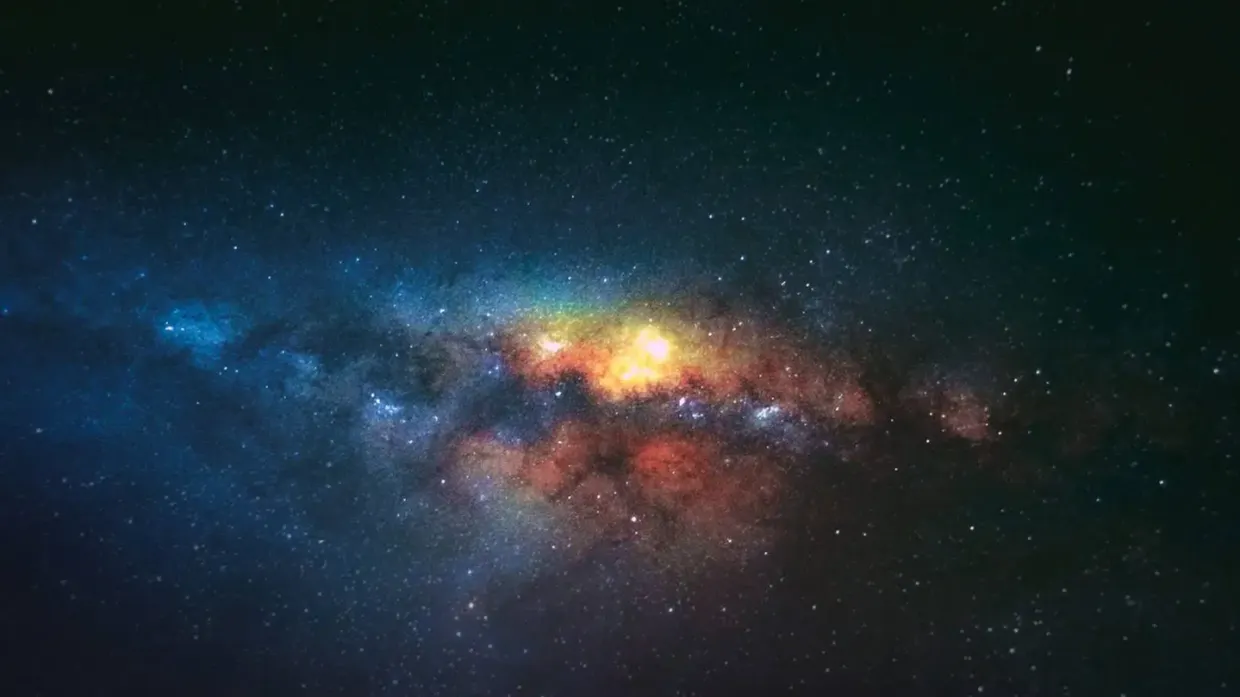
Specialists from NASA's Jet Propulsion Laboratory, the California Institute of Technology, and Duke University have created a three-dimensional map of dark matter distribution covering the COSMOS-Web survey area of 0.54 square degrees, according to Naked Science naked-science.ru
Naked Sciencenaked-science.ruOpen source ↗. The team probed the distant Universe up to a redshift of z ≈ 2, corresponding to approximately 10 billion years ago. This range doubles the observational depth of earlier equivalent maps constructed using data from the Hubble Space Telescope. The findings were released as a preprint on arXiv.org.
Algorithmic reconstruction
Standard astronomical observations typically yield flat two-dimensional projections where structures situated at varying line-of-sight distances overlap. To resolve this projection effect, the researchers paired the high-resolution observations of the James Webb Space Telescope with generative diffusion models trained on cosmological simulations. The algorithm decomposed the invisible mass distribution into 20 distinct tomographic slices, reconstructing the volumetric profile of the target cosmic volume.
Cosmic web architecture
The resulting three-dimensional model reveals the configuration of the cosmic web during the era of peak star and galaxy formation, known as cosmic noon. The technique separated structures overlapping in projection and identified massive dark matter clumps associated with distant galaxy clusters that were undetected in previous mapping efforts. According to the authors, the methodology also accounts for positional and morphological uncertainties in the reconstructed mass fields.