Chang'e-6 impact glass from the South Pole-Aitken Basin contains nanoscale γ-Fe particles
Chinese researchers found γ-Fe, a high-temperature iron phase not previously documented in lunar samples, preserved at ambient temperature as nanoparticles with a magnetic vortex state.
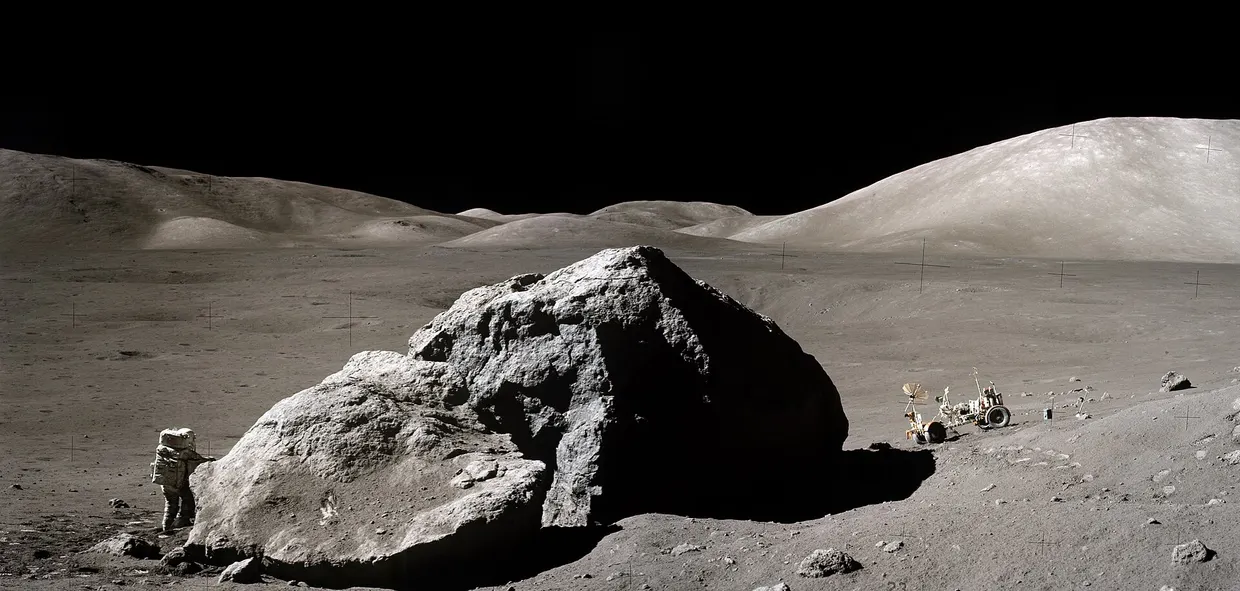
A team led by Prof. Haifeng Du of the High Magnetic Field Laboratory, Hefei Institutes of Physical Science, Chinese Academy of Sciences, has identified face-centered cubic γ-Fe in impact glass fragments from the Chang'e-6 samples. The material comes from the South Pole-Aitken Basin on the Moon. The results were published on 16 September in the journal Proceedings of the National Academy of Sciences. The iron is present as nanometer-scale particles that are stable at ambient temperature pnas.org
Proceedings of the National Academy of Sciencespnas.orgOpen source ↗.
A phase of iron not seen before in lunar samples
On the lunar surface, α-Fe and Fe-Ni alloys are widespread and are the dominant carriers of remanent magnetization. Metallic γ-Fe, by contrast, is stable only at high temperatures and had not been documented in lunar samples. Under normal conditions it transforms into α-Fe as the temperature falls.
The researchers prepared the samples by focused ion beam and examined them with transmission electron microscopy and chemical analysis. In the two glass samples studied, γ-Fe was the dominant iron phase. The authors propose that its formation and preservation at lunar surface temperature require trace γ-phase-stabilizing elements together with extremely rapid quenching during impacts. According to the team, small amounts of carbon and other elements and the surrounding glassy matrix may also have helped retain the crystal structure.
Magnetic vortex state in individual particles
To test whether the particles can hold magnetic information, the group used off-axis electron holography, a technique that maps magnetic fields at very small scales. Electron holography showed that the γ-Fe particles have a magnetic vortex domain state pnas.org
Proceedings of the National Academy of Sciencespnas.orgOpen source ↗. Relatively large particles displayed a stable single-vortex state, with magnetization arranged in a circulating pattern, and kept a stable magnetic response in an external magnetic field.
The Moon no longer has a global magnetic field, but its rocks and soils contain magnetic minerals that can record past conditions. The authors say the findings provide a basis for understanding the evolution of the lunar core dynamo and the mechanisms of impact-induced magnetic recording. Because γ-Fe and α-Fe form under different conditions and have distinct magnetic properties, they may preserve records from different stages of impact events. Dr. Long Li of the institute, a member of the team, called the particles a "tiny magnetic fossil". The researchers note that further work is needed to establish how reliably these minerals preserve ancient magnetic signals.