JWST detected heavy element outflows in three galaxies at z > 7
Spectroscopic observations reveal rapid redistribution of carbon, oxygen, and silicon into gas around early galaxies within 500 million years of the Big Bang.
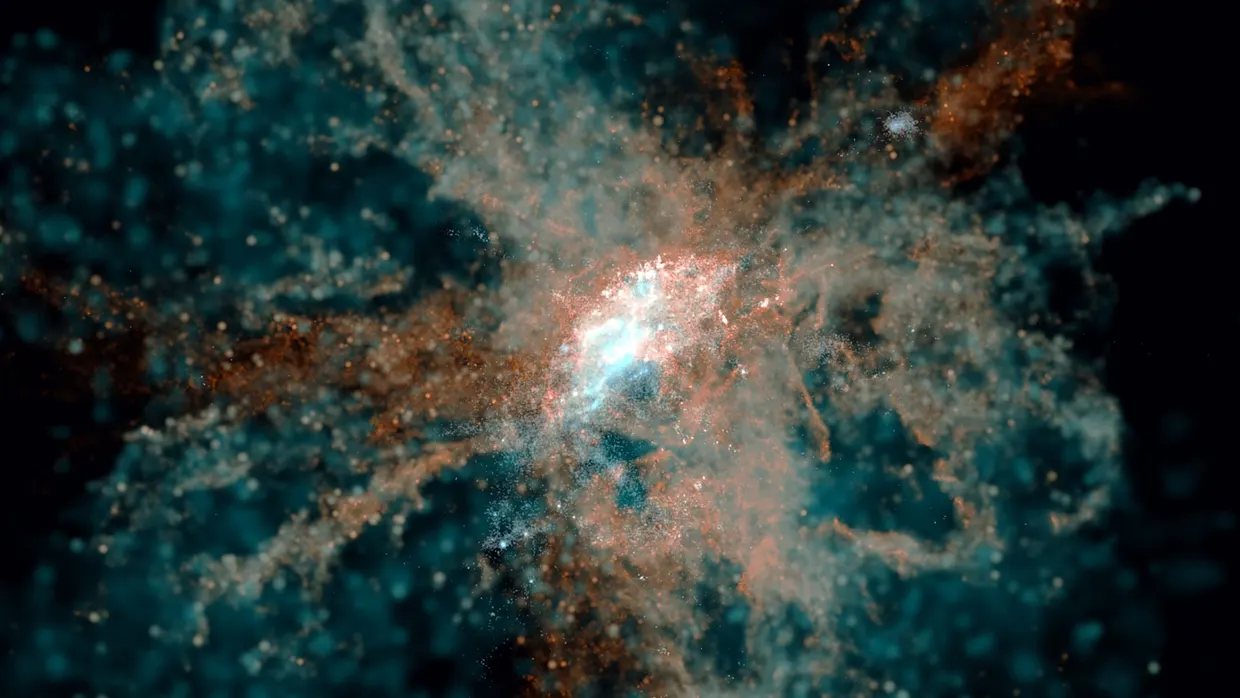
Astronomers led by Yongda Zhu from the University of Arizona reported direct spectroscopic evidence of metal-enriched gas around three early galaxies at redshifts 7.2 < z < 9.3, observing conditions roughly 500 million years after the Big Bang nature.com
Nature Astronomynature.comOpen source ↗. The data were obtained using the NIRSpec instrument on NASA's James Webb Space Telescope during roughly 29 hours of ultraviolet observations within the SPURS survey. According to the study published in Nature Astronomy, the light from these bright objects revealed that chemical elements manufactured inside stars were already being expelled into the surrounding circumgalactic environment well before cosmic reionization concluded.
Ionized transitions and blue velocity shifts
The team analyzed absorption lines imprinted on each galaxy’s own rest-frame ultraviolet starlight as it traversed foreground gas clouds. The spectra revealed neutral, low-ionization, and high-ionization states across multiple elements, including O I, Si II, C II, Si IV, and C IV. Rather than appearing stationary relative to the galaxies' nebular systemic redshifts, these absorption features were systematically blueshifted toward the observer. The measured velocity offsets span |Δv| ≈ 50 to 250 km s⁻¹, matching outflowing gas moving away from the host galaxies.
Implications for early baryon cycling
The simultaneous presence of multiple ionic phases at overlapping speeds points to kinematically disturbed gas clouds driven outward by stellar feedback from massive stars and supernovae. The equivalent-width ratios and kinematics confirm that enriched material was actively escaping the galaxies rather than settling passively inside them. According to the authors, rapid dispersal of carbon, oxygen, and silicon into surrounding halos established critical baryon cycling within the first several hundred million years of cosmic time, which may explain why chemically pristine gas environments quickly disappeared in the early universe.