Japanese team uses radiocarbon of organic carbon in a Kumano Trough core to find event layers in marine mud
Researchers dated hemipelagic mud from the Kumano Trough by radiocarbon of organic carbon at 0.5–1 cm steps. Some age anomalies match historical earthquakes, others match no known event.
A Japanese team has dated a sediment core from the Kumano Trough, off the Kii Peninsula, by measuring the radiocarbon age of total organic carbon, according to a paper published on cambridge.org cambridge.org
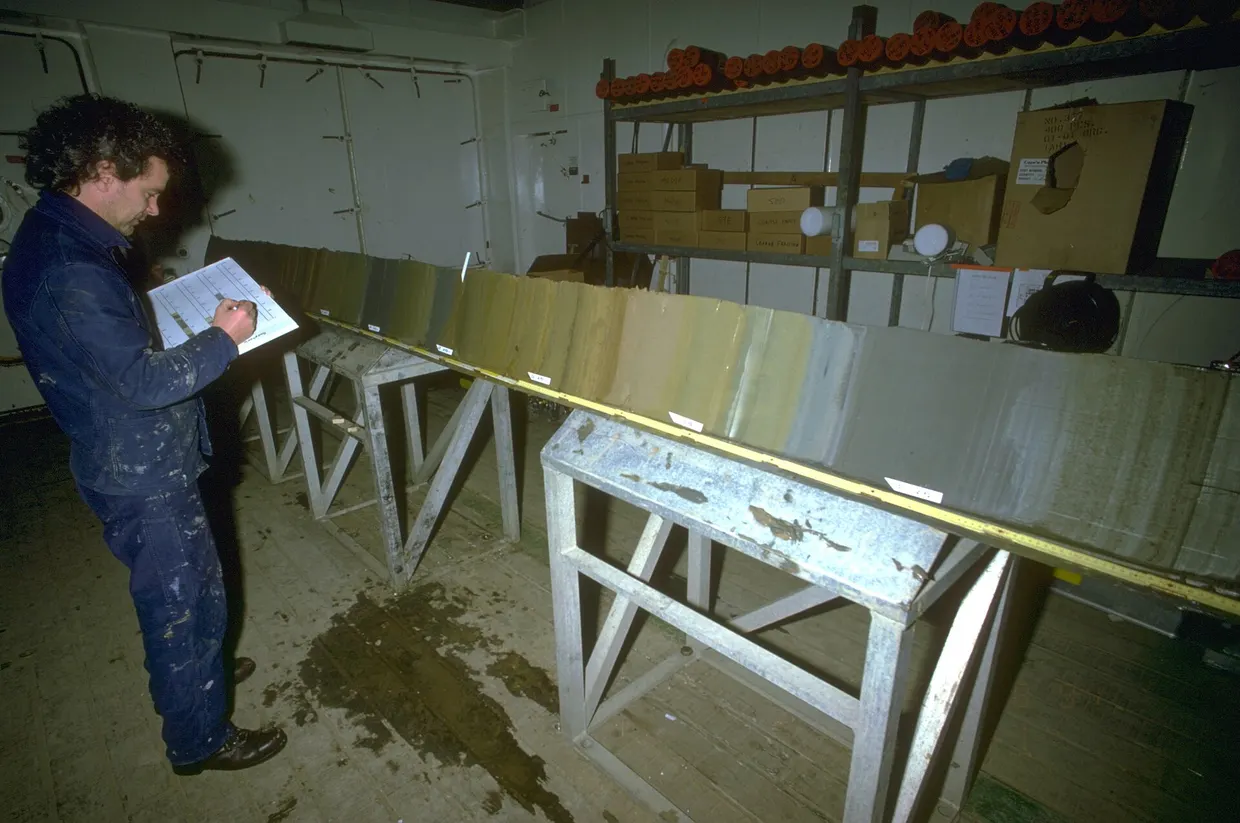
cambridge.orgcambridge.orgOpen source ↗. The core was taken in 2012 at site KT-12-34-MC01. Measurements were made every 0.5–1 cm along its whole length, and the oldest part dates to about 1440 CE. The aim was to find layers linked to historical earthquakes and floods.
Why the mud between turbidites matters
Turbidites, deposits of deep-sea events such as submarine earthquakes, landslides and severe floods, are a standard tool of paleoseismology in plate boundary areas. The hemipelagic mud between them is usually treated as normal sediment. Recent work has shown that it also contains material remobilized from the submarine slope by slope failure and turbidity currents.
Such remobilized layers are expected to be older than the normal layers below them, because they may carry older material. Older organic carbon between younger deposits therefore points to a disturbance of the seafloor. The authors note that a slope failure triggered by shaking is one possible cause, while storms and floods remain possible too.
Method and results from the Kumano Trough
Radiocarbon dating of total organic carbon is not often used for age models, because the carbon can be marine, terrestrial or reworked cambridge.org
cambridge.orgcambridge.orgOpen source ↗. Its advantage is resolution: hemipelagic mud usually contains organic carbon, and a small sample is enough if the age offsets can be determined and calibrated. The team combined these ages with small-scale radiocarbon measurements of planktonic foraminifera.
The Kumano Trough is a forearc basin formed where the Philippine Sea Plate subducts beneath the Eurasian Plate. Its floor lies at about 2000 m depth, below a steep slope and a shelf less than 10 km wide, with the shelf edge at about 150 m.
Age anomalies appeared along the core. Some coincide with submarine shaking documented in Japanese historical records, and the rest match no known event. According to the authors, these may be earthquakes missing from the record, although they do not rule out violent storms producing a similar signal. Visual inspection, X-ray imaging and CT scanning did not distinguish the redeposited layers, which look the same as the surrounding clay.