At the DIII-D tokamak, physicists test a 1980s helicon idea for the first time: plasma absorbs the wave
General Atomics physicists recorded plasma heating by helicon waves at DIII-D, a method meant to let tokamaks run longer without recharging the solenoid.
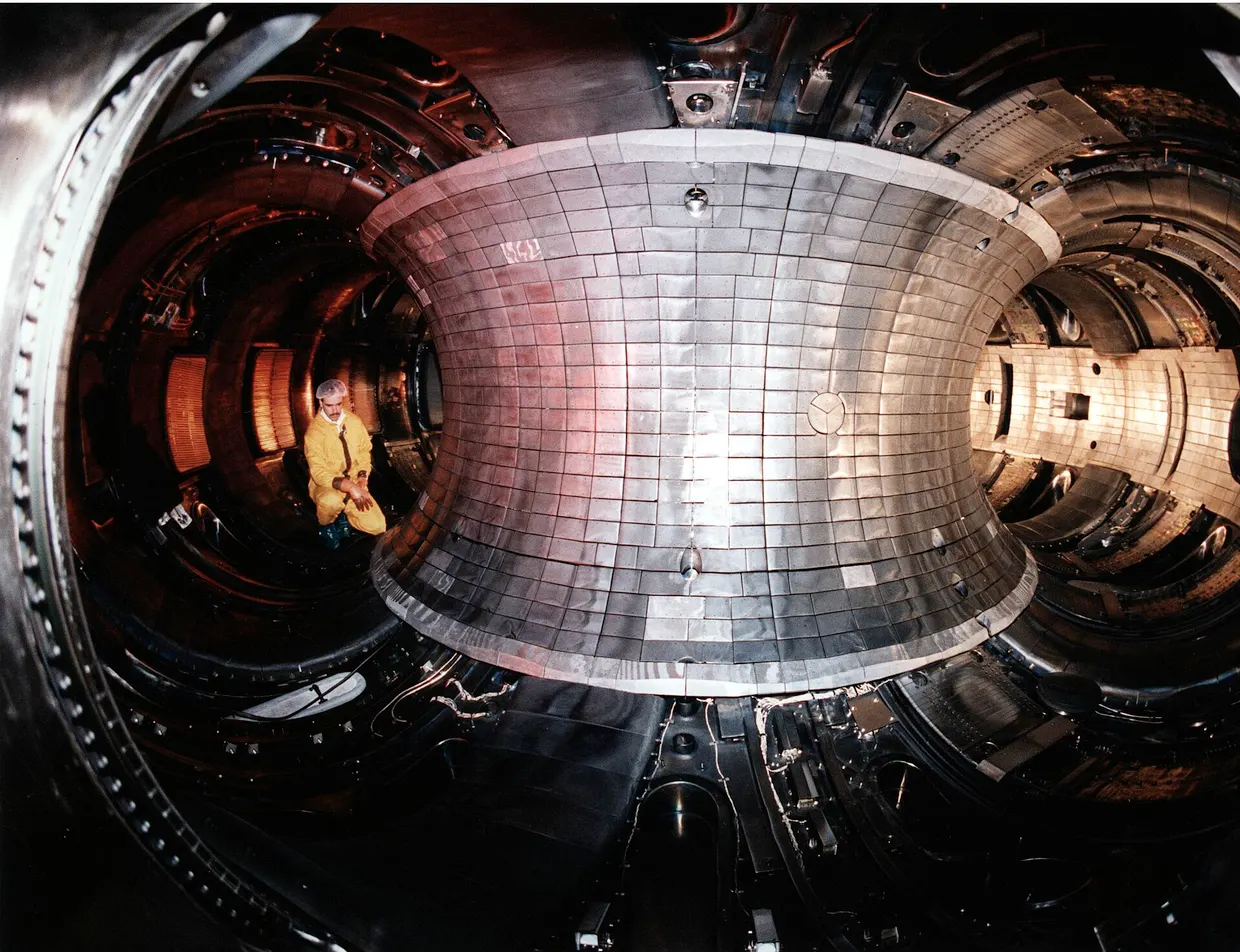
Physicists have tested in practice a method of sustaining current in fusion plasma that was proposed in the 1980s and then set aside, UNIAN reports, citing Gizmodo. The experiment was carried out at the DIII-D national fusion facility. The method is called helicon current drive, and the co-authors of the work are General Atomics physicists Bob Pinsker, Jeff Lestz and Bart Van Compernolle. unian.ua
УНІАНunian.uaOpen source ↗
In helicon current drive, hot plasma inside the reactor is driven by high-frequency radio waves of a special type. The waves produce an electric current in the plasma that helps keep the reaction stable. The idea dates to the 1980s, but the machines of that time could not implement it.
Why tokamaks need non-inductive current
Most modern fusion devices are doughnut-shaped tokamaks in which magnetic fields confine the plasma. One field comes from coils wrapped around the torus. The other comes from a solenoid, and the plasma current is sustained on a transformer principle.
According to Pinsker, this limits the duration of operation: sooner or later the solenoid has to be recharged and the plasma extinguished. One such cycle in DIII-D lasts about 10 seconds. Large reactors can run for roughly 500 seconds (8 minutes) or even 1000 seconds (17 minutes). unian.ua
УНІАНunian.uaOpen source ↗
Lestz noted that, according to most design studies, commercially viable reactors need a steady-state mode. Researchers are therefore looking for non-inductive ways to sustain current with electromagnetic waves. Pinsker described helicon current drive as one more technology that can be applied to a tokamak, not a separate approach to fusion.
What changed since the 1980s
Pinsker named three reasons the attempts of the 1980s failed. The plasma in the tokamaks of that time was not reactor-like enough to absorb helicon waves well. Wave-launching technology was inefficient. Diagnostics could not verify whether a non-inductive current appeared in the plasma.
Pinsker and colleagues began preparing to return to the theory in 2014, and a new series of experiments started in the summer of 2024. DIII-D had a special comb-like antenna able to direct helicon waves into plasma hot enough to absorb them. New measurement methods also allowed the experiments to be followed in more detail. unian.ua
УНІАНunian.uaOpen source ↗
According to Pinsker, the team clearly recorded plasma heating through absorption of the helicon wave. Before announcing the result, the researchers checked the statistics thoroughly, so that they could not be accused of showing a single lucky run with a large effect.