Tokyo University of Science etched a copper MOF at room temperature with ionic liquid in its pores
Researchers filled the pores of a copper-based MOF with ionic liquid and etched it with a gallium ion beam, avoiding the cryogenic cooling previously required for such patterning.
Researchers at Tokyo University of Science (TUS), Japan, have developed a way to dry-etch metal–organic frameworks (MOFs) at room temperature by filling their pores with an ionic liquid, according to eurekalert.org eurekalert.org
eurekalert.orgeurekalert.orgOpen source ↗. The study was led by Assistant Professor Yumeng Zheng and Professor Kentaro Kinoshita of the Department of Applied Physics. It is scheduled for publication in Communications Materials on 10 November 2026. The method produced patterns at the scale of hundreds of nanometres.
Why MOFs are hard to pattern
MOFs are porous materials formed by linking metal ions with organic molecules. The concept goes back to 1974, when Professor Richard Robson of the University of Melbourne began experimenting with copper ions linked by a four-armed organic molecule. The pores can capture pollutants, support chemical reactions and store gases, which makes MOFs candidates for chemical sensors and electronic devices.
Their delicate structures, however, can be damaged during dry etching, which uses energetic particles such as ion or electron beams to remove material and create patterns. Until now, cryogenic etching has been the only known approach to physically etching MOFs while preserving their structure.
Ionic liquid filling and results
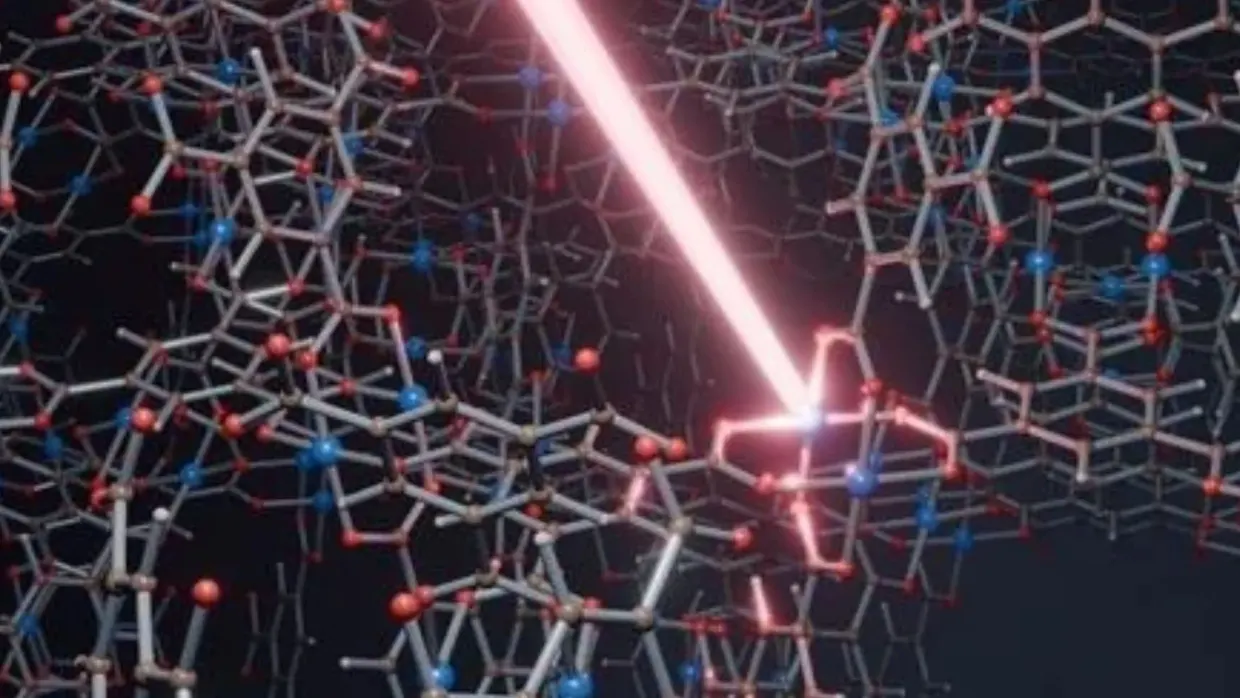
The team filled Cu3BTC2, a copper-based MOF, with four imidazolium-based ionic liquids that occupied 50–60% of its pore volume. They then etched patterns into it with a focused gallium ion beam at room temperature eurekalert.org
eurekalert.orgeurekalert.orgOpen source ↗.
Without the ionic liquid, the beam damaged the crystal structure and created large cavities. The filled samples showed substantially less apparent microstructural damage under the tested conditions. The researchers made a 5 × 5 µm² square, a pillar and a Chinese character with etched lines 130–300 nm wide.
Thermal analysis showed that the treated MOFs decomposed at higher temperatures than the untreated material. In hardness tests, all four treated samples were harder than the untreated MOF, while their stiffness remained largely unchanged.
The authors suggest that the ionic liquids absorb heat and help dissipate the electrical charge that accumulates during ion beam exposure. Their thermal properties may buffer temperature changes, and the redistribution of ions may screen the local electric field eurekalert.org
eurekalert.orgeurekalert.orgOpen source ↗.
The method was demonstrated on a copper-based MOF only. The researchers say it could potentially be extended to other MOFs, about 100,000 of which are known, without the liquid-nitrogen cooling equipment that cryogenic etching requires. Professor Kinoshita named high-sensitivity sensors, separation and analysis devices, and catalytic devices as possible applications.