White dwarf HS 0209+0832 accretes niobium-rich gas, a candidate second-generation planet
Ultraviolet spectra show zinc, copper and niobium but no iron around HS 0209+0832; the authors link it to an evaporating giant planet formed after the main sequence.
Researchers at the University of Warwick report in a paper on nature.com that the white dwarf HS 0209+0832 is accreting material unlike any known Solar System object nature.com
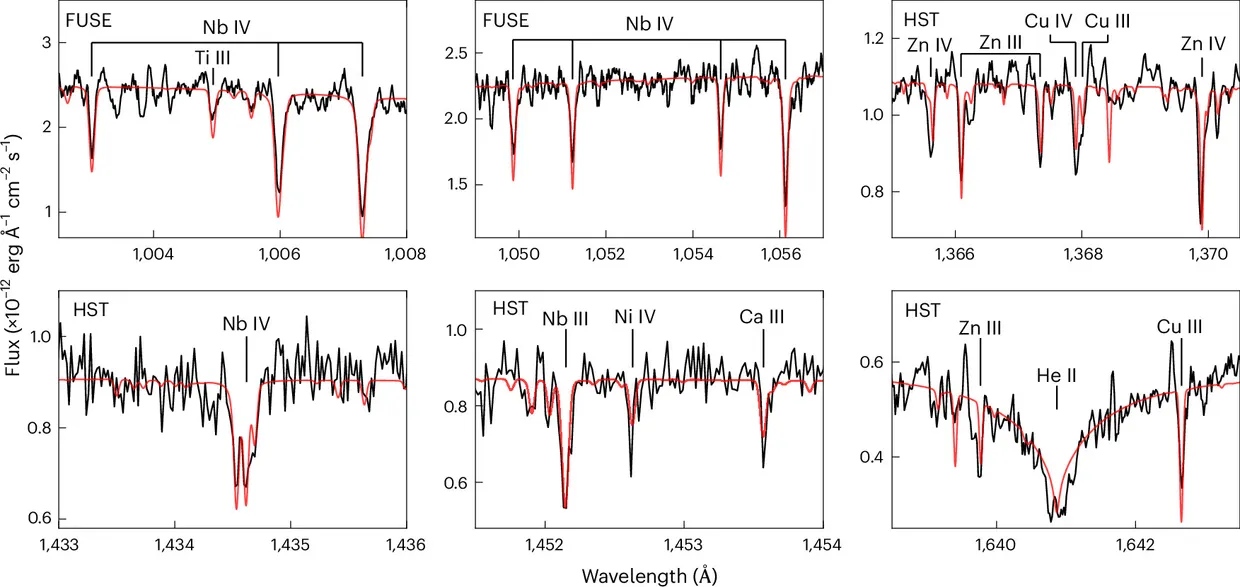
nature.comnature.comOpen source ↗. The star has an effective temperature of about 35,800 K and a cooling age of about 5 Myr. Its atmosphere is dominated by hydrogen, with roughly 1% helium. A Hubble STIS ultraviolet spectrum from 1999 contained about 100 unidentified lines. The team reanalysed it together with FUSE and VLT/UVES spectra, Pan-STARRS photometry and the Gaia parallax.
Niobium, copper and no iron
Most of the unidentified lines matched copper and niobium. Niobium was identified using five Nb III lines and 57 Nb IV lines. Archival FUSE spectra of 33 known metal-enriched white dwarfs, with temperatures from 20,000 to 77,000 K, showed no niobium.
The authors measured abundances of nine metals and set upper limits for 15 more. The atmosphere is strongly enriched in zinc, copper and niobium. It is depleted in silicon and iron, which together make up about 48% of the bulk Earth by mass. Silicon appears only in traces, compatible with radiative levitation, and iron is not detected. The nickel-to-iron ratio is above 2.09, compared with about 0.05 in CI chondrites. The composition matches neither the sample of white dwarfs accreting rocky material nor Solar System meteorites.
For carbon, nitrogen, aluminium, silicon and phosphorus, radiative support prevents the analysis from fixing their mass fractions in the accreted material nature.com
nature.comnature.comOpen source ↗.
A candidate second-generation planet
The authors find the composition consistent with a candidate second-generation planet. Such a planet would have formed from stellar material ejected during the giant phase, and its distinguishing mark is the high enrichment of s-process elements. Helium in the photosphere and the absence of terrestrial rock-forming elements imply that the white dwarf is accreting from the escaped atmosphere of a photo-evaporating giant planet candidate.
Photometry shows a sinusoidal period of 4.399 ± 0.026 days with an amplitude of 0.120% ± 0.018%. The authors attribute it either to thermal emission phase variability from a planetary day–night cycle or to a transiting cometary tail of an evaporating gas giant. They conclude that close-in planets around white dwarfs can form after the main sequence.
The model does not fully reproduce the unusual structure of the He II line. The authors suggest that additional absorption by circumstellar gas could be the cause nature.com
nature.comnature.comOpen source ↗.