Cosmogenic nuclides date stone tools at Korolevo, Ukraine, to 1.42 million years
Two burial-dating methods gave 1.42 million years for the sediment with Mode-1 artefacts; the authors call it the earliest securely dated hominin presence in Europe.
In a paper on nature.com, researchers report ages of 1.42 ± 0.10 million years and 1.42 ± 0.28 million years for the sedimentary unit at Korolevo, western Ukraine, that contains Mode-1-type lithic artefacts. The ages come from two methods of burial dating with cosmogenic nuclides. nature.com
nature.comnature.comOpen source ↗ By the authors' account, Korolevo is the earliest securely dated hominin presence in Europe.
Dating the Korolevo artefacts
The stone tools at Korolevo lie in alluvium and loess. The site was discovered in the 1970s and has since been studied by several research groups. Its importance for the European Palaeolithic is widely acknowledged, but age constraints on the lowermost artefacts had not been determined conclusively.
The supplementary materials give the parameters of isochron burial dating and of P-PINI model runs, along with all the cosmogenic nuclide data. The MATLAB code used to calculate the P-PINI burial ages is published on GitHub. According to novinky.cz, the measurements are of beryllium-10 and aluminium-26 values in the samples.
Place in the settlement of Europe
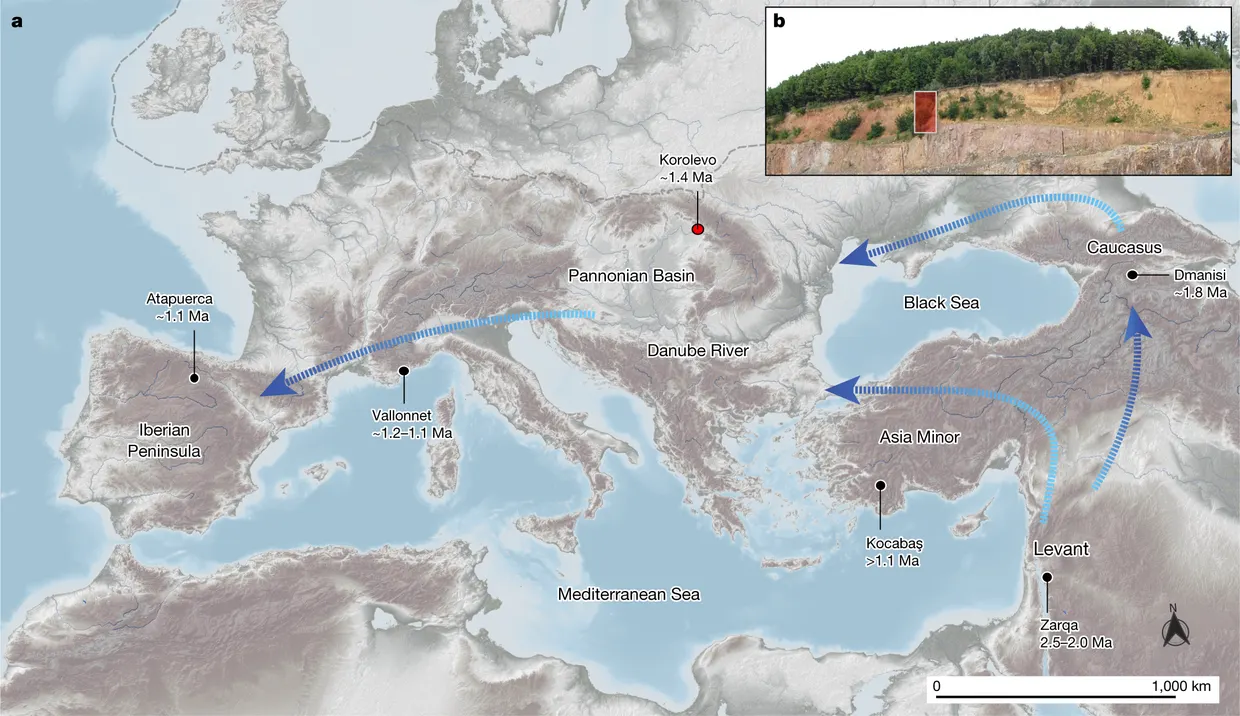
The authors say the result bridges a spatial and temporal gap between the Caucasus (around 1.85–1.78 million years ago) and southwestern Europe (around 1.2–1.1 million years ago). nature.com
nature.comnature.comOpen source ↗ They state that the findings advance the hypothesis that Europe was colonized from the east.
The team also analysed habitat suitability. According to the authors, it suggests that early hominins used warm interglacial periods to disperse into higher latitudes and into relatively continental sites such as Korolevo, well before the Middle Pleistocene Transition.
Fieldwork in the Transcarpathian region
Novinky.cz also reports a six-day expedition by the Institute of Archaeology of the Czech Academy of Sciences in Brno and the Institute of Archaeology of the National Academy of Sciences of Ukraine. It worked at the Molochnyi Kamin cave, first studied in 1972 and last worked in 1973. The team re-exposed the 1970s trench and the sediment profile at the cave entrance. It found a stone artefact and bear bones.
The researchers took seven charcoal samples for dating, ten samples for sedimentary DNA analysis and two for geochemical analysis. Roman Garba of the Brno institute said modern dating methods and sedimentary DNA can reveal more about the cave than was possible in the 1970s. The aim of further work is to refine the stratigraphy.